Contents
History & cultureBY TELLBY7 sections · numbered as on the map01 Orientation
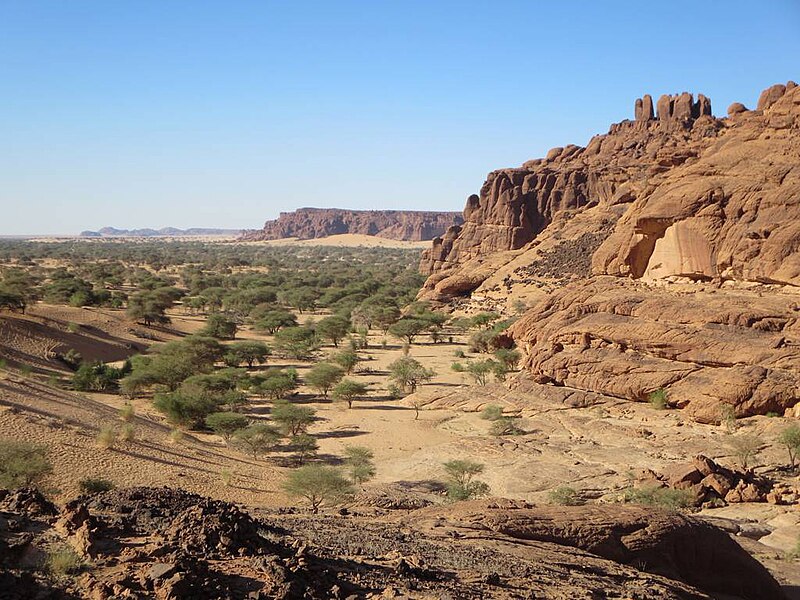
Welcome to the Ennedi Plateau, a monumental natural bastion of sculpted sandstone rising dramatically out of the vast Sahara Desert in northeastern Chad. Situated within the Sahelian belt that stretches across Africa from the Atlantic Ocean to Sudan, this extraordinary landscape represents a seamless harmony between natural grandeur and ancient human creativity. Recognized as a UNESCO World Heritage site in 2016, the Ennedi Massif is celebrated as a mixed property of outstanding universal value, encompassing awe-inspiring geological formations and one of the largest, most significant ensembles of prehistoric rock art anywhere in the Sahara. As demonstrated by the discovery of Toumaï, a Sahelanthropus tchadensis fossil dating back nearly seven million years in the nearby Djurab desert, together with the ancient remains of Australopithecus bahrelghazali, this region forms an integral part of the deepest chapters of the human story.
Geologically, the Ennedi Massif consists of dense Paleozoic sandstone layered during the Cambrian, Ordovician, and Carboniferous periods, resting atop an ancient Precambrian basement of granite and gneiss ridges. Over millions of years, the unceasing forces of wind and water erosion, combined with extreme daily thermal fluctuations, have carved this massive plateau into a labyrinth of towering rock pillars, colossal stone arches, deep canyons, and sheltered caves. Furthermore, during wetter climatic phases starting around seven thousand years ago, when the Sahara was a vibrant savanna teeming with wildlife, successive populations of hunter-gatherers and pastoralists inhabited these fertile valleys. On the walls and ceilings of rock shelters, they painted and engraved thousands of images depicting wild animals, herded cattle, horses, camels, and human figures. These monumental rock art galleries offer an invaluable record of human adaptation, artistic evolution, and environmental change over millennia.
Throughout this audio guide tour, you will follow a carefully designed walking itinerary visiting five remarkable spots that highlight the geological, ecological, and cultural significance of the Ennedi Plateau. We begin our journey at the colossal Aloba Arch, one of the largest natural stone bridges on Earth. Next, we travel to Guelta d'Archei, a dramatic canyon waterhole where a rare relict population of West African dwarf crocodiles survives alongside drinking camel herds. We then proceed to Niola Doa, where monumental petroglyphs depict giant engraved female figures known as the Beautiful Ladies alongside tiny drum players. After that, we visit Manda Guéli Cave to observe beautifully preserved polychrome paintings capturing the daily life and livestock of ancient pastoralists. Finally, we explore Ehi Tighi, a massive rock shelter that features an extraordinary three-meter-long cow painting and served as a vital historic refuge.
Now, let us embark together on this memorable walking tour through time, sand, and stone, as we uncover the enduring secrets and breathtaking wonders of the Ennedi Massif.
02 Aloba Arch: The Colossal Natural Cathedral of Sandstone
Standing at an extraordinary height of approximately one hundred and twenty meters and spanning nearly seventy-six meters across, Aloba Arch is widely recognized as one of the most colossal natural stone arches on Earth and a monumental masterpiece sculpted by nature.
Look up at the breathtaking sandstone bridge towering high into the desert sky above you. …
03 Guelta d'Archei: The Ancient Desert Oasis and Relict Crocodiles
Nestled deep within a towering sandstone canyon where rain almost never falls, Guelta d'Archei shelters a relict population of West African dwarf crocodiles that have miraculously survived in this permanent waterhole through eons of dramatic climate change.
Look down at the dark, gleaming pool cradled between sheer vertical red sandstone cliffs and observe the vast herds of camels gathering along its edges to drink. …
04 Niola Doa: The Monumental Engravings of the Beautiful Ladies
Known in the local Tubu language as Niola Doa, which translates to the "Beautiful Ladies," this site features monumental petroglyphs depicting naked female figures measuring over two meters in height, completely covered from head to toe in elaborate labyrinthine patterns.
Look closely at the intricate labyrinthine lines and geometric patterns engraved with remarkable precision across the entire bodies of these colossal female figures. …
05 Manda Guéli Cave: The Polychrome Gallery of Pastoralist Life
Positioned high upon a sheltered cliff face that protected it from the destructive forces of wind and rain erosion, Manda Guéli Cave retains the amazingly vivid red and white pigments painted by ancient pastoralists thousands of years ago.
Look up toward the ceiling and inner walls of the cave alcove. …
06 Ehi Tighi: The Rock Shelter of the Three-Meter Cow
Beneath the expansive shadow of this massive rock shelter, a colossal ancient cow painting measuring a full three meters in length is grandly rendered across the entire sandstone wall.
Look at the giant red cow shape dominating the center of the rock wall and observe the much smaller human figures artfully arranged around its perimeter. …
07 Closing
Thank you very much for joining us on this remarkable audio guide journey across the Ennedi Plateau, where thousands of years of human history and the monumental nature of the Sahara converge in breathtaking harmony. We hope that walking among eons-old sandstone arches, vibrant desert gueltas, and ancient rock galleries filled with the artistic expressions of long-vanished societies has inspired you with a deep sense of wonder and appreciation for our shared global heritage. …