 Photo Wikimedia Commons
Contents
History & cultureBY TELLBY7 sections · numbered as on the map01 Orientation
Welcome to the Ancient City of Sirwah, the first military and religious center of the Sabaean Kingdom that flourished amidst the harsh desert landscape of the Arabian Peninsula. Sirwah is a deeply meaningful cultural sanctuary inscribed on the UNESCO World Heritage List in recognition of its Outstanding Universal Value. It stands as a brilliant symbol of the ancient Sabaean civilization, which mastered the incense trade routes through the desert three thousand years ago and developed unique temple architecture and hydrological engineering expertise. From the first millennium BCE until the arrival of Islam around the year six hundred thirty CE, the Sabaeans overcame the semi-arid environment of valleys, mountains, and deserts to establish a central node in a vast trade network connecting South Arabia with the Mediterranean and East Africa. The ancient city we are visiting today is located forty kilometers west of the official Sabaean capital of Marib and ninety kilometers east of Sanaa, situated atop a rocky outcrop in a mountainous region. Built upon a natural rock protrusion rising eight to eighteen meters high, the city served as an impregnable natural fortress overlooking the surrounding agricultural plain and wadi valleys. To the south and west, basalt lava flows border the plain, while to the northeast rise the limestone heights of Mount Makhdarah and Mount Marthad. Watered by Wadi al-Milh, a major tributary of Wadi Dhana, this oasis basin provided fertile ground for ancient Sabaean life. Thanks to this naturally fortified topography and strategic water resources, Sirwah established itself as a paramount military bastion and sacred religious sanctuary, housing monumental temples and administrative complexes within its three-hectare walled enclosure. Due to the severe threats posed by ongoing regional conflicts and civil war, UNESCO inscribed Sirwah and the landmarks of the Ancient Kingdom of Saba on the List of World Heritage in Danger through an emergency procedure to ensure enhanced international protection. Since its discovery by the French explorer Thomas Arnaud in eighteen forty-three, followed by surveys by Joseph Halevy, Eduard Glaser, and extensive modern excavations by the German Archaeological Institute, the historical secrets of Sirwah have been systematically unveiled. Our audio tour begins right here at the entrance to the monumental outer stone wall that once protected the ancient city. After passing through the city gate, we will proceed to the magnificent oval sanctuary of the Almaqah Temple, dedicated to the god of the moon and fertility. Next, we will inspect the monumental victory inscription of King Karib-il Watar, one of the largest and most significant historical epigraphs in ancient Arabia, located in the temple courtyard. We will then walk toward the elevated administrative building and the site known as Dar Balqis, where local rulers once governed. Finally, we will ascend to the northern viewpoint overlooking the marble quarry at Mount Makhdarah and the expansive plain. Let us step slowly into this awe-inspiring historical site, guided by the enduring legacy and wisdom of the ancient Sabaeans.
02 The Monumental Enclosure Wall of Sirwah
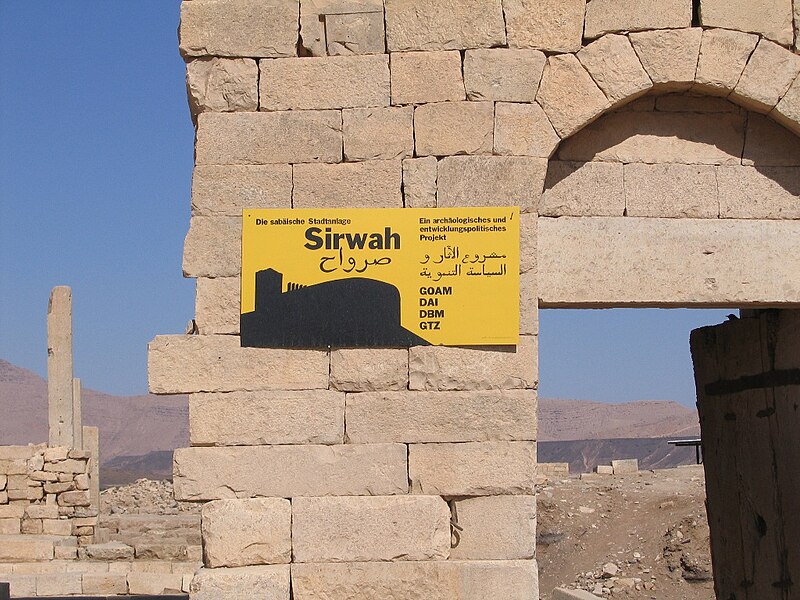
Please look closely at the monumental defensive enclosure wall rising majestically before you. This colossal stone rampart boasts an impressive scale, reaching a height of eight meters and extending over a total length of seven hundred thirty meters. However, the most astonishing surprise lies in the way it was constructed. Despite being built in the distant eighth century BCE, this massive rampart was erected without using any mortar, cement, or mud bonding agents whatsoever. …
03 The Oval Sanctuary of Almaqah Temple
Stepping inside through the city gateway, we now arrive at the oval sanctuary of the Almaqah Temple, the most sacred sanctuary dedicated to Almaqah, the chief deity of the Sabaean Kingdom who presided over the moon, fertility, and the abundance of flora and fauna. Upon entering this sacred precinct, visitors are confronted with an astonishing architectural contrast. …
04 The Monumental Victory Inscription of Karib'il Watar
Standing in the center of the Almaqah Temple courtyard, we now face one of the most astonishing historical epigraphs in ancient Arabian history: the Monumental Victory Inscription of King Karib-il Watar. Anyone encountering this inscription for the first time is immediately awed by its imposing physical mass and historical gravity. Composed of a single monumental limestone block, this towering pillar measures seven meters in length and weighs well over five tons. …
05 The Administrative Building and Dar Balqis
Leaving the victory inscription behind and ascending to the elevated platform on the western side of the site, we arrive at the monumental administrative complex historically known as Dar Balqis, or the House of Balqis. Standing before these impressive stone foundations, visitors encounter a fascinating tension between romantic legend and historical reality. …
06 Pillared Sanctuary and View of Al-Makhdarah Marble Quarry
Standing at the northernmost viewpoint of the ancient city, we are greeted by a breathtaking panorama overlooking the Sirwah plain and the surrounding mountain landscape. Looking out across the terrain from this high vantage point reveals an astonishing truth behind the construction of this ancient city. All the magnificent white marble blocks that adorn the temple pillars, altars, and monumental enclosure walls of Sirwah were not quarried from the local immediate vicinity. …
07 Closing
Dear visitors, our audio guide tour through the Ancient City of Sirwah, where three thousand years of history resonate across the desert, has now come to a close. Today, we have journeyed together along the glorious footsteps of the ancient Sabaean civilization, starting from the colossal dry-stone enclosure wall, passing through the sacred oval sanctuary of the Almaqah Temple, standing before the monumental victory inscription of King Karib-il Watar, exploring the administrative hall of Dar…