 Photo Wikimedia Commons
Contents
History & cultureBY TELLBY7 sections · numbered as on the map01 Orientation
Welcome to the Fortifications of Kotor, a magnificent historic defense system built where sheer rocky cliffs meet the deep blue waters of the Adriatic Sea. Nestled at the innermost end of the Bay of Kotor, this town served for centuries as a vital maritime trading post and an extraordinarily strategic military stronghold. The breathtaking stone ramparts stretching up the mountain before you are much more than mere protective walls. They stand as enduring testaments to a dramatic history shaped by successive world powers, from ancient Illyrian roots and the Byzantine Empire to the Republic of Venice and the Austrian Empire, all fighting for dominance over these crucial Mediterranean waterways.
The extraordinary global significance of the Kotor fortifications, recognized as a UNESCO World Heritage site, lies primarily in its unique Venetian defensive architecture constructed between the 15th and 17th centuries. During this era, as the Venetian Republic expanded its influence across the Adriatic, military engineers deployed cutting-edge design principles to shield their vital maritime trade routes from both naval and overland Ottoman threats. The outer ramparts stretch over four and a half kilometers, seamlessly integrating with the steep natural terrain from the sea-level urban core all the way up to San Giovanni Castle, which commands the entire bay from a height of two hundred and eighty meters.
These formidable outer walls range in thickness from two to sixteen meters and rise to heights of up to twenty meters in key defensive sectors. Despite enduring fierce military sieges and devastating natural earthquakes over the centuries, the fortifications continue to overlook the calm waters of the bay with timeless strength and grandeur. This site represents an exceptional synthesis of natural landscape and military engineering, illustrating how human ingenuity adapted to extreme topography over successive historical epochs. On this audio tour, we will journey from the Sea Gate along the riverfront, ascend the historic stone stairways winding up the mountain slope, and reach the high citadel at the summit. As you explore each point along the way, take a moment to sense the deep history, tactical genius, and remarkable resilience preserved within these ancient stone walls.
02 Sea Gate / Main Gate
The Sea Gate, constructed in 1555 as the principal maritime entrance to the old town, serves as much more than a simple entry point. It stands as a vivid historical witness where the shifting political ideologies of successive rulers were carved directly into stone. Before passing through into the ancient city streets, direct your gaze to the upper portion of the stone arch right in front of you. …
03 Kampana Tower and River Gate
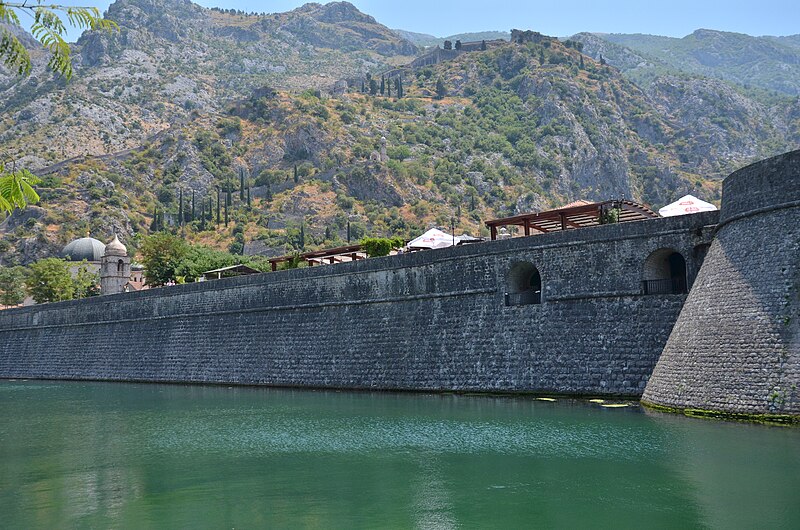
The rapid advancement of gunpowder artillery and siege cannon technology in the sixteenth century completely transformed defensive military design, forcing engineers to replace tall vertical medieval walls with thick, low-profile sloped ramparts capable of absorbing heavy ballistic shock. As you stand near the riverbank, look at the swift turquoise waters of the Skurda River flowing to your left and gaze up at the thick, imposing stone masonry of Kampana Tower rising above the corner of the…
04 Church of Our Lady of Remedy
Perched dramatically on a rocky cliff face halfway up the mountain zigzag path, this sacred chapel stands as an enduring monument of communal faith, constructed during the horrific plague that devastated the city in the sixteenth century. As you catch your breath during the steep uphill trek, look up to admire the quiet elegance of the chapel's bell tower and red-tiled roof set against the dramatic backdrop of gray limestone cliffs and the fjord-like waters below. …
05 San Giovanni Castle
Standing at an elevation of two hundred and eighty meters above sea level, San Giovanni Castle was the site of a legendary military siege in 1814, when a daring British naval captain defied conventional warfare tactics by hauling heavy ship artillery up sheer mountain cliffs to force the surrender of Napoleon's garrison. …
06 Spiljarskia Gate and Outer Defenses
The Spiljarskia Gate and its hidden mountain trail once formed a vital logistical lifeline connecting the coastal fortress of Kotor with the rugged inland mountain territory leading toward Njegusi and Cetinje. Look closely at the modest arched opening of the Spiljarskia Gate, set directly into the precipitous cliffside masonry along the eastern outer wall perimeter. …
07 Closing
Thank you for taking this audio journey through the historical ramparts, bastions, and mountain strongholds of the Fortifications of Kotor. From its origins as an ancient Illyrian mountain refuge through its expansion under the Byzantine Empire, the Venetian Republic, the French Empire, and the Austro-Hungarian Monarchy, this extraordinary stone defense system stands as a monumental witness to the rich and complex history of the Adriatic region. …
