Contents
History & cultureBY TELLBY7 sections · numbered as on the map01 Orientation
Welcome to the sacred and eternal terrace of Persepolis, where the magnificent breath of the ancient Persian Empire still resonates with profound authority today. As you stand before this vast landscape, you are walking upon the grand ceremonial capital of the Achaemenid Empire, a site created to display the ultimate power, unity, and artistic splendour of a realm that once spanned the known world. Look slowly across the majestic ruins before you. This colossal platform is not merely a collection of palace remains, but a monumental masterpiece of ancient architectural ingenuity. UNESCO recognized this extraordinary place as a World Heritage site because it represents the unique imperial capital where the groundbreaking construction technology, urban planning, and artistic expression of the ancient Persian Empire were fully concentrated, offering an unparalleled witness to a most ancient civilization.
The story of this legendary terrace began around five hundred and eighteen BC. Darius the Great, the ambitious king of the Achaemenid Empire, selected this strategic site at the foot of Kuh e Rahmat, known as the Mountain of Mercy. On an immense platform measuring nearly thirteen hectares, constructed partly from natural rock outcrops and partly through artificial stonework, he laid the foundations for a complex that would astonish the ancient world. Utilizing heavy grey limestone, mud bricks, and precious cedar wood lintels, Darius envisioned a place that transcended standard administrative duties. He created a spectacular showplace designed specifically for seasonal festivals, royal receptions, and grand gatherings that would immortalize the Persian monarchy for generations to come.
Every inch of this terrace reflects the skill and dedication of craftsmen brought together from across the vast empire. Unlike many ancient monuments built by forced labor, administrative clay records show that these workers received fair wages in silver and grain for their labor. Architects engineered light wooden roofs supported by remarkably slender columns, allowing for expansive open reception rooms adorned with intricate sculpted friezes. Construction that began under Darius the Great continued through the reigns of his son Xerxes the First and his grandson Artaxerxes the First, spanning over a century of continuous expansion and artistic refinement.
As you prepare to ascend the grand entrance stairways, imagine the awe felt by ancient envoys as they approached this royal sanctuary. The soaring stone columns and beautifully carved reliefs before you have endured for more than twenty five centuries, preserving the eternal spirit of the Achaemenid kings. Let yourself be transported back in time as we begin our exploration of this monumental terrace.
02 The Gate of All Nations
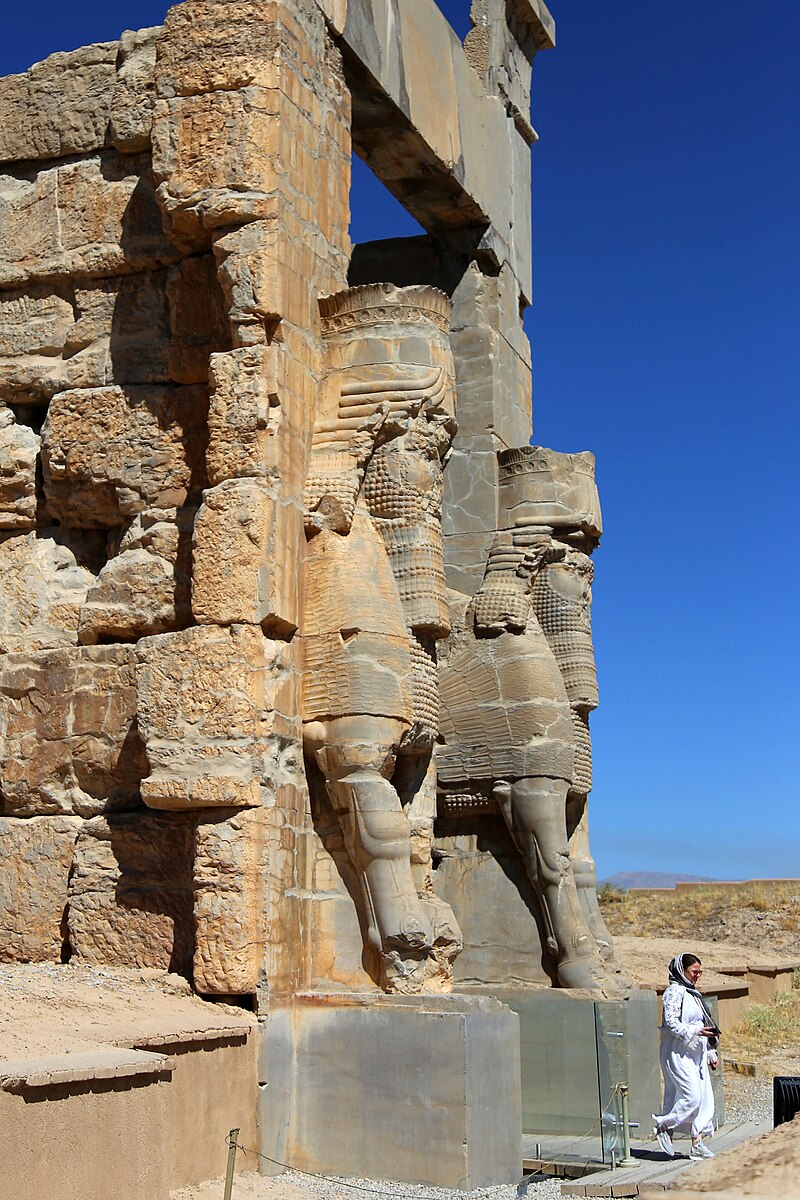
As you step up from the grand entrance stairs and gaze at the majestic stone gateway before you, look up at the towering stone structure and the soaring columns that reach over sixteen meters into the sky. This is the Gate of All Nations, the official entrance to Persepolis and a monument built to project the ultimate authority of the empire. As you approach this colossal portal, consider one truly astonishing fact. …
03 The Great Apadana Palace
As you step into the vast perimeter of the Apadana Palace, pause to consider one of the most remarkable achievements of the ancient world. Standing as an astonishing miracle of ancient engineering, this grand audience hall possessed soaring vertical stone columns rising to a height of twenty meters that supported lightweight wooden ceiling lintels, creating an immense open interior capable of accommodating thousands of guests simultaneously. …
04 Tachara: The Palace of Darius
As you stand before the impressive entrance of the Tachara Palace, pause to consider a truly astonishing historical fact. Despite the catastrophic conflagration set by Alexander the Great in three hundred and thirty BC that reduced most of Persepolis to ash and rubble, this structure survived as the most intact building on the entire terrace, largely due to the exceptional density and quality of its polished grey limestone. …
05 Hadish Palace and the Great Conflagration
As you stand among the silent ruins of the Hadish Palace, reflect upon one of the most dramatic and pivotal turning points in ancient history. It was right here, in this very palace, that the devastating conflagration of three hundred and thirty BC was ignited, consuming the royal complex of Persepolis and signaling the ultimate collapse of the Achaemenid Empire. …
06 The Throne Hall of One Hundred Columns
As you step into the vast expanse of the Throne Hall, pause to contemplate one truly astounding fact about this monumental structure. Measuring seventy meters on each side, this enormous square hall was supported by a forest of one hundred massive stone columns arranged in a precise grid, making it the largest single enclosed hall in the entire Achaemenid Empire. …
07 Closing
As our tour comes to an end, turn your gaze toward the eastern slope behind the terrace and look up at the rock cliffs of Kuh e Rahmat, known as the Mountain of Mercy. Hewn directly into the vertical stone cliff face are the grand rock cut tombs of Artaxerxes the Second and Artaxerxes the Third. Shaped in the form of massive stone crosses, these royal sepulchres feature elaborate reliefs depicting the kings standing before sacred fire altars under the divine protection of Ahuramazda while their…