Contents
History & cultureBY TELLBY7 sections · numbered as on the map01 Orientation
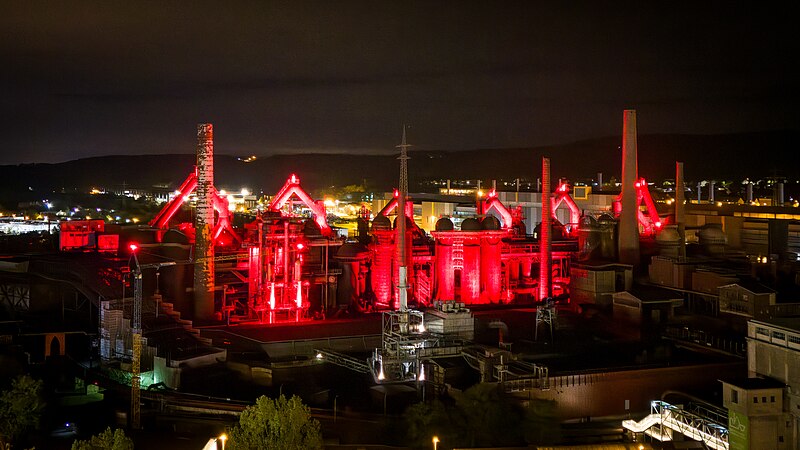
Welcome to the Völklingen Ironworks, a magnificent monument to the age of heavy industry situated along the banks of the Saar River in Saarland, Germany. Standing here today at the central entrance area, you are embarking on an unforgettable journey through one of the most extraordinary technical ensembles ever constructed by human hands. Founded in eighteen seventy-three by industrial engineer Julius Buch and subsequently acquired and expanded into a vast integrated enterprise under Karl Röchling and the Röchling family through the late nineteenth century, this ironworks powered European industrialization for over a century before ceasing production in nineteen eighty-six. In nineteen ninety-four, UNESCO inscribed the site on the World Heritage List. It remains the world's only fully intact pig-iron production plant surviving in its entirety from the nineteenth and early twentieth centuries. As an indispensable anchor point of the European Route of Industrial Heritage, the Völklingen Ironworks stands as a monumental symbol of human labor, engineering brilliance, and metallurgical innovation, located just ten kilometers west of Saarbrücken.
Because this historic industrial complex preserves authentic production areas across a sprawling six-hectare site, please keep several essential safety precautions in mind as you begin your walking tour. The designated visitor routes wind through genuine historical structures featuring steep steel staircases, elevated grid walkways, and uneven concrete floors shaped by decades of heavy manufacturing. When walking across elevated walkways and high platforms, please hold firmly to the metal handrails at all times and pay close attention to your footing on the steel grating. Wearing sturdy, comfortable closed-toe walking shoes is strongly recommended. Please observe all posted informational signs and remain strictly within designated visitor paths to ensure a safe, engaging, and enjoyable exploration.
Our guided audio tour follows the logical flow of raw materials through the historical pig-iron manufacturing process. We begin inside the monumental Blower Hall, where gigantic gas-blowing engines once generated enormous volumes of compressed air for the blast furnaces. Next, we explore the Sinter Plant and Möller Hall, where industrial waste dust and fine iron ore were recycled into reusable sintered cakes. We then climb to the charging platform twenty-seven meters above the ground for sweeping panoramic views of the entire furnace complex, the Saar River, and the surrounding Saarland landscape. From there, we move into the quiet, dark atmosphere of the Coking Plant and its moving memorial created by artist Christian Boltanski, dedicated to the thousands of forced laborers who suffered here during World War II. Finally, we step out into the Paradise Garden, where wild flora and contemporary art have reclaimed the former industrial grounds. Prepare to discover a monumental sanctuary of fire, iron, history, and culture.
02 Spot 1: The Blower Hall and Giant Gas-Blowing Engines
In nineteen hundred, the Völklingen Ironworks achieved a monumental technological breakthrough by becoming the very first large-scale ironworks in the world to harness toxic blast furnace waste gas to operate massive gas-blowing engines. Before this historic innovation, high-energy furnace gas released during pig-iron smelting was treated as a dangerous byproduct that simply escaped into the surrounding atmosphere. …
03 Spot 2: The Sinter Plant and Raw Material Bunkers
In nineteen twenty-eight, the Völklingen Ironworks constructed one of Europe's largest and most technologically advanced sintering plants, introducing a groundbreaking industrial recycling system designed to process blast furnace waste dust and fine iron ore into high-grade solid raw material. Prior to this milestone, microscopic iron dust blown out of blast furnaces by high-pressure gas streams was considered unusable industrial waste and discarded. …
04 Spot 3: The Blast Furnace Platform and Charging Gantries
Five giant blast furnace stacks stand lined up here in silent grandeur, having poured out molten pig iron continuously for over a century until their final shutdown in July nineteen eighty-six. Beginning with the first smelter in eighteen eighty-three and expanding with four additional stacks constructed between eighteen eighty-five and eighteen ninety-three, this imposing blast furnace complex formed the absolute beating heart of the Völklingen Ironworks. …
05 Spot 4: The Coking Plant and Memorial of Forced Laborers
During the dark years of World War II, more than twelve thousand forced laborers and prisoners of war were compelled to work under brutal, life-threatening conditions inside the Völklingen Ironworks. The Coking Plant, where coal was converted into blast furnace coke alongside valuable chemical byproducts like tar, ammonia, benzene, sulfur, and coal gas, became the primary site of immense human suffering. …
06 Spot 5: The Paradise Garden and King Kong Sculpture
Where scorching heat, dense coal dust, and sulfur fire once destroyed all living organisms, a thriving wild forest of birch trees, blooming butterfly bushes, and diverse wildlife has completely reclaimed the concrete industrial landscape. Known as Paradise, this extraordinary garden area represents the most remarkable ecological transformation across the entire Völklingen Ironworks complex. …
07 Closing
Today we have journeyed through the incredible history of the Völklingen Ironworks, exploring a monumental industrial power that helped drive the global Industrial Revolution through the nineteenth and twentieth centuries. From the thundering mechanical power of the giant gas-blowing engines inside the Blower Hall to the pioneering recycling innovations of the Sinter Plant and Möller Hall, we have witnessed the sheer magnitude of human engineering. …