 Photo Wikimedia Commons
Contents
History & cultureBY TELLBY8 sections · numbered as on the map01 Orientation
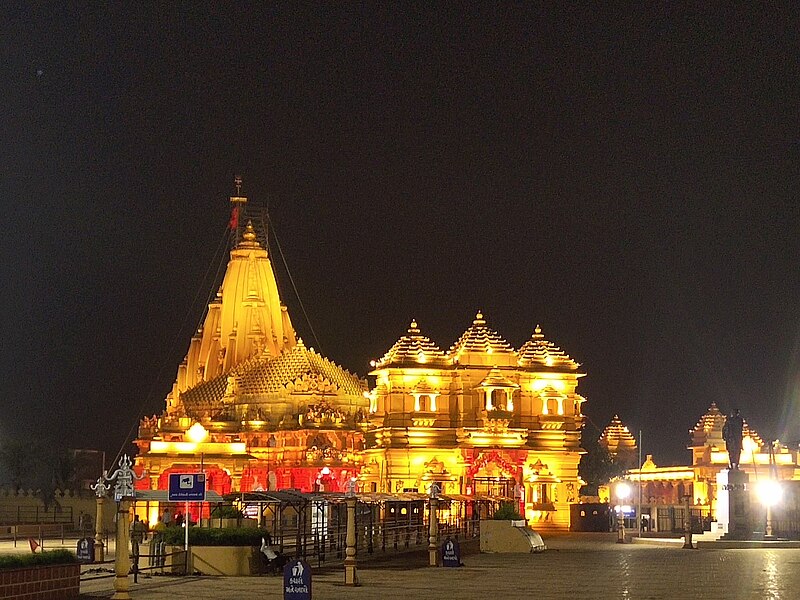
Welcome to the legendary Dwarkadhish Temple, widely revered as Jagat Mandir, meaning the universal shrine of the world, and Trilok Sundar, which translates to the most beautiful sanctuary in all three realms. You are standing on the sacred western coast of Gujarat in India, right where the holy Gomti River gently flows into the vast expanse of the Arabian Sea. In Hindu tradition, Dwarka holds a paramount position of spiritual devotion. It is celebrated both as one of the four cardinal Char Dham pilgrimage sites, along with Rameswaram, Badrinath, and Puri, and as one of the seven holy cities of salvation known as Sapta Puri. According to ancient scriptures, epics, and enduring oral tradition, the foundation of this sacred place dates back over two thousand two hundred years. It is believed that Vajranabh, the great grandson of Lord Krishna, built the very first shrine over the royal residence where Lord Krishna once established his capital city after leaving Mathura. Over many centuries, this sacred sanctuary has endured repeating cycles of invasion, destruction, and faithful reconstruction. The magnificent structure standing before you today was rebuilt and enlarged primarily during the fifteenth and sixteenth centuries, brilliantly displaying the regional Chalukya and Maru Gurjara architectural styles. Constructed entirely from soft limestone and warm sandstone, the main five story shrine rests on a massive structural base supported by seventy two hand carved pillars, rising to an extraordinary height of seventy eight meters. As we begin our audio tour today, we will walk along a carefully designed spatial path through history and legend. Our journey begins at the tranquil waters of Gomti Ghat where pilgrims perform ritual purification. We will then ascend the fifty six stone steps to Swarga Dwar, pass through the spacious outer courtyard to examine the towering spire and its famous fifty two yard flag, and step inside the central Garbhagriha to view the black marble idol of Lord Krishna. Finally, we will exit through Moksha Dwar and conclude at the sea view point where modern marine archaeologists discovered submerged ancient structures. Please pause for a moment to absorb the ocean breeze, the rhythmic chime of temple bells, and the timeless aura of faith.
02 Where Sacred Waters Meet the Sea: Gomti Ghat
You are currently standing on the ancient stone steps of Gomti Ghat, where the freshwater stream of the Gomti River flows into the marine waters of the Arabian Sea. For many centuries, this sacred riverbank has served as the essential spiritual threshold for millions of pilgrims arriving in Dwarka. Traditional practice dictates that before entering the holy courts of Jagat Mandir, worshippers must gather along these steps to perform ritual baths, immersing themselves in the cool waters to wash…
03 Ascending the 56 Steps to Heaven: Swarga Dwar
Turning away from the river bank and looking straight upward, you face the majestic southern entrance of the temple complex, historically named Swarga Dwar, or the Gate to Heaven. To reach this monumental portal, every visitor must ascend a impressive grand flight of fifty six steep stone steps built directly into the rising slope. In Hindu scriptural symbolism and local history, the specific number fifty six carries intense layers of meaning. …
04 The Architectural Marvel: 78-Meter Shikhara and 72 Pillars
Standing here in the broad outer prakaram, cast your eyes upward toward the sky to gaze at the most majestic element of Jagat Mandir, its grand five story shikhara, or central temple spire. Rising to a height of seventy eight meters above the stone floor, this tower represents one of the finest achievements of Chalukya and Maru Gurjara architectural traditions in Western India. …
05 The Sacred Inner Sanctum: Garbhagriha of Swarna Dwarkadhish
We now step into the innermost spiritual heart of Jagat Mandir, known as the Garbhagriha, or Nija Mandir. This dimly lit, highly sacred chamber is the primary focal point for all pilgrims, housing the main presiding deity, Swarna Dwarkadhish. As you approach the entrance threshold surrounded by the soothing aroma of burning sandalwood paste, camphor, and fresh garland flowers, direct your attention toward the central altar. …
06 The Door to Liberation: Moksha Dwar and Dvaraka Pitha
Having completed your reverent darshan inside the Garbhagriha, follow the exit passage toward the northern gateway of the complex, historically known as Moksha Dwar, or the Door to Salvation. In contrast to the southern Swarga Dwar which welcomes arriving pilgrims up from the river, Moksha Dwar serves as the official exit leading worshippers out into the lively market streets of modern Dwarka. …
07 Echoes of the Sunken City: Marine Archaeology of Ancient Dwarka
We have now stepped out to the open coastal viewpoint overlooking the waters of the Arabian Sea. Gazing across the horizon, you are looking directly above one of the most remarkable meeting points between ancient Indian epics and modern marine science. According to classical Sanskrit texts including the Mahabharata, Bhagavata Purana, and Vishnu Purana, Lord Krishna instructed the divine architect Vishwakarma to build a splendid capital city here, complete with fortified stone walls, magnificent…
08 Closing
Our guided audio tour of the Dwarkadhish Temple complex now comes to its completion. As the late afternoon sunlight fades across the western ocean, the setting sun casts a warm golden hue over the soft limestone walls of Jagat Mandir. If you remain near the temple grounds until dusk, you can watch the evening floodlights illuminate the spire, transforming the seventy eight meter shikhara into a dramatic silhouette against the dark night sky. …