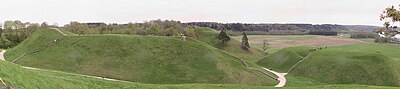
 Photo Wikimedia Commons
Contents
History & cultureBY TELLBY7 sections · numbered as on the map01 Orientation
Welcome to the State Cultural Reserve of Kernavė, a breathtaking landscape where human memory stretches back through eleven thousand years along the winding banks of the Neris River. Designated as a UNESCO World Heritage site in two thousand four, Kernavė preserves an exceptional archaeological ensemble that captures the continuous evolution of human society in the Baltic region from the Late Palaeolithic era through the Middle Ages. Following the retreat of glacial ice sheets around twelve thousand years ago, early hunter-gatherers settled in this fertile river basin, initiating an unbroken sequence of human habitation across millennia. The very name of Kernavė originates from a local stream, rooted in an ancient Baltic word describing a boggy sanctuary within forest and field. Spanning one hundred and ninety-four point four hectares, the reserve encompasses the sweeping expanse of Pajauta Valley, framed by a legendary defense network of five earthwork hill-forts: Aukuro Kalnas, Mindaugo Sostas, Lizdeikos Kalnas, Įgulos Kalnas, and Kriveikiškio Hill. Together, these impressive mounds formed an integrated defensive complex that protected the political and economic heartland of early Lithuanian civilization. Unlike many ancient political centers across Europe that were overwritten by centuries of modern urban development, the valley floor preserved its ancient layout beneath layers of protective river sediments. As you embark on your walking tour today, you will journey through thousands of years of human endeavor, spiritual devotion, and community life. Your path begins at the site museum, where excavated treasures offer an intimate look into ancient craftsmanship, long-distance trade, and ritual traditions. From there, your steps will lead you into the open air to wander along quiet woodland paths, cross scenic floodplains, and ascend the soaring green summits that overlook the river valley. Take a moment to pause, breathe in the fresh valley air, and listen to the quiet murmur of the river below. The landscape before you is a living canvas of Baltic identity, where every grassy slope and forested ridge tells part of an extraordinary story. We invite you to walk slowly, observe the subtle contours of the earth, and immerse yourself in the timeless atmosphere of this sacred landscape as we guide you through its rich historic layers.
02 Kernavė Archaeological Museum: Traces of the Last Pagans
The fact that organic materials such as timber building frames, leather footwear, and delicate wooden utensils remained virtually intact for centuries beneath the oxygen-deprived alluvial mud of the river valley is an extraordinary archaeological miracle. As you step into the main exhibition hall of the Kernavė Site Museum, direct your eyes to the prominent display case located in the center of the room. …
03 Aukuro Kalnas: The Citadel of Duke Traidenis
Beneath the waterlogged soil near the base of this steep earthwork lies one of ancient Lithuania's most ingenious engineering secrets: the nation's oldest paved road, a hidden subterranean wooden causeway buried beneath the wetland. Constructed in the middle of the first millennium, this concealed log road allowed local defenders to navigate treacherous marshland safely while keeping their tactical movements completely invisible to invading forces. …
04 Mindaugas' Throne: Legendary Seat of the First King
Nineteenth-century romantic historians bestowed the majestic title of Mindaugo Sostas upon these empty grassy earthworks without ever discovering a single brick wall or stone fortification. Unlike medieval European castles that relied heavily on stone masonry, ancient Lithuanians constructed formidable wooden fortresses atop raised earthen ramparts, seamlessly integrating massive timber architecture with the natural contours of the glacial landscape. …
05 Lizdeikos Kalnas: Sanctuary of the High Priest
Before the arrival of Christianity, Lithuania's pagan high priests kept a sacred eternal fire burning night and day beneath the open sky atop these elevated mounds. To a pantheistic society deeply attuned to the spiritual powers of nature, this perpetual flame represented the living heartbeat of the community, zealously guarded by holy priestesses known as vaidilutės and prognosticators who interceded with the gods on behalf of the realm. …
06 Įgulos Kalnas: The Final Defense and The Fire of 1390
In thirteen ninety, faced with an overwhelming invasion by the crusading Teutonic Order, the heroic defenders of Kernavė set fire to their own wooden castles and lower town, choosing to leave behind nothing but ash and cinders rather than surrender their sacred capital to the invaders. This dramatic scorched-earth retreat permanently froze the vibrant urban history of Old Kernavė in a single catastrophic moment. …
07 Closing
Our walking journey through the Pajauta Valley and across the five monumental hill-forts of Kernavė now comes to its natural conclusion. Spanning over ten millennia of human settlement along the Neris River, Kernavė stands as a profound symbol of Lithuanian statehood, ancient Baltic identity, and cultural endurance. …