 Photo Wikimedia Commons
Contents
History & cultureBY TELLBY7 sections · numbered as on the map01 Orientation
Welcome to the historic Jameh Mosque of Isfahan, one of the most revered and ancient Islamic monuments in Iran, officially designated as a UNESCO World Heritage Site in 2012. This sprawling complex, covering an extraordinary area of more than twenty thousand square meters, stands in the very heart of Isfahan historic center. The reason this monument holds such legendary status on the World Heritage List is that it serves as an unmatched textbook of Islamic architectural evolution spanning over twelve centuries. Starting from its earliest foundations laid around 771 CE during the reign of the Abbasid caliph al-Mansur as a modest mud-brick structure, and its subsequent major reconstruction in 840 to 841 CE under Caliph al-Mu'tasim into a monumental baked brick hypostyle sanctuary, the mosque continuously transformed under successive ruling powers. Through the Buyid dynasty in the tenth and eleventh centuries, the Great Seljuk Empire, the Ilkhanid period, the Muzaffarids, the Aq Qoyunlu, and the Safavid dynasty, each era contributed its own distinct structural innovations, engineering feats, and artistic decorations to this sacred space, turning it into a living museum of architectural history.
During our audio tour today, we will navigate through the layered history of this complex, witnessing firsthand how a uniform hypostyle brick structure evolved into a magnificent world-class masterpiece. Our route will guide you through key highlights of the complex in a smooth, logical sequence. We will begin at the vast central courtyard, where you will observe how Iranian architects revolutionized mosque design by adapting the ancient Sassanid four-iwan palace layout. From the courtyard, we will proceed to the southern dome chamber, built in 1086 to 1087 by the famous Seljuk vizier Nizam al-Mulk, which was the largest masonry dome in the Islamic world at the time of its completion. Next, we will cross over to the northern side to inspect the Taj al-Mulk dome, constructed in 1088 to 1089 as a mathematically flawless rival project featuring sophisticated star-shaped interlacing ribs along the north-south axis. Afterwards, we will re-examine the southern iwan to admire its exquisite fifteenth-century mosaic tilework added by the Aq Qoyunlu ruler Uzun Hasan and its lofty seventeenth-century Safavid minarets. Finally, we will step inside the quiet interior of the western winter hall to view the breath-taking stucco mihrab carved in 1310 by the master artist Haydar under Sultan Uljaytu, before exiting toward the bustling alleyways of the Grand Bazaar. Please take your time, listen closely, and enjoy this extraordinary journey through twelve centuries of Persian heritage.
02 The Central Courtyard and the Four-Iwan Layout
The vast central courtyard in which you are now standing represents a monumental breakthrough in architectural history, as this very site pioneered the adaptation of the ancient Sassanid Iranian palace layout into Islamic religious architecture. Before this revolution, congregational mosques across the Islamic world were primarily constructed as uniform hypostyle halls with endless rows of repetitive columns supporting flat wooden roofs. …
03 The Southern Dome: Nizam al-Mulk's Architectural Triumph
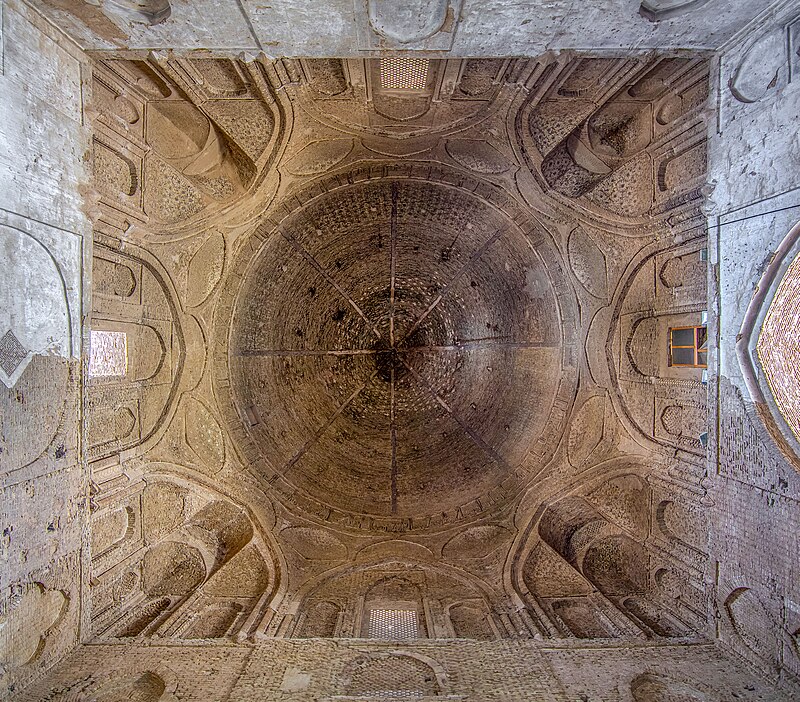
When this colossal southern dome chamber was constructed between 1086 and 1087 CE, it stood as the largest masonry dome built anywhere in the entire Islamic world at that time. Following the conquest of Isfahan in 1050 CE, when the city was chosen as the proud capital of the Great Seljuk Empire, this magnificent structure marked a monumental turning point in Islamic engineering. …
04 The Northern Dome: Taj al-Mulk's Geometrical Masterpiece
Constructed between 1088 and 1089 CE, this northern dome chamber stands as a triumphant mathematical masterpiece of medieval Iranian architecture, born directly out of a fierce political rival project aimed at outshining Nizam al-Mulk's southern dome. Although slightly smaller in physical scale than its southern counterpart, world-renowned architectural historians consider this northern dome to be unmatched in its structural harmony, mathematical precision, and flawless aesthetic execution. …
05 The Southern Iwan: Aq Qoyunlu Tiles and Safavid Minarets
This magnificent southern iwan represents a layered masterwork of Islamic architectural decoration, constructed and embellished across multiple centuries by the contrasting ruling powers of the Aq Qoyunlu dynasty and later the Safavid Shahs. Standing directly before this colossal portal, you are observing an extraordinary artistic synthesis where vibrant blue glazed tilework and soaring minarets were seamlessly layered over the massive, unglazed red brickwork originally built during the Seljuk…
06 The Ilkhanid Hall: Uljaytu's Masterpiece Stucco Mihrab
Tucked away inside this atmospheric interior hall is one of the most astonishing artistic treasures in existence, featuring what is universally recognized as the single most intricately carved stucco mihrab in the entire history of Islamic art. Constructed during the Mongol Ilkhanid period, this rectangular winter prayer hall offers a stark, contemplative contrast to the sunlit splendor of the main courtyard, enveloping visitors in a quiet sanctuary defined by profound spiritual reverence and…
07 Closing
Our audio tour through the magnificent Jameh Mosque of Isfahan has now come to its official conclusion. Over the past hour, we have walked through more than twelve centuries of continuous faith, architectural innovation, and Persian history. From its earliest foundations as a modest eighth-century Abbasid mud-brick sanctuary, through the ambitious Seljuk structural revolutions that birthed its colossal domes and four-iwan courtyard layout, to the breathtaking Ilkhanid stucco carvings, the…