 Photo Wikimedia Commons
Contents
History & cultureBY TELLBY7 sections · numbered as on the map01 Orientation
Welcome to the ancient archaeological site of Navekat, a monumental crossroads of human civilization where diverse cultures, faiths, and merchants intersected along the legendary Silk Road. Today, as you stand in the fertile Chuy Valley of Central Asia, you are visiting one of the most vital urban trade centers of antiquity, situated approximately thirty to thirty-five kilometers east of Bishkek, near the modern village of Krasnaya Rechka in present-day Kyrgyzstan. Established between the fifth and sixth centuries, Navekat flourished as a bustling oasis metropolis for over six centuries until its gradual decline in the twelfth century. The historical prominence of this great city is vividly reflected across ancient historical records. The name Navekat appears for the very first time in a famous Sogdian document dated to seven hundred eleven, discovered at Mount Mugh, and it was subsequently recorded with high esteem in Chinese imperial chronicles as well as medieval Arab and Persian geographical treatises. Recognizing its exceptional contribution to international trade and human interaction, UNESCO inscribed Navekat onto the World Heritage List in twenty fourteen as a key component of the Silk Roads: the Routes Network of Chang'an-Tianshan Corridor. This vast network stretched nearly five thousand kilometers from the ancient Chinese capitals of Chang'an and Luoyang across the soaring Tianshan Mountains into the heart of Central Asia, comprising over eight thousand seven hundred kilometers of interconnected trade routes. Navekat functioned not merely as a regional market, but as a dynamic cultural melting pot where goods, technologies, spiritual philosophies, and artistic traditions converged from across Eurasia. Here, industrious Sogdian agriculturalists, nomadic Turkic pastoralists, and international merchants from China, India, Persia, and the Mediterranean lived in peaceful coexistence. Together, they exchanged Chinese silk and porcelain, Western glassware, precious gems, spices, local wines, and profound ideas. As we begin our tour today, we will step through the historic layers of soil to explore the buried earthen citadels, expansive defensive fortifications, sacred temples, and multi-faith burial grounds that together reveal the rich, cosmopolitan spirit of this extraordinary Silk Road oasis.
02 The Massive Earthen Citadel Platform
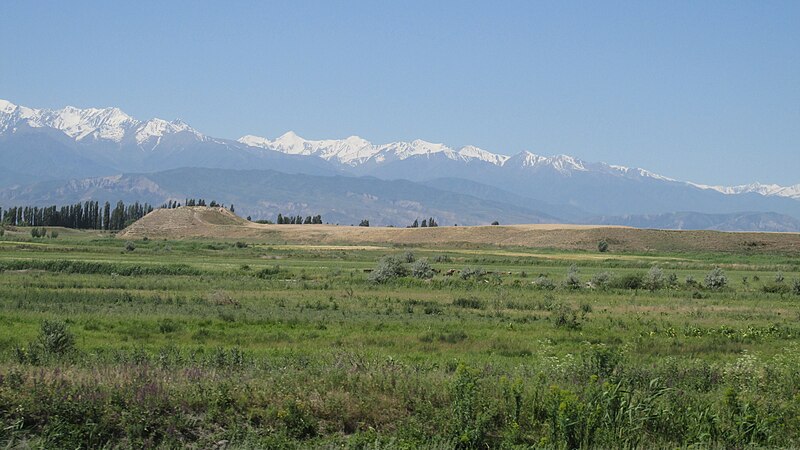
The citadel of Navekat stood as the commanding administrative heart of the metropolis, resting atop an artificial earthen platform constructed from an astonishing volume of thirteen million cubic meters of earth, making it one of the largest man-made earthen mounds in human history. If you look up directly ahead toward the northeastern sector of the site, you can see the monumental earthen mound rising twenty-one meters above the surrounding flat alluvial plain, clearly outlining the structural…
03 The Great Outer Wall and Multi-Cultural Suburbs
Navekat possessed an exceptionally rare urban layout, enclosed by a monumental outer wall extending over eighteen kilometers in length to safeguard not only the administrative core, but also surrounding agricultural fields, suburban neighborhoods, bustling markets, and extensive orchards. If you gesture with your hand toward the wide open terrain stretching beyond the central residential district known as the shahristan, you are looking across the ancient municipal hinterland and the outer…
04 The First Buddhist Temple and the Giant Reclining Buddha
Archaeologists made a breathtaking discovery during the excavation of a narrow corridor inside this first Buddhist temple, uncovering a monumental eight-meter-long clay sculpture of a reclining Buddha entering Nirvana. Look down towards the foundational outlines on the ground before you, which mark the central sanctuary and the surrounding circumambulatory corridor that once adjoined a massive pyramidal stupa mound. …
05 The Altar Room and Seated Buddha of the Northern Temple
Deep within the inner altar room of the Northern Mound Temple, archaeologists unveiled a extraordinarily preserved painted clay sculpture of a seated Buddha resting upon a lotus throne. As you look directly ahead, you can observe the rectangular ground plan of the outer temple measuring twenty-two point four by nineteen point five meters, centered around an inner sanctuary cella measuring eight by seven point three meters. …
06 Necropolis of Coexisting Faiths: Zoroastrians and Christians
Remarkably, archaeological excavations at Navekat revealed a golden burial mask, Zoroastrian ceramic ossuaries, Nestorian Christian votive stones, and Manichaean relics all within the bounds of a single city. Looking toward the western suburbs and the gentle earthen slopes around the citadel, you are viewing the designated areas where ancient inhabitants established their necropolises and sacred shrines according to their respective cultural and religious customs. …
07 Closing
Our exploration of Navekat, a brilliant beacon along the Silk Road for over six centuries from the sixth to the twelfth century, has now come to a close. The monumental earthen citadel, the eighteen-kilometer outer defensive wall, the exquisite Buddhist temple complexes, and the multi-faith necropolises we have encountered today all offer profound physical testimony to the enduring values of peaceful coexistence and cultural exchange preserved beneath these ancient soil layers. …