 Photo Wikimedia Commons
Contents
History & cultureBY TELLBY7 sections · numbered as on the map01 Orientation
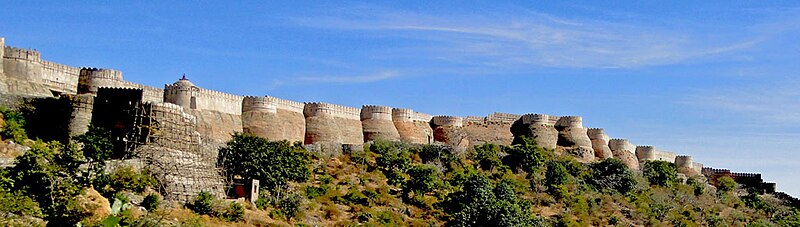
Welcome to the magnificent vista of Kumbhalgarh Fortress, where an incredible continuous stone defense wall snakes across the rugged crests of the Aravalli Hills. Standing proudly at an elevation of 1,100 meters above sea level in the Rajsamand district of Rajasthan, this formidable mountain citadel is celebrated worldwide as a monumental UNESCO World Heritage Site. Included under the serial cultural property known as the Hill Forts of Rajasthan, Kumbhalgarh represents the absolute pinnacle of Rajput military architecture and strategic engineering. Commissioned by the visionary ruler Rana Kumbha, this immense fortification served as the second most important capital of the Kingdom of Mewar and provided an impregnable refuge for the royal family during times of desperate siege and foreign invasion. The defining landmark of Kumbhalgarh is its staggering outer wall, which stretches continuously for 36 kilometers along the mountainous contours. Widely acclaimed as the Great Wall of India, this colossal barrier is recognized as one of the longest continuous walls on Earth. Within its fortified perimeter, encompassing an expansive territory across rugged ridges, the fortress integrates natural topographies into its defense design. By uniting multiple valleys and hilltops, the master builders constructed a self-sustaining citadel where flat terrain was reserved for agriculture and sloped grounds were converted into water reservoirs to endure prolonged military blockades. Enclosed within these monumental ramparts are more than 360 ancient temples, comprising both Hindu and Jain sacred shrines, alongside remarkably preserved royal complexes and defensive bastions. From the lofty heights of its mountain terrain, one can gaze for kilometers across the sweeping green ridges and valleys of the Aravalli Range. Today's walking route will guide you through this historic stronghold, beginning at the majestic main gate known as Ram Pol, ascending through historic stone pathways and sacred temple enclosures, and culminating at the cloud-kissed summit palace of Badal Mahal. As you prepare to embark on this journey, take a moment to admire the sheer scale of the stone masonry before you. Please adjust your footwear, take a drink of water, and proceed gently toward the primary gateway to begin exploring the invincible heritage of Mewar.
02 Section 1
As you stand directly before the imposing threshold of Ram Pol, you are gazing at a masterwork of military engineering that was constructed in 1448 AD and remained virtually impenetrable throughout its historical existence. Engineered under the direct personal supervision of Chief Architect Mandan during the glorious reign of King Maharana Kumbha, this magnificent portal served as the primary defensive shield for the entire Mewar stronghold. …
03 Section 2
As you ascend along the winding stone ramp toward Hanuman Pol, you encounter one of the most spiritually significant and surprising features of the entire fortress defenses. Standing directly before the entrance is a revered stone idol of the deity Hanuman, which was personally brought to this exact spot by King Maharana Kumbha as a sacred protective talisman to safeguard the fort against evil forces and enemy invasions. …
04 Section 3
Stepping into the tranquil enclosure of the Neelkanth Mahadeva Temple on the fort's eastern terrace reveals a breathtaking sanctuary that leaves every visitor in awe. Resting at the heart of the inner sanctum is an extraordinary deity: an extremely rare idol of Lord Shiva sculpted from a single block of black stone and depicting the deity with 12 arms. Guide your step into the central rectangular enclosure of the temple complex and look up at the soaring ceiling of the main mandapa hall. …
05 Section 4
Standing directly before the three-story structure of the Vedi Temple, you are viewing a masterpiece of sacred architecture that holds a unique place in the fortress's history. Constructed in 1457 AD under the orders of King Maharana Kumbha, this magnificent three-story temple was built specifically to perform Vedic consecration rituals marking the successful completion of Kumbhalgarh Fort. …
06 Section 5
You have reached the pinnacle of Kumbhalgarh Fort, standing within the regal precinct of Badal Mahal, famously known as the Palace of Clouds. Perched at the highest elevation of Katargarh citadel, this palace offers an extraordinary natural phenomenon: during the monsoon season, thick mountain clouds literally drift through the open stone windows, enveloping the royal chambers in a swirling white mist. Turn toward the open stone window frames and look out across the surrounding landscape. …
07 Closing
As you stand amidst the soaring peaks of the Aravalli Range, our audio tour of Kumbhalgarh Fortress comes to a gentle conclusion. Throughout its history, this colossal stronghold served as a sacred sanctuary of royal refuge during times of war, an astonishing triumph of Rajput military engineering, and a flourishing haven for artistic and architectural expression. …
