Contents
History & cultureBY TELLBY7 sections · numbered as on the map01 Orientation
Welcome to Canaima National Park, a vast and magnificent natural sanctuary located in southeastern Venezuela, stretching toward the borders of Brazil and Guyana. In 1994, UNESCO designated this extraordinary wilderness as a World Natural Heritage Site in recognition of its ancient sandstone tabletop mountains, locally known as tepuis, its towering vertical escarpments, and a pristine ecological system that has evolved in isolation over millions of years. Spanning an immense area of thirty thousand square kilometers, this national park is roughly equivalent in size to the entire nation of Belgium, making it one of the largest protected areas in South America.
Beyond its vast geographic extent, Canaima serves as a vital hydrological heartland for the country. The pristine headwaters flowing down from these high sandstone plateaus feed directly into the Caroni River basin, which in turn supplies the massive Guri Dam downstream. This single hydroelectric infrastructure generates more than seventy percent of Venezuela's electrical power, demonstrating how the protection of these remote watersheds directly sustains the modern nation. Yet long before modern infrastructure was built, this landscape was the ancestral home of the indigenous Pemon people. For the Pemon, these dramatic tepui formations are not merely impressive geological structures, but sacred realms inhabited by powerful guardian spirits known as Mawari. Their customary lore, deep ecological familiarity, and spiritual traditions are woven into every river, forest canopy, and savanna trail across this ancient ground.
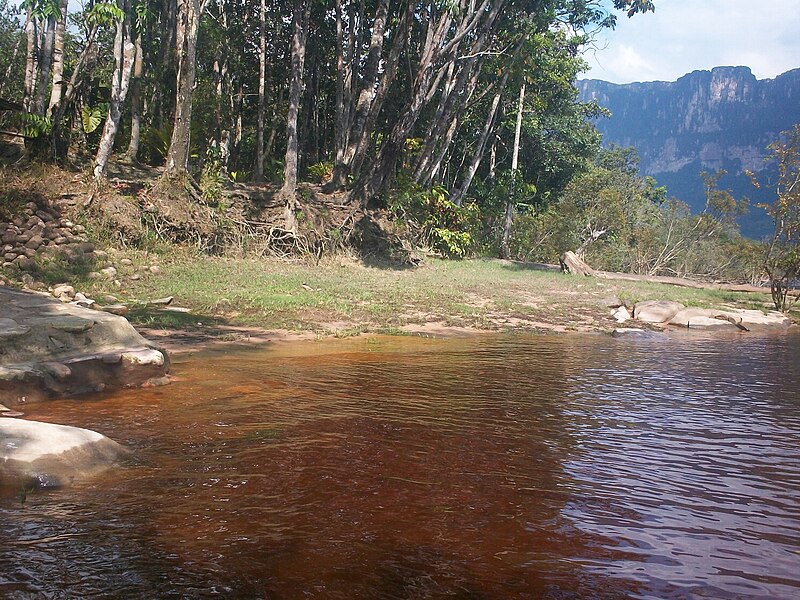
Our guided walking itinerary today will explore the western sector of the park around the breathtaking Canaima Lagoon. We begin here at the lagoon overlook, where you can take in the panoramic view of the tea-tinted waters and soft pinkish sands. From this vantage point, our route will guide you north along the sandy shoreline toward the thunderous torrents of El Hacha Falls and the tranquil forest path of Ucaima Waterfalls. Afterward, our journey turns toward the iconic El Sapo Falls, where a natural rock ledge allows us to walk directly behind a wall of cascading water. Finally, we will gather at the Pemon Cultural and Fire Ecology Space before reaching our final departure point at the Caroni River overlook. Take a slow, deep breath of the fresh forest air, listen to the distant chorus of rushing cascades, and prepare to embark on a memorable journey through one of the planet's most majestic landscapes.
02 Canaima Lagoon Shore
The sandy beach along the shoreline of Canaima Lagoon presents a striking linguistic and historical paradox that few visitors realize upon arrival. The name Canaima, chosen by state officials to designate this national park, actually translates to spirit of evil or a practitioner of deadly sorcery and witchcraft in the local Pemon language. …
03 El Hacha Falls Viewpoint
Standing here at the viewpoint facing the thunderous cascades of El Hacha Falls, you are looking directly at geological structures that connect us to the absolute infancy of planet Earth. The colossal sandstone tabletop mountains that capture rain and feed these immense waterfalls rest upon a deep igneous granite foundation that is nearly three billion years old. …
04 Ucaima Waterfalls Trail
As you walk along the shaded curves of the Ucaima Waterfalls trail, you are entering a botanical sanctuary defined by extraordinary evolutionary adaptations. Over thirty percent of the plant species thriving on the high plateaus and tepui summits of this region are strictly endemic, meaning they exist nowhere else on the face of the Earth. …
05 El Sapo Falls Cavern Trail
The trail leading toward the thrilling rock cavern behind El Sapo Falls provides the backdrop for a revolutionary scientific discovery that transformed modern conservation science. Controlled scientific field research conducted continuously over a seven year period across seasonal test plots proved that the traditional burning practices of the Pemon people do not cause environmental degradation. …
06 Pemon Cultural and Fire Ecology Space
Welcome to the Pemon cultural and fire ecology space, a sanctuary that reveals a historical human presence far deeper than most travelers imagine. Archaeologists exploring Canaima National Park have discovered ancient pictographic rock art painted onto sheer stone cliffs that date back between four thousand and seven thousand years. …
07 Closing
Standing here at the Caroni River overlook, we bring our journey through Canaima National Park to a memorable and reflective close. The wide, tea colored currents flowing before us feed directly into the Caroni River basin, which journeys downstream to power the massive Guri Dam hydroelectric complex. …