 Photo Wikimedia Commons
Contents
History & cultureBY TELLBY7 sections · numbered as on the map01 Orientation
Located on a high plateau over two thousand meters above sea level in the Horn of Africa, Asmara represents an extraordinarily rare and precious urban heritage site. Formed from the late nineteenth century onwards as a colonial outpost and administrative capital, this city stands as an exceptional open-air laboratory of early twentieth-century modernist architecture and urban planning in an African context. Its designation as a UNESCO World Heritage site rests not merely on individual architectural landmarks, but on the remarkably preserved integrity and authenticity of its complete urban fabric. Here, prominent European architectural movements including Art Deco, Rationalism, Neoclassicism, and Futurism merged seamlessly with the distinct topography and local cultural traditions of the Eritrean highlands, creating an urban landscape unparalleled anywhere in the world.
The origin of the city's name traces back to a profound local tradition. Long before European colonial rule, four separate agrarian villages occupied this high plateau. Facing constant threats from wild fauna and predatory raids by neighboring groups, the local inhabitants lived in perpetual vulnerability. Recognizing the urgent need for collective protection, the women of the four villages convened a historic assembly. They issued a resolute ultimatum to the men, declaring that no meals or domestic services would be provided until the men agreed to unify their separate settlements into a single fortified community. Moved by this uncompromising female resolve, the men constructed a unified village and named it Arbate Asmera, which in the Tigrinya language signifies that four women united the four villages. Over time, this foundational name evolved into Asmara, embedding a narrative of unity and female leadership at the very heart of the modern national capital.
Beginning in 1893 and accelerating through the 1930s under Italian colonial administration, Asmara underwent structured urban expansion. Planners implemented a hybrid street network combining an orthogonal grid with scenic radial avenues, monumental plazas, and functional zoning regulations. Although originally designed to assert imperial authority and enforce racial segregation, the physical space was progressively reclaimed by the Eritrean people. Throughout decades of conflict, political turmoil, and economic isolation, the citizens of Asmara protected their city's built environment, transforming colonial structures into an integral element of their national heritage.
Today, our walking tour guides you through the premier highlights of this living modernist museum. We begin at the Great Mosque of Asmara, where Islamic tradition meets European Rationalism. Next, we examine Cinema Impero, an Art Deco masterpiece preserved in its original 1937 state. We then walk along Harnet Avenue, the palm-lined commercial spine celebrated for its cafe culture and evening promenade. Afterwards, we explore the Arbate Asmera native quarter, where traditional organic roots endure. Finally, we conclude at the iconic Fiat Tagliero Building, famous for its thirty-meter cantilevered concrete airplane wings. Let us embark on this unforgettable journey.
02 Great Mosque of Asmara (Al Khulafa Al Rashiudin)
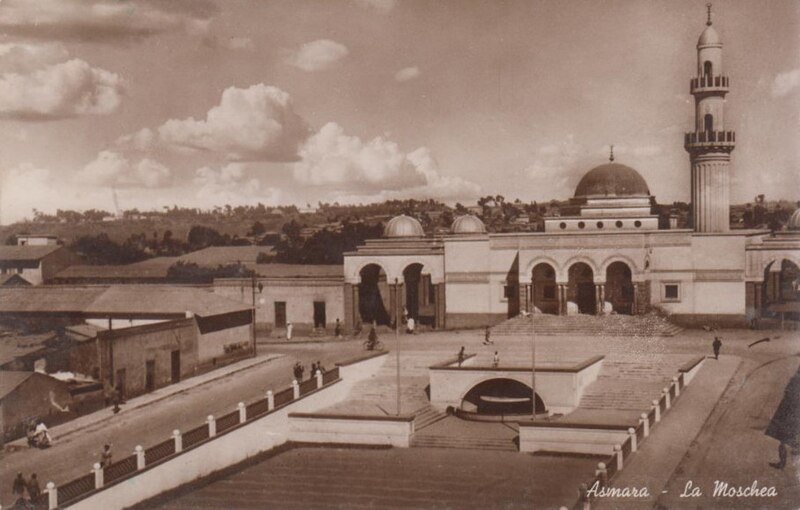
Standing in the vibrant center of Asmara, look upon the Great Mosque of Asmara, historically known as Al Khulafa Al Rashiudin. This extraordinary religious complex represents a captivating synthesis of Italian Rationalism, Neoclassical architectural principles, and traditional Islamic structural design. …
03 Cinema Impero
Welcome to Cinema Impero, a monumental landmark standing proudly along Harnet Avenue. The most astonishing historical reality regarding this building is that despite decades of violent conflict, military bombardment, and political turmoil that swept across the Horn of Africa, Cinema Impero has survived in an almost miraculous state of complete preservation. …
04 Harnet Avenue
You are now walking along Harnet Avenue, the vibrant central artery and primary commercial boulevard of Asmara. A surprising historical fact about this thoroughfare is that during the late 1930s, the concentration of motor vehicles here was significantly higher than in Rome, the capital city of Italy. By 1938, over fifty thousand registered automobiles and motorcycles were operating in Asmara, filling this high-altitude avenue with unprecedented vehicular movement. …
05 Arbate Asmera & Abbashawel Quarters
Leaving behind the rigid grid system of the planned central European core, we arrive at the threshold of the Arbate Asmera and Abbashawel native quarters. The most fascinating reality regarding this area is that despite being situated entirely outside the planned colonial street grid, this quarter is the historic birthplace of the city's name and original identity. …
06 Fiat Tagliero Building
You are now standing before the Fiat Tagliero Building, the undisputed climax of Asmara's modernist architecture and a celebrated milestone in global architectural history. The most astonishing reality about this building is that it functions as a service station featuring unsupported cantilevered reinforced concrete wings that extend thirty meters into the air without any supporting columns. …
07 Closing
Our audio guide exploration through Asmara, the extraordinary modernist city of Africa, has now reached its conclusion. Situated high upon an East African plateau over two thousand meters above sea level, this unique capital stands as a profound testament to human resilience. Asmara has endured successive waves of foreign domination, including decades of Italian colonial extraction, British military administration, forced federation, and nearly thirty years of relentless armed struggle for…