Contents
History & cultureBY TELLBY7 sections · numbered as on the map01 Orientation
Welcome to the historic old town of Kuldīga, a tranquil sanctuary in western Latvia where time seems to stand still amid charming cobblestone streets and centuries of rich Baltic history. Situated at a scenic river confluence, this remarkable historic settlement was officially inscribed on the UNESCO World Heritage list in the year two thousand twenty-three. It received this global honor because it stands as an extraordinarily well-preserved example of traditional Baltic wooden architecture and urban layout, capturing an unbroken line of historical development from the thirteenth century through the ducal era and into the early twentieth century. Much of the unique heritage you see today flourished during the golden age of the Duchy of Courland and Semigallia, which governed this region from fifteen sixty-one until seventeen ninety-five. During that prosperous era, Kuldīga served as the main administrative center and primary residence for the duchy's first ruler, attracting international traders and skilled craftsmen who combined foreign Hanseatic styles with local Baltic timber building techniques.
At the very core of Kuldīga's geographical identity is the dramatic natural intersection where the wide Venta River meets the smaller, winding Aleksupīte stream. This dynamic confluence defined how the town expanded across centuries, creating a rare urban townscape where water infrastructure and historic wooden architecture exist in complete harmony. High on the plateau overlooking the valley lies Kalnamiests, the ancient medieval heart of the town, distinguishable by its classic oval shape. Unlike many historic urban centers across Europe, Kuldīga miraculously survived the destructive wars of the twentieth century largely unscathed. Furthermore, modern urban developments were thoughtfully directed far outside the old quarter, leaving the historic street layout, red clay tile roofs, and traditional wooden structures remarkably authentic and vibrant.
As we begin our audio walking tour, you will discover a living historic settlement rather than a static outdoor museum. Local residents still live in these timber houses, maintaining their homes and traditional crafts just as generations did before them. Over the course of five carefully curated stops, we will explore the vibrant central square and its royal history, walk down Liepājas Street past protected firewood sheds and the Duke Jacob Teleport statue, follow the Aleksupīte stream directly along house foundations, cross one of Europe's longest operational brick road bridges built in eighteen seventy-four, and marvel at the sweeping width of the Ventas Rumba waterfall alongside Castle Park. Please step forward into the historic center, set a comfortable walking pace, and allow the gentle sound of flowing water and atmospheric old-world charm to welcome you to Kuldīga.
02 Town Hall Square and Steffenhagen's House
Did you know that during the dramatic military operations of the Great Northern War in seventeen hundred and one, King Charles the Twelfth of Sweden stayed right here in Kuldīga and left behind a massive wooden chest that remains carefully preserved inside the building to this very day? Look directly across the historic stone-paved expanse of Town Hall Square to locate the grand facade of Steffenhagen's house, standing proudly as one of the most remarkable architectural and historical treasures…
03 Liepajas Street and Duke Jacob's Teleport
Did you know that in Kuldīga, municipal heritage regulations strictly protect every single humble wooden firewood shed located behind residential houses, ensuring that not a single one is ever demolished? This extraordinary commitment to protecting daily life structures prevents the old town from turning into an artificial museum shell and keeps it a genuine, living neighborhood. …
04 Aleksupite Stream and Latvia's Venice
Did you know that the modest four-meter drop of the Aleksupīte waterfall located right here is officially recorded as the highest natural waterfall in all of Latvia? While many travelers come expecting massive mountain cascades, this charming four-meter drop holds a unique title in Latvia's flat landscape. …
05 The Old Red Brick Bridge
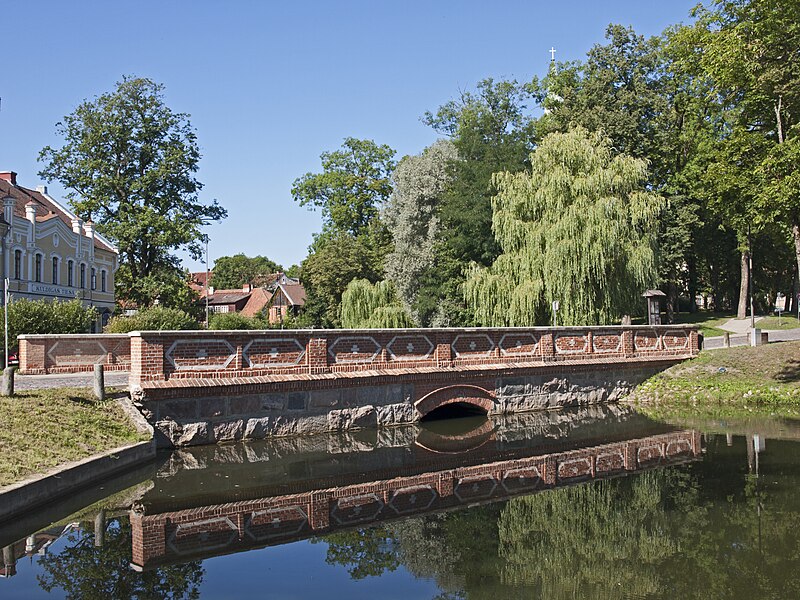
Did you know that this magnificent red brick bridge, constructed in eighteen seventy-four and stretching one hundred and sixty-four meters across the river, ranks as one of the longest operational brick road bridges in all of Europe? As you arrive at the riverbank, look closely across the series of sweeping red vault arches that span the wide Venta River. …
06 Ventas Rumba Waterfall and Castle Park
Did you know that the Ventas Rumba waterfall stretches across an astonishing width of up to two hundred and forty-nine meters, expanding up to two hundred and seventy meters during spring floods, officially making it the widest waterfall in all of Europe? As you stand along the riverbank promenade, guide your eyes across the broad, shallow ledge where the Venta River cascades gracefully over a continuous dolomite threshold. …
07 Closing
As our journey through Kuldīga comes to an end, take a quiet moment to look back upon the peaceful timber-lined streets and historic waterways we have traversed together. What makes Kuldīga truly extraordinary among European heritage sites is not merely its ancient buildings or wide waterfalls, but the remarkable fact that it avoided the destructive modern redevelopments and wartime damage that reshaped so many historic Baltic towns. …