 Photo Wikimedia Commons
Contents
History & cultureBY TELLBY7 sections · numbered as on the map01 Orientation
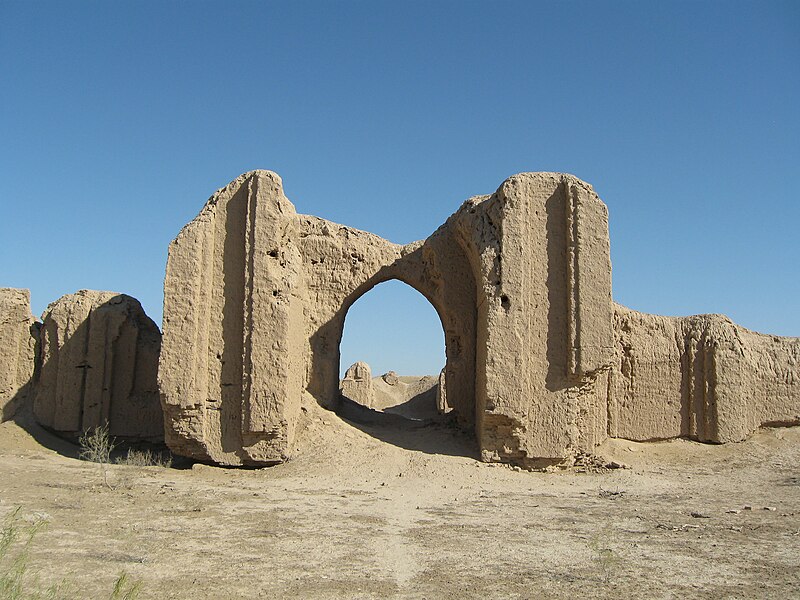
Welcome to Ancient Penjikent, a core component of the transnational UNESCO World Heritage property known as the Silk Roads Zarafshan Karakum Corridor, inscribed on the World Heritage List in twenty twenty-three. Spanning across Tajikistan, Uzbekistan, and Turkmenistan, this ancient trade artery extends through rugged mountain ranges, fertile river valleys, and vast desert landscapes along the Zarafshan River toward the Merv Oasis. Ancient Penjikent was founded around four hundred AD as the easternmost urban center of Sogdiana, an Iranian civilization that controlled international commerce across Central Asia. Positioned at the strategic geographic interface where the Zarafshan terrace meets the high mountain passes of Kuhistan, Penjikent served as a compulsory gateway for every caravan, trader, and pack animal moving between the mountain trails and the famous oasis city of Samarkand. The Sogdians were renowned master merchants and cultural mediators who facilitated long-distance trade between Tang Dynasty China, Persia, the Byzantine Empire, and northern pastoral nomads without ever establishing a single centralized military empire. Instead, their society flourished as a network of autonomous city-states, among which Penjikent held an exceptionally lucrative monopoly. By controlling this mountain pass bottleneck, the ruler of Penjikent levied customs duties on rare alpine minerals, silver, musk, silk, and luxury ceramics passing through his domain. Today, your walking tour through these earthen ruins will guide you through the sophisticated urban architecture of a preserved eighth-century Sogdian city. You will begin at the elevated Citadel, known locally as the Kuhendiz, which housed the grand ruler palace and massive defensive bastions overlooking the river valley. From there, you will proceed to the religious precinct to explore two Zoroastrian fire temples where sacred flames burned continuously. Your route will then lead into the inner city, the Shahristan, where narrow streets were covered overhead with continuous vaulted clay arches that protected residents and artisans from the fierce desert sun. You will also discover the grand reception halls of wealthy merchant mansions, where vibrant wall paintings depicting deities, heroes, and river gods survived for over thirteen centuries beneath collapsed clay roofs. Finally, you will reach the outer suburban Rabad and the Necropolis, where unbaked clay crypts called nauses and ossuary boxes called assuaries preserve ancient mortuary rites. Excavated systematically since nineteen forty-six, Penjikent was abandoned suddenly in the eighth century and never rebuilt, leaving an unadulterated time capsule of Silk Road heritage. Prepare to step back into the golden age of Sogdian civilization.
02 Citadel and Ruler's Palace
One of the most remarkable and surprising facts about Ancient Penjikent is that every merchant caravan moving between the formidable mountain passes of Kuhistan and the desert plains to the west was completely dependent on a single Sogdian ruler for safe passage and commercial clearance. As caravans of merchants and hundreds of heavily laden pack camels traversed this compulsory mountain corridor toward the oasis of Samarkand, they were obligated to halt directly before these citadel gates. …
03 Zoroastrian Temple of Sacred Altars
The sacred Zoroastrian scriptures of the Avesta specifically praised the region of Sogdiana as the second best land created on earth by their supreme deity, Ahura Mazda. This passage reflects the deep spiritual pride and identity of the Sogdian people. As you pause inside this sacred open sanctuary, look directly down at the rectangular temple courtyard and the raised clay pedestal remnants where holy fires burned continuously twenty-four hours a day. …
04 Residential Quarter and Vaulted Streets
The most extraordinary and innovative urban feature of Ancient Penjikent was that its narrow residential lanes and commercial thoroughfares were completely covered overhead with continuous vaulted clay arches. Built to block out the scorching desert sun and intense summer heat, these arched mud-brick roofs transformed the entire street grid into a cool, shadowed pedestrian tunnel network. …
05 Hall of Wall Paintings
The most astonishing fact about the ancient artists of Penjikent is that they created these vibrant wall paintings on raw, unbaked mud-brick plaster using organic glue binders and natural pigments that survived underground for over thirteen hundred years without losing their rich colors. When collapsed clay roofs buried these chambers, the fallen mud created an airtight protective seal that shielded delicate plant dyes and mineral pigments from atmospheric decay. …
06 Necropolis and the Castle on Mount Mugh
Unlike almost every other ancient city in Central Asia that was repeatedly destroyed and rebuilt over medieval centuries, Ancient Penjikent was abandoned suddenly in the eighth century and never inhabited again. Frozen in time for over thirteen hundred years beneath protective layers of fallen mud, this undisturbed site offers archaeologists an unadulterated urban window into eighth-century Sogdian civilization. …
07 Closing
As our walking tour through Ancient Penjikent comes to a quiet close, pause for a moment to take in the serene atmosphere resting over these earthen ruins. For over thirteen hundred years, this remarkable city lay completely forgotten beneath protective layers of collapsed clay and windblown mud, preserved like an authentic time capsule until systematic archaeological excavations began in nineteen forty-six. …