 Photo Wikimedia Commons
Contents
History & cultureBY TELLBY7 sections · numbered as on the map01 Orientation
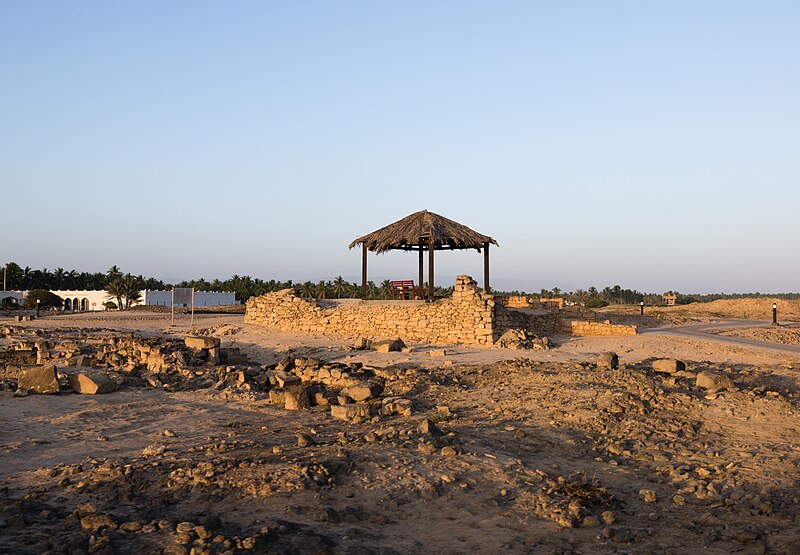
Welcome to Al Baleed Archaeological Park, located on the picturesque coastline of Salalah in the Dhofar Governorate of the Sultanate of Oman. As you step onto this revered ground, you are entering one of the most prominent maritime trade hubs of the ancient and medieval world. In the year two thousand, UNESCO inscribed this remarkable site onto the World Heritage List as an integral component of the Land of Frankincense, alongside the natural resin groves of Wadi Dawkah, the desert caravan oasis of Shisr, and the ancient coastal port of Khor Rori. Together, these sites illustrate an extraordinary commercial network that supplied precious frankincense to distant civilizations across Asia, Africa, and Europe. The history of human habitation in the broader Dhofar region reaches back to prehistoric antiquity, with archaeological sites like the Natif Caves illustrating a long continuum of human settlement. Al Baleed itself traces its urban origins back to the medieval era, reaching its commercial peak under the name Zafar. For centuries, this fortified port city functioned as a vital center along the Maritime Silk Road, establishing direct trade links with Ming Dynasty China, the Indian subcontinent, and the East African coast. In eighteen forty six, the British researcher Howard Carter visited these abandoned ruins and produced the first detailed survey map, documenting the ancient city walls and urban layout. As you look around today, you can see the surviving stone foundations, defensive bastions, and coastal lagoon that once sheltered heavy trading vessels. To ensure the preservation of these irreplaceable archaeological remains, visitors are requested to remain strictly on the designated pathways laid with protective geotextiles and avoid climbing on the historic stone masonry. Because the walking routes span across open and uneven ground, comfortable footwear and sun protection are strongly recommended. When exploring sacred areas such as the ancient mosque complex, please maintain respectful behavior and attire. We advise visiting the on-site Museum of the Land of Frankincense first to gain rich historical context before wandering through the open-air ruins. During the seasonal monsoon, known locally as the khareef, moisture-laden winds sweep across the Dhofar mountains and coast, transforming the surrounding landscape and echoing the ancient maritime climate that governed dhow navigation across the Indian Ocean. Enjoy your journey through this historic sanctuary, where the ocean breeze meets centuries of trade, heritage, and culture.
02 The Great Mosque Ruins
You are now standing before the magnificent ruins of the Great Mosque of Al Baleed, the spiritual and communal heart of the medieval metropolis. During its period of greatest prosperity, this monumental place of worship featured an extraordinary architectural design comprising more than one hundred and forty-four stone columns and seven grand entrance portals. …
03 The Citadel and Ruler's Residence
Welcome to the Citadel Fort and Ruler's Residence, which served as the political nerve center and primary defensive stronghold of ancient Al Baleed. Archaeological investigations at this site revealed a fascinating and surprising discovery regarding its structural complex. During targeted excavations conducted in twenty fifteen, archaeologists uncovered an extensive secondary architectural complex directly behind the main fortress, constructed exclusively to accommodate the royal court,…
04 The South Wall and Ocean Ramparts
You have arrived at the South Wall and Ocean Ramparts, directly overlooking the vast waters of the Indian Ocean. This coastal defense barrier features a surprising historical and engineering reality that demonstrates the incredible scale of the city's fortification. Along this single southern seawall, medieval military architects constructed no fewer than seventeen defensive watchtowers and four stone breakwaters. …
05 Maritime Hall - The Seafaring Legacy
Welcome to the Maritime Hall, the first major exhibition wing inside the Museum of the Land of Frankincense, which officially opened its doors to visitors in two thousand seven. As you step into this gallery, you are introduced to a truly surprising engineering feat that defined ancient Omani seafaring. Traditional Omani dhows navigated the vast expanses of the Indian Ocean without utilizing a single iron nail in their hull construction. …
06 History Hall - The Frankincense Trail
Welcome to the History Hall, the second main display hall inside the Museum of the Land of Frankincense, dedicated to chronicling the cultural evolution and trade history of the region. As you enter this gallery, you are presented with an astonishing historical truth regarding the value of this regional product. The aromatic resin harvested from the hardy Boswellia sacra trees native to Dhofar's arid wadis was once literally worth its weight in pure gold across ancient civilizations. …
07 Closing
You have reached the final stop of our tour, the scenic Khawr Al Baleed Lagoon Viewpoint, where our exploration of this ancient site comes to a poetic conclusion. Standing on the peaceful banks of this freshwater lagoon, take a moment to take in the serene natural surroundings: the swaying coconut palm trees, the gentle reflection of the sky on the water's surface, and the graceful coastal birds gliding above the reed beds. …