Contents
History & cultureBY TELLBY8 sections · numbered as on the map01 Orientation
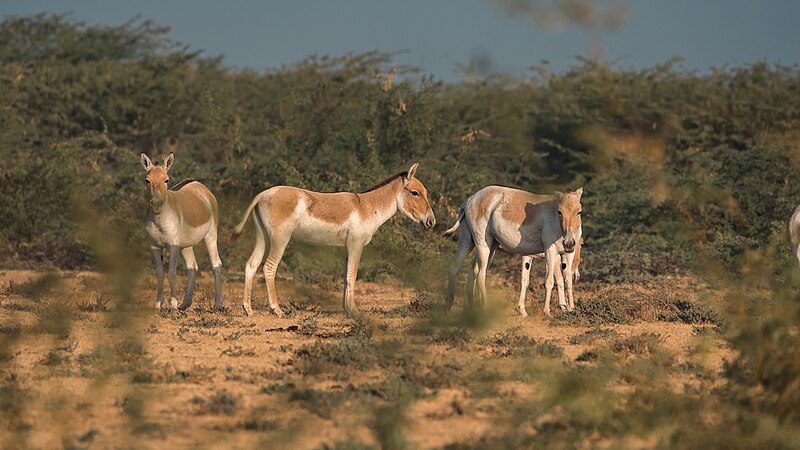
Welcome to the Indian Wild Ass Sanctuary, an extraordinary ecological realm embedded within the expansive basin of the Little Rann of Kachchh in Gujarat. Spanning across five administrative districts including Kachchh, Rajkot, Surendranagar, Patan, and Banaskantha, and encompassing ten talukas, this unique landscape connects over one hundred and eight peripheral settlements housing more than fifty-two thousand families. Here, human livelihoods and fragile wilderness exist side by side in a environment defined by dramatic geographical transformations. During the annual monsoon season, powerful tidal surges from the Gulf of Kachchh push saline seawater deep inland through marine creeks, while several ephemeral mainland rivers discharge massive volumes of freshwater runoff into the low basin. The mixing of these fresh and saline waters turns the flat expanse into an immense, shallow, brackish water wetland spanning hundreds of square kilometers. As you look across the horizon, the landscape pulses with aquatic life, providing a rich nursery ground for countless marine and estuarine species. However, as the rainy season subsides and the unyielding solar heat of the dry season takes over, rapid surface evaporation strips away the moisture, revealing a dust-blown, arid saline desert covered in glistening white salt crusts. Listen carefully to the desert wind whispering across the dry salt pan, a testament to the extreme conditions that define this unique sanctuary. This shifting mosaic of habitats serves as the ultimate stronghold for the endangered Indian Wild Ass, known locally as the Khur, which exists nowhere else on Earth. Within the legally protected boundary of the sanctuary, these resilient ungulates thrive alongside a remarkably diverse assemblage of dryland wildlife, including gray wolves, desert foxes, desert cats, nimble chinkara gazelles, and rare houbara bustards. The nutrient-dense brackish waters foster dense populations of fish and crustaceans, which in turn attract spectacular congregations of over two hundred migratory and resident bird species, including massive breeding colonies of lesser flamingos. Rising above the flat saline basin are slightly elevated landmasses composed of sandy and rocky soils, known locally as bets or dhasis. Because these raised islands feature significantly lower soil salinity compared to the surrounding salt crusts, they sustain vibrant natural grasslands and dense thorny scrub cover. Iconic islands such as Nanda Bet, Pung Bet, and Keshmara Bet remain unflooded even during heavy monsoon downpours, serving as vital terrestrial refuges and rich foraging grounds for wild ass herds. As you begin this audio guide journey, you enter a world where natural resilience and human heritage meet under the vast Indian sky.
02 Kuda Station: Salt Pans and Maldhari Pastures
The Kuda Station marks a fascinating transition zone where the sandy, rocky village uplands gradually merge into the vast, shimmering saline floor of the Little Rann of Kachchh. As you step along this fringe landscape, listen to the dry desert breeze rustling through the thorny vegetation and notice the crisp salt crust forming beneath your feet. …
03 Tikar Dhassi: Prawn Fishing Grounds in the Flooded Desert
Tikar Dhassi stands as one of the largest and most dynamic seasonal fishing encampments in the interior basin of the Little Rann of Kachchh. As heavy monsoon downpours flood the flat saline desert between August and October, two hundred to two hundred and fifty fishing families belonging predominantly to the Miyana Muslim and Koli communities arrive in long caravans. …
04 Surajbari Creek: Tidal Currents and Traditional Bag Nets
Surajbari Creek serves as the vital hydrographic gateway connecting the marine environment of the Gulf of Kachchh with the vast interior wetland basin of the Little Rann of Kachchh. As an essential estuarine corridor, this tidal waterway experiences intense hydrological dynamics governed by lunar cycles. Stand along the lookout and listen to the rushing tidal roar that echoes through the creek bed. …
05 Nanda Bet: Shallow Pools and Migratory Avifauna
Nanda Bet and Shedwa Bet, situated in the northern sector of the sanctuary near Adesar, represent a critical ecological refuge during the dry season transition. As October arrives and the vast, shallow floodwaters across the main floor of the Rann evaporate, the hydrological connectivity breaks down, isolating large, standing pools of water around Nanda Bet. …
06 Keshmara and Pung Bets: Grassland Habitats and Wild Ass Herds
Pung Bet and Keshmara Bet, located deep within the interior basin of the sanctuary, represent two of the most ecologically vital raised island grassland ecosystems in the Little Rann of Kachchh landscape. Stand on the edge of these elevated plateaus and listen to the wind whistling across the open prairie while taking in the sweet aroma of wild grasses. …
07 Kharaghoda: The Indigenous Udhvaro Fish Trap
Along the eastern fringe of the sanctuary near Kharaghoda village, local fishermen practice a remarkably unique and ingenious indigenous fishing method known as Udhvaro. Mastered and maintained by a small group of approximately fifteen local fishing families, Udhvaro is a traditional night-fishing trap technique specifically designed to catch small freshwater and estuarine fish without relying on modern synthetic gear, commercial nylon netting, or motorized equipment. …
08 Closing
As our audio journey across the Indian Wild Ass Sanctuary comes to a close, we reflect upon the remarkable ecological tapestry and delicate natural balance of the Little Rann of Kachchh. Take a moment to listen to the quiet vastness of the horizon, where the wind bridges the saline desert and the seasonal waters. This extraordinary landscape, continuously shifting between an arid saline desert and a thriving seasonal brackish wetland, stands as one of the most remarkable biomes on Earth. …