 Photo Wikimedia Commons
Contents
History & cultureBY TELLBY7 sections · numbered as on the map01 Orientation
Welcome to Paphos Archaeological Park, a grand sanctuary where classical mythology and ancient history resonate in profound harmony. The historic ground beneath your feet was inscribed as a UNESCO World Heritage Site in 1980 because it stands as the sacred realm of the goddess Aphrodite and thrived as the administrative capital during both the Ptolemaic and Roman eras, preserving extraordinarily magnificent floor mosaics and monumental archaeological structures. As a crucial maritime commercial hub in the eastern Mediterranean, this ancient coastal metropolis holds exceptional historical significance.
The story of Nea Paphos began in the late 4th century BC when King Nicocles, the final monarch of the city-kingdom of Palaipaphos, established this new coastal settlement. During this period of dramatic political transformation, Ptolemy I Soter relocated the population of Marion to Nea Paphos, propelling rapid urban expansion that transformed the town into a strategic Ptolemaic shipbuilding center and provincial capital, ultimately replacing Salamis. When the Roman Republic acquired Cyprus, Nea Paphos retained its prestigious capital status, flourishing as a vibrant political and economic metropolis surrounded by trade routes reaching Egypt, the Levant, the Aegean, and the western Mediterranean.
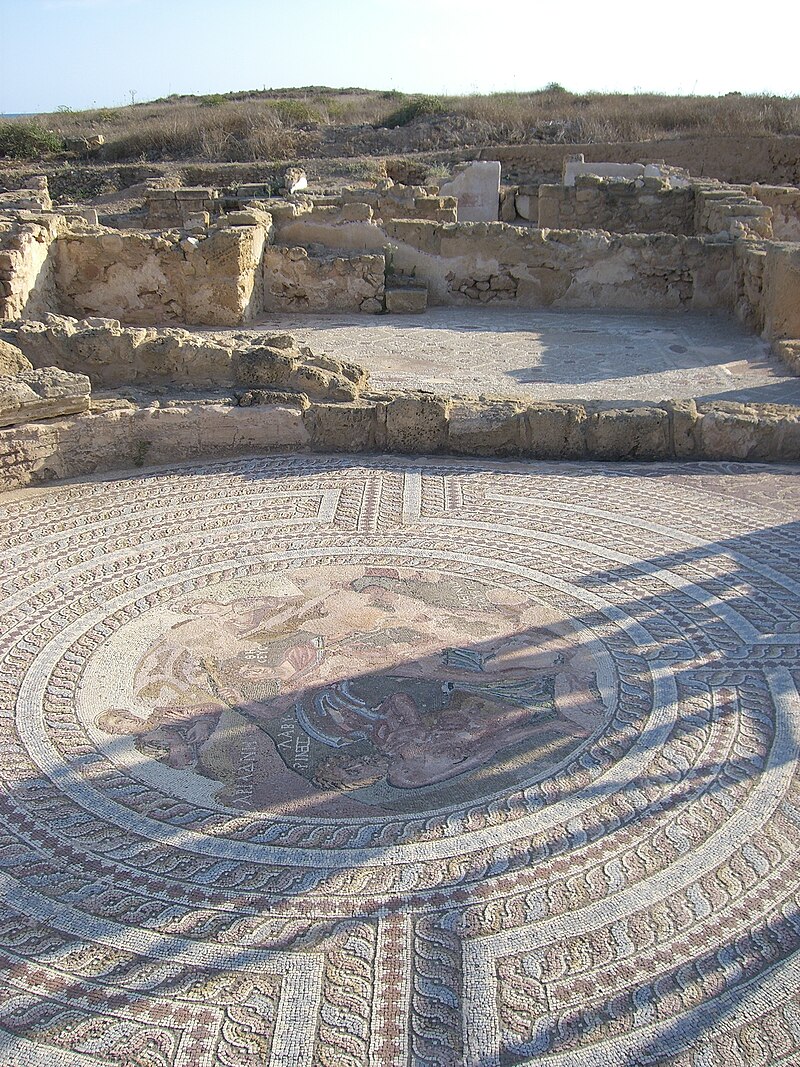
Our walking tour today follows a carefully designed path connecting five primary monumental highlights that illuminate ancient daily life and culture. We begin at the House of Dionysos, famous for its extraordinarily colorful mosaic floors depicting classical myths. Next, we visit the House of Aion, named after the deity of eternal time, which houses intricate narrative panels of unmatched artistic quality. We then proceed to the Villa of Theseus, the largest aristocratic residence and administrative complex in Paphos, featuring an expansive peristyle courtyard. Afterward, we explore the Odeon and Agora, the civic, cultural, and commercial heart of public life, before concluding at the Basilica of Panagia Limeniotissa, an Early Christian sanctuary located near the ancient harbor.
As you begin your walk, allow yourself to step back thousands of years into an extraordinary landscape where human history, monumental architecture, and mythical legends seamlessly intertwine across the Mediterranean shore.
02 Main Spot 1: House of Dionysos
The House of Dionysos is an extraordinary mosaic-paved villa that astonished the international archaeological community in 1962 when a local farmer accidentally discovered its buried pavement while ploughing his field. Buried beneath the soil for centuries, this sprawling ancient residence revealed remarkably well-preserved floor mosaics covering an impressive area of approximately 556 square meters, establishing itself as one of the finest artistic treasures of the Roman Mediterranean. …
03 Main Spot 2: House of Aion
The House of Aion is an extraordinary 4th-century Roman aristocratic residence named after Aion, the ancient Greek deity representing eternal time and eternity. Uncovered by archaeologists in 1983, the residence immediately captured global attention due to its remarkable preservation of five dramatic, highly sophisticated narrative mosaic panels embedded within the floor of its primary reception hall, known as the triclinium. …
04 Main Spot 3: Villa of Theseus
The Villa of Theseus is an exceptionally vast archaeological complex, standing as the largest aristocratic residence and administrative seat ever uncovered in Paphos. Spanning an astonishing 120 meters in length and 80 meters in width, the compound features an immense central peristyle courtyard measuring approximately 56 meters across. …
05 Main Spot 4: Odeon and Agora
The Odeon and Agora complex formed the beating civic, economic, and cultural heart of ancient Nea Paphos. Built during the 2nd century AD using finely dressed local limestone blocks, the semicircular Odeon was designed to accommodate approximately 1,200 spectators for musical recitals, poetic competitions, theatrical performances, and civic assembly meetings. …
06 Main Spot 5: Basilica of Panagia Limeniotissa
The Basilica of Panagia Limeniotissa is a monumental Early Christian sanctuary constructed in the early 5th century AD during the Byzantine era, standing directly beside the bustling ancient harbor. Its Greek title, 'Limeniotissa,' translates to 'Our Lady of the Harbor,' indicating its sacred role as a spiritual sanctuary and protective haven for sailors, merchants, and maritime travelers navigating the eastern Mediterranean trade routes. …
07 Closing
We extend our warmest gratitude to you for joining us on this journey through the extraordinary history, grand architecture, and classical mythology of Paphos Archaeological Park. From the vibrant mosaic floors of noble Roman villas to the bustling civic forum of the Agora and the sacred harborside basilica, the historic soil beneath your feet has carried the living memory of Mediterranean civilization for thousands of years. …