 Photo Wikimedia Commons
Contents
History & cultureBY TELLBY7 sections · numbered as on the map01 Orientation
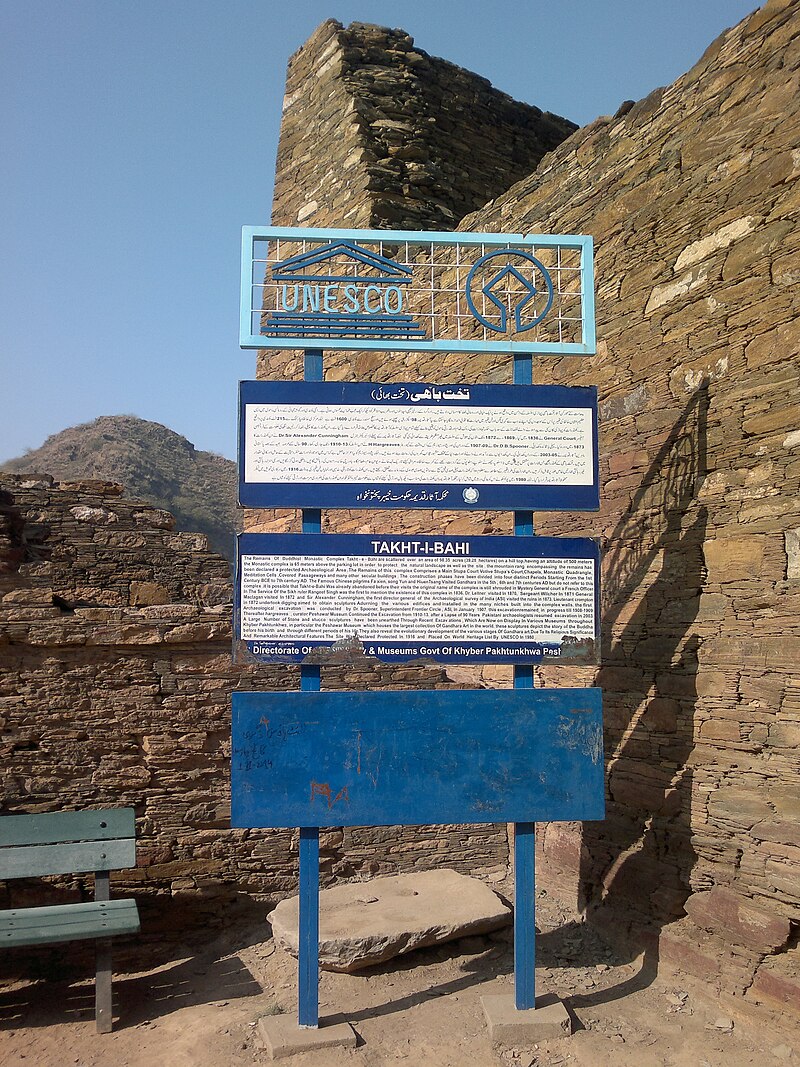
Welcome to Takht-i-Bahi. The sacred heritage site where you are standing is an ancient Buddhist monastic complex positioned upon the rugged mountain ridges of the Mardan District in the northern Peshawar basin of Pakistan. Dramatically situated across three connected spurs of the Takht-i-Bahi hill, with elevations ranging from thirty-six point six meters to one hundred fifty-two point four meters above the valley floor, this imposing complex covers an area of approximately thirty-three hectares. Founded in the early first century Common Era, the monastery benefited immensely from its elevated crest position. This high altitude served as a formidable natural barrier against successive foreign invasions over the centuries, allowing its architectural structures to escape widespread destruction and remain exceptionally well preserved to this day. To maximize the usable space along the steep mountain contours, ancient Gandharan master builders skillfully cut into the bedrock and erected thick retaining walls and vaulted masonry arcades to form level terraces for their sacred structures. Recognizing its unique value as the most complete surviving example of Buddhist monastic architecture in the Gandhara region, reflecting the continuous development of monastic communities from the first century through the seventh century, UNESCO inscribed the site on the World Heritage List in nineteen eighty under cultural criterion four.
Looking at the overall spatial organization of the complex, the monastic buildings are arranged along the natural contours of the hill. The sacred center encompasses multiple stupa courts, a central monastic quadrangle, an assembly hall, underground meditation vaults, and various image shrines. Approximately five kilometers away in the fertile plain lies the second component of this World Heritage property, the ancient fortified town of Sahr-i-Bahlol. Set upon an elongated mound up to nine meters high and covering nine point seven hectares, Sahr-i-Bahlol represents a small Kushan period urban center surrounded by protective defensive walls, illustrating the close economic and spiritual relationship between the mountain monastery and the nearby town. The name Takht-i-Bahi carries several intriguing etymological meanings in local tradition. In Persian, Takht means top or throne, while Bahi refers to a spring or water, together translating to spring from the top or high spring, referencing two natural springs situated at the mountain summit. Other interpretations translate the name as throne of origins, or derive it from Arabic concepts signifying a grand castle that has become empty and abandoned following the departure of a king.
Visitors approach this hilltop sanctuary from the north along a winding pathway provided with stone steps that ascend southward before turning westward to enter the sacred precincts. Alternatively, an eastern approach ascends through a dry water channel along the hillock before leading through a covered staircase. As you ascend these ancient stones, you tread the exact same routes taken by ancient monks and pilgrims over two thousand years ago. Let us now begin our exploration by proceeding into the Court of Many Stupas, where dozens of delicate votive monuments await our discovery.
02 The Court of Many Stupas
It is a truly surprising revelation that this dense collection of dozens of small votive stupas was not erected at a single moment during the monastery's founding, but was gradually assembled over several centuries as individual donations from pilgrims and monks seeking spiritual merit.
Look at the low square stone plinths and neatly arranged masonry bases extending side by side across the courtyard floor. …
03 The Main Stupa Court
It is a truly astonishing fact that at the center of this high court once towered a colossal main stupa, surrounded on three sides by high alcove walls containing dozens of life-sized and oversized statues of the Buddha and Bodhisattvas that created a breathtaking spectacle for ancient worshippers.
Look at the massive square stone plinth standing in the center of the court, and look up at the high alcove walls that enclose three sides of the courtyard. …
04 The Monastic Quadrangle and Meditation Cells
It is a truly remarkable fact that this two-story quadrangular structure was not only the primary living quarters for residing monks, but also represented the absolute pinnacle of ancient Buddhist architectural engineering, equipped with sophisticated natural ventilation systems, optimized sunlight exposure, and highly efficient drainage infrastructure. …
05 The Assembly Hall
It is a truly astonishing fact that this vast open space represents the largest single enclosed structure within the entire Takht-i-Bahi complex, functioning as a grand assembly hall where hundreds of monks gathered simultaneously to recite monastic vows, resolve community matters, and engage in rigorous theological debates.
Look at the wide, open rectangular floor and observe the thick stone wall boundaries that define the perimeter of this majestic space. …
06 The Underground Meditation Cells
It is a truly surprising discovery that this low, dark vaulted underground complex was engineered specifically to insulate practicing monks from extreme temperature fluctuations while completely blocking out all ambient sunlight, creating a specialized environment tailored for advanced Tantric meditation.
Stoop down to examine the low arched entrances and the covered stepped passageways that descend into these subterranean chambers. …
07 Closing
Standing here on the high mountain terrace of Takht-i-Bahi, take a moment to gaze out over the sweeping vistas of the Peshawar basin and the Mardan plain spreading far below. Resting upon the mountain crest for over two thousand years, this ancient Buddhist monastery has silently weathered the passage of centuries and the storms of history, preserving the sublime spiritual heritage of Gandhara for modern humanity. …