 Photo Wikimedia Commons
Contents
History & cultureBY TELLBY8 sections · numbered as on the map01 Orientation
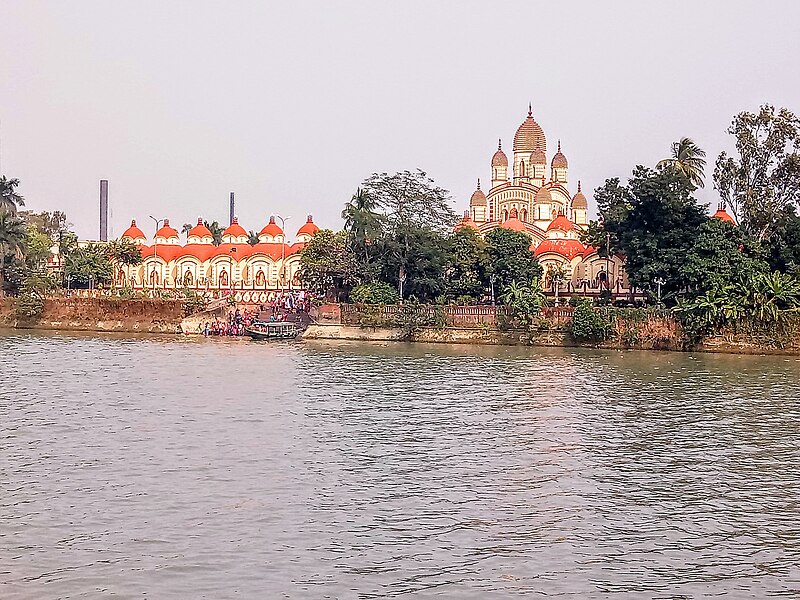
A very warm welcome to the Dakshineswar Kali Temple, serene and magnificent, located on the eastern bank of the sacred Hooghly River in the northern part of Kolkata, West Bengal, India. As you step through the grand main entrance known as the Lion Gate, or Singha Dwar, you are entering not merely a historic architectural marvel, but a sacred sanctuary brimming with India's rich spiritual heritage. Completed and consecrated in May 1855, this temple complex stands as an enduring monument to profound devotion and selfless philanthropy. The remarkable history of this temple centers around Rani Rashmoni, an extraordinary woman and zamindar from the Janbazar family. Following the passing of her husband, Rani Rashmoni managed her vast estates with exceptional wisdom and courage, funding public works, constructing river ghats, and boldly standing up against British colonial authorities to protect local fishermen and livelihoods. In the year 1847, Rani Rashmoni was preparing for a grand pilgrimage to the holy city of Kashi, also known as Varanasi or Benares. She had arranged twenty-four boats loaded with relatives, servants, and extensive supplies for the journey. However, on the night before her departure, the Divine Mother Goddess Kali appeared to her in a transformative dream vision. The Goddess instructed her that there was no need to travel all the way to Banaras, but rather to construct a beautiful temple on the banks of the sacred Ganges River, where the Divine Mother would manifest her presence in the idol and accept her worship. Deeply moved by this divine command, Rani Rashmoni immediately canceled the pilgrimage and searched for an ideal site along the riverbank. She purchased a large plot of land from an Englishman named Jake Hastie, a property then popularly known as Saheban Bagicha. A portion of this land was shaped naturally like the shell of a tortoise, which according to Tantra traditions made it an exceptionally auspicious ground for the worship of Shakti. Despite social hurdles and objections from some orthodox Brahmins owing to her Kaibarta caste background, Rani Rashmoni persevered with unwavering faith. The construction spanned eight years from 1847 to 1855, costing nine hundred thousand rupees and utilizing the skills of countless artisans. The temple was grandly consecrated on the auspicious day of Snana Yatra on May 31, 1855, with more than one hundred thousand Brahmins invited from across the country to share in the divine celebrations. Ramkumar Chhattopadhyay became the first head priest, accompanied by his younger brother Gadadhar, who would later become world-renowned as Sri Ramakrishna Paramahamsa, and his nephew Hriday. Take a moment to absorb the peaceful atmosphere near the Lion Gate, honoring the extraordinary devotion of Rani Rashmoni before stepping forward into the central courtyard.
02 Main Temple of Goddess Bhavatarini
As you step into the center of the spacious main courtyard, your eyes are immediately drawn to the majestic main temple, rising over thirty meters, or one hundred feet, into the sky. Facing south, this magnificent three-storeyed temple features nine elegant spires distributed across its upper two levels, serving as a quintessential example of the traditional Bengal Navaratna architectural style. …
03 Twelve Shiva Temples along the River
Moving toward the western side of the main Kali temple, positioned along the riverfront courtyard framing the central entrance to the bathing ghat, you will discover a grand procession of twelve identical Shiva temples. All twelve shrines are meticulously constructed facing east toward the temple courtyard, standing in a perfectly aligned row along the banks of the sacred Hooghly River. These temples are masterfully built in the traditional Bengal aat-chala architectural style. …
04 Radha-Krishna Temple Radhakanta Jiu
Located in the northeastern section of the temple courtyard stands the elegant Radha-Krishna Temple, also known as the Radhakanta Jiu Temple, dedicated to Lord Vishnu and his divine incarnations. Within the Dakshineswar complex, this sacred shrine serves as a vital spiritual pillar representing Vaishnavism, harmoniously coexisting alongside Shaktism and Shaivism. …
05 Sri Ramakrishna's Room
Stepping into the northwest corner of the main courtyard brings you to a modest room with a charming semicircular verandah directly overlooking the tranquil waters of the Hooghly River. This sacred sanctuary is Sri Ramakrishna's Room, where the revered 19th-century saint lived for decades, welcoming seekers from all walks of life and imparting timeless spiritual wisdom. …
06 The Nahabat Music Tower and Holy Mother Shrine
Located northeast of the main complex, just beyond the row of Shiva temples, stands a small two-storey structure known as the Nahabat, or Music Tower. Originally designed as a traditional music tower where musicians played instruments during festivals and daily temple rituals, this modest building holds immortal spiritual significance. It is revered worldwide as the residence and holy shrine of Holy Mother Sarada Devi, the spiritual consort and wife of Sri Ramakrishna. …
07 Bathing Ghat and Panchavati Grove
Steps leading down toward the flowing Hooghly River bring you to the main Bathing Ghat, and just to the north lies the tranquil and sacred grove known as Panchavati. The Bathing Ghat serves as a vibrant point of connection between the temple complex and the holy river, where pilgrims gather from early morning to take sacred dips in the water, offering prayers for spiritual purification. …
08 Closing
You have now completed your audio guide tour of the Dakshineswar Kali Temple complex. On February 18, 1861, just one day before her passing on February 19, Rani Rashmoni accomplished her final noble act by transferring her Dinajpur estate to the temple trust, ensuring the permanent maintenance and preservation of this sacred sanctuary. What began as one woman's visionary devotion evolved into a world-renowned spiritual epicenter under the divine guidance of Sri Ramakrishna Paramahamsa. …