 Photo Wikimedia Commons
Contents
History & cultureBY TELLBY7 sections · numbered as on the map01 Orientation
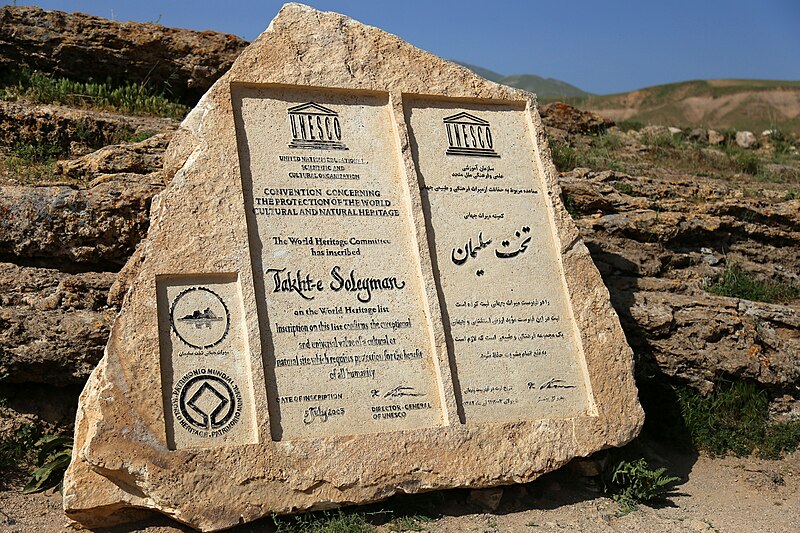
Welcome to Takht-e Soleyman, a sacred sanctuary steeped in the soul and profound historical breath of ancient Persia. This is a holy and mysterious realm where monarchs over thousands of years walked long distances to this volcanic hill to worship the sacred fire and build grand palaces around an enigmatic lake. It has been designated a UNESCO World Heritage site in recognition of its extraordinary value, where the rise and fall of civilizations are stacked in physical layers along the lakeshore. The reason this sanctuary was honored as world heritage is not merely because old stone structures survive here, but because for centuries, kings journeyed on foot to revere the holy flame, building temples and royal halls that made this plateau the spiritual heart of the Persian world. Today, we will gently explore these layers of time, tracing the remains of the supreme fire temple guarded by Sassanid kings and armies, through the subtle residential traces of Seljuk villagers, to the summer hunting palace ruins erected by Abaqa Khan of the Mongol Ilkhanid Empire. Our guided route begins at the massive North Gate, which served as the principal fortified portal to the sanctuary. After stepping through the North Gate, you will encounter the deep blue natural spring crater lake situated at the very center of the oval wall. Next, we will visit the Azargashnasab Fire Temple site that once stood grandly to the north of the lake, representing the highest tier of Zoroastrian sanctuaries. We will then proceed to the Ivan-e Khosrow, a giant vaulted brick arch located to the west, and move on to the summer hunting palace site of Abaqa Khan, constructed directly upon the ancient temple ruins. As you walk through the sanctuary, please refrain from climbing the stone walls or touching the historic masonry to ensure the preservation of these fragile architectural remains. We invite you to experience the profound inspiration and weight of history crafted by fire, wind, and water across millenniums. Let us now walk toward our first stop at the North Gate to begin our journey.
02 Section 1
You are currently standing directly before the imposing North Gate, which served as the principal entrance to the sacred sanctuary of Takht-e Soleyman. Remarkably, whenever a new monarch of the ancient Sassanid Empire was crowned in the imperial capital city of Madain, he was bound by tradition to undertake a grueling pilgrimage across hundreds of kilometers to this high mountain sanctuary entirely on foot or even barefoot. …
03 Section 2
Look upon the serene deep blue lake stretching out directly before you. This is a extraordinary natural spring crater lake whose water levels never recede regardless of severe droughts or heavy water extraction, possessing an enigmatic depth that has baffled observers for millenniums. Observe the quiet surface of the water gently. …
04 Section 3
This is the central altar platform of the Azargashnasab Fire Temple, revered above all other sanctuaries by the monarchs and military commanders of the Sassanid Dynasty. For centuries, the supreme grade Bahram fire burned here continuously with radiant flames, producing no ash and never allowed to go out. The Bahram fire represented the divine martial protector of the state, and high priests gathered consecrated embers from across the nation to enthrone them upon this sanctuary altar. …
05 Section 4
You are now standing before the Ivan-e Khosrow, a grand reception hall constructed to display imperial authority and monarchical prestige. This structure represented a true engineering miracle of late antiquity, featuring a massive brick vault soaring high into the air without a single supporting central pillar. Focus your eyes on the towering brick wall section and arch springer remaining on the right side. …
06 Section 5
This is the site of the Abaqa Khan Palace, constructed by the Mongol Ilkhanid Dynasty long after the Sassanid fire temple had fallen into ruin. In the late thirteenth century, roughly seven hundred years after the sacred Zoroastrian sanctuary was destroyed, Abaqa Khan of the Ilkhanid Empire was captivated by the stunning landscape and built his summer hunting palace directly over the ancient ruins. …
07 Closing
All guided visits at Takht-e Soleyman have now come to a close. Today, you have journeyed through thousands of years of stacked history, exploring the sacred grounds where the Sassanid Bahram fire once burned, the peaceful Zoroastrian village that protected the flame, the subsequent Seljuk settlement layer, and the grand summer hunting palace erected by Abaqa Khan of the Mongol Ilkhanid Empire. …