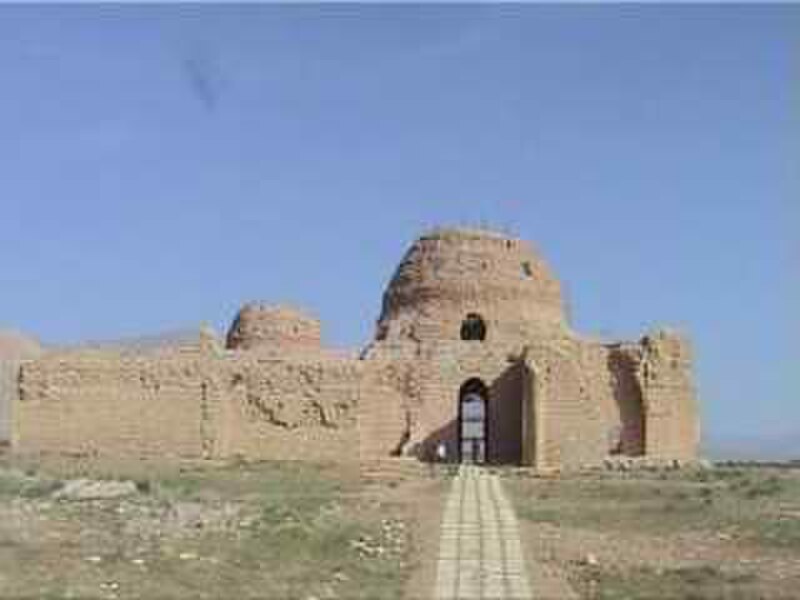
 Photo Wikimedia Commons
Contents
History & cultureBY TELLBY7 sections · numbered as on the map01 Orientation
Welcome to the magnificent Sarvestan Palace, an extraordinary architectural masterpiece preserved within Fars Province that stands as a monumental testament to the ingenious spirit and deep cultural heritage of the Sassanid Empire. Designated as a key component of the Sassanid Archaeological Landscape of Fars Region on the UNESCO World Heritage list, this historical complex embodies the artistic brilliance, sovereign authority, and sophisticated engineering of an ancient civilization that once shaped the history of the Near East. Before you step across the ancient threshold and enter the structural core of this site, take a moment to pause and absorb the timeless atmosphere of the surrounding landscape. You are standing upon earth that has maintained its quiet dignity through centuries of shifting sands, extreme temperature fluctuations, and the unyielding passage of historical eras. The Sassanid period represents one of the most remarkable golden ages of Persian architecture, characterized by ambitious spatial forms, grand vaulted domes, and an unparalleled mastery of natural building techniques. What sets the Sarvestan Palace apart from conventional ancient monuments is its total reliance on locally available soil and organic earthen materials to erect an imperial residence that naturally harmonizes with its harsh desert surroundings. Ancient Persian builders possessed a profound understanding of ecological conditions, configuring this complex to capture light, control airflow, and insulate living spaces without sacrificing structural elegance. Today, you will embark on an immersive journey through a monumental ruin where structural innovation and environmental intelligence exist in flawless equilibrium. As you prepare to explore, clear your thoughts and attune your senses to the ancient craftsmanship that transformed humble mud into an enduring architectural icon. Our audio tour will guide you systematically through the core structural highlights of this extraordinary palace complex. We will begin at the main archway and approach, where massive mud brick arches set the architectural tone for the entire site. From there, we will enter the soaring central domed hall to marvel at a vast interior volume constructed entirely without central supporting columns. Next, we will walk along the sweeping open iwans and shaded connecting corridors designed to harvest natural desert breezes for passive cooling. We will then transition into the secluded inner courtyard, where the thermal mass of thick earthen walls creates a balanced microclimate. Finally, we will step outside to inspect the foundation engineering of the outer walls while looking out over the desert horizon to reflect upon the enduring lessons of ancient Persian eco-architecture. Please take a slow step forward toward the earthen approach as we begin our journey into history.
02 Main Archway & Approach
Let us begin our exploration with an astonishing historical revelation that reshapes our understanding of global architectural history. Built in the fifth century AD under the direct royal command of King Bahram the Fifth, one of the most legendary monarchs of the Sassanid Empire, this palace served as a foundational structural prototype and inspiration for European Gothic architecture centuries later. …
03 Central Domed Hall
Welcome to the Central Domed Hall, the soaring ceremonial heart of the Sarvestan Palace. Let us begin with an astonishing engineering revelation that highlights the supreme technical intellect of the Sassanid builders. The creation of this vast, completely uninterrupted interior hall without a single internal supporting column, relying entirely on the precise distribution of mud brick deadweight, represents one of the most remarkable structural triumphs of the ancient world. …
04 Large Iwan and Corridors
Welcome to the Large Iwan and Corridors, a pivotal transitional zone where architectural geometry, light, and natural airflow converge. Let us open with a fascinating structural revelation regarding this unique space. The vaulted iwan configuration, defined by three solid surrounding masonry walls and one entirely open side facing the exterior landscape, creates a high-efficiency passive wind tunnel that naturally captures, accelerates, and circulates ambient breezes throughout the complex. …
05 Internal Courtyard & Thermal Mass
Welcome to the Internal Courtyard, a serene open-air sanctuary where Sassanid thermodynamic intelligence is fully revealed. Let us begin with an astonishing scientific truth regarding this quiet central space. Without electricity, modern air conditioning, or artificial heating equipment, the high thermal mass performance of the palace's thick mud brick walls naturally self-regulates internal temperatures, enabling the complex to effortlessly buffer both blistering daytime desert heat and…
06 Outer Walls & Desert Landscape View
Welcome to the Outer Walls and Desert Landscape Viewpoint, where the monumental architecture meets the expansive horizon. Let us start with an astonishing truth regarding the miraculous structural survival of this historic site. Standing resilient against centuries of exposure to severe desert sandstorms, thermal shock, and environmental weathering, the Sarvestan Palace stands today as an undefeated testament to the structural durability of natural earth construction. …
07 Closing
As our audio tour of the Sarvestan Palace comes to a close, we reflect on the remarkable journey we have taken together through one of the ancient world's most extraordinary architectural achievements. Moving from the monumental entrance archway into the column-free grandeur of the central domed hall, and passing through the breezy iwans into the thermally self-regulating inner courtyard, we have witnessed how fifth-century Sassanid master builders achieved an unprecedented synthesis of…