 Photo Wikimedia Commons
Contents
History & cultureBY TELLBY7 sections · numbered as on the map01 Orientation
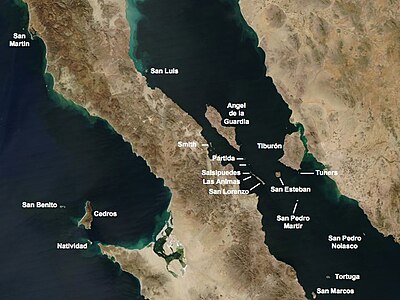
Welcome to San Pedro Mártir Island, an extraordinary volcanic sanctuary located in the deep waters of the central Gulf of California. Designated as a UNESCO Natural World Heritage site in two thousand five, this pristine island represents one of Mexico's most untouched oceanic ecosystems, serving as a vital breeding habitat for vast seabird colonies. As you gaze across the landscape, you see a dramatic ocean dome rising steeply from deep blue waters to a height of three hundred meters. Covering approximately two point six seven square kilometers, the island is enveloped by towering, precipitous sea cliffs that create a formidable natural barrier between the harsh sea and the fragile desert life above. Because this volcanic dome has never been connected to any continental landmass throughout its geological history, every species that established itself here endured remarkable journeying across open water or through wind currents. As you stand near the approach, you can feel the vast oceanic isolation that defines this place, lying roughly fifty kilometers distant from both the Sonora mainland and the Baja California Peninsula. The climate here is extraordinarily arid, with intense summer heat dominating most of the year. Yet during the cooler seasons, early morning ocean fog routinely rolls over the upper volcanic dome, drenching the vegetation in life-giving dew. With no freshwater streams or springs on the island, the resident wildlife and plant species have adapted to survive under rigorous ecological constraints, where massive concentrations of nitrogen and phosphorus from bird guano profoundly shape the soil conditions. This depauperate ecosystem supports only twenty-four species of vascular plants, making every organism a key component of a tightly knit biological web. Over the course of this immersive audio guide, we will journey from the historical southern landing area up through the mid-elevation cliffs, traverse the dense cactus forests on the central slopes, explore the summit plateau, and examine the remarkable conservation victories that restored this sanctuary to its natural glory. Please take a moment to absorb the vastness of the surrounding sea, listen to the endless calls of nesting marine birds, and prepare to discover one of the planet's most fascinating evolutionary laboratories.
02 Southeast Landing and the Stone Huts of Guano Miners
It may surprise you to learn that this completely uninhabited and barren volcanic rock once supported a bustling human community of over one hundred laborers in the late nineteenth century. Look down toward the shoreline near the southeast landing, where you can see the crumbling, dry stone wall shelters built directly against the whitewashed rock faces. …
03 Mid-Elevation Cliffs and the Resilient Cliff Figs
As we reach the mid-elevation sea cliffs, prepare to discover an extraordinary botanical marvel that defies expectation. Remarkably, the plant with the largest leaves in the entire Sonoran Desert grows directly out of bare, vertical sea cliffs bathed in continuous ocean salt spray. Look toward the steep rock walls, where you can spot the broad, vibrant green foliage of the cliff fig tree, known scientifically as Ficus palmeri. …
04 The Dense Forest of Trunkless Dwarf Cardón Cacti
Step onto the gentle slopes of the central plateau, where you are now entering one of the most astonishing botanical formations on the planet. Revealing a staggering biological reality, San Pedro Mártir Island harbors the highest population density of cardón cacti found anywhere on Earth, with an estimated density of precisely two thousand six hundred and ninety-seven individuals per hectare. …
05 Summit Plateau and the Seasonal Green Carpet
Welcome to the high summit plateau, resting nearly three hundred meters above the surrounding sea. Despite the intense desert aridity that characterizes this region, early morning oceanic fog routinely envelopes this summit during cooler months, drenching the entire island plateau in life-giving dew. Direct your gaze down toward the rocky ground, where you will see a dense, intertwining blanket of vegetation covering the soil and wrapping around the bases of the cacti. …
06 High Plateau and the Restored Island Ecosystem
You are now standing at the high plateau monitoring station, a site of monumental importance in global island conservation history. Remarkably, this remote mesa was the location of a groundbreaking ecological restoration effort that achieved the first successful aerial helicopter rodent eradication project in all of Latin America. …
07 Closing
As our journey across San Pedro Mártir Island comes to an end, we invite you to reflect on the extraordinary natural legacy of this isolated volcanic dome. From its dramatic sea cliffs and historic guano miner ruins to its unique trunkless cardón forest and restored seabird colonies, this island stands as a triumphant example of ecological isolation and scientific conservation. …