 Photo Wikimedia Commons
Contents
History & cultureBY TELLBY7 sections · numbered as on the map01 Orientation
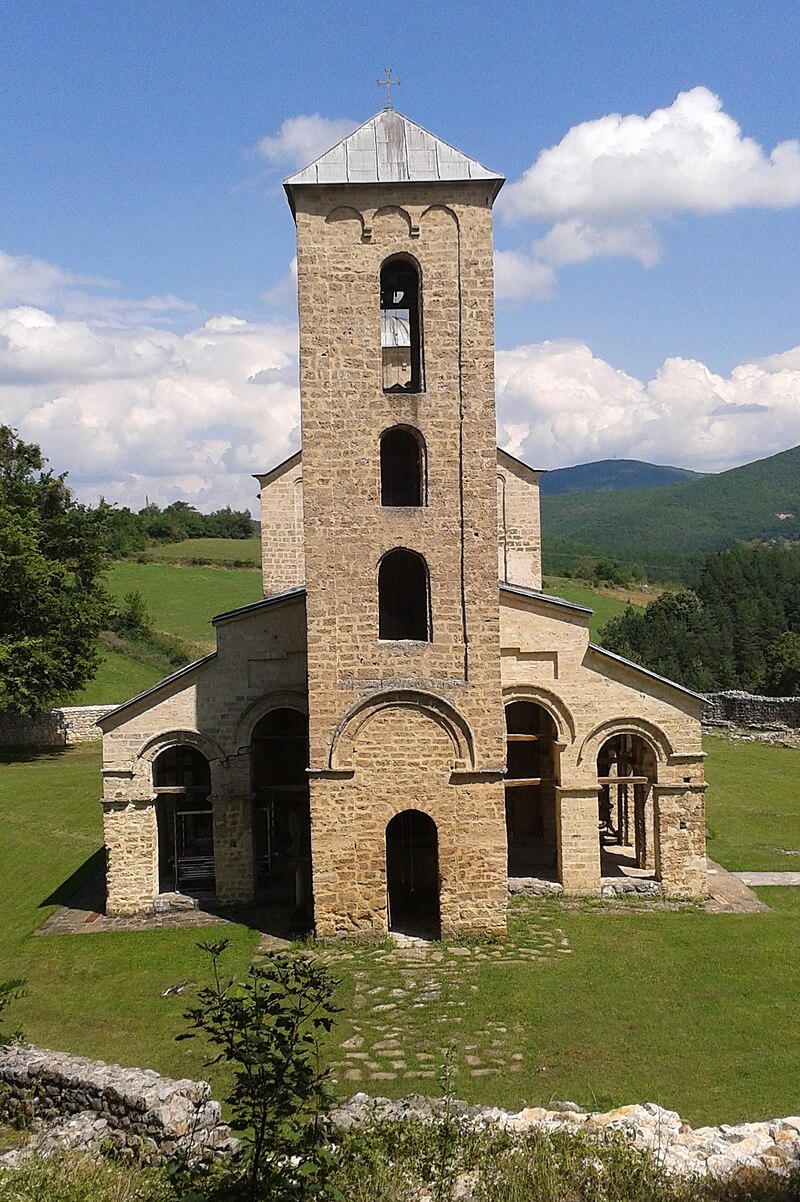
Welcome to the sacred precincts of Sopocani Monastery, an enduring monument of medieval Serbian spirituality, artistic genius, and historic resilience. Nestled peacefully in the scenic mountainous landscape of the Raska region in southern Serbia, fifteen kilometers west of the historic city of Novi Pazar, this revered sanctuary stands near the pristine headwaters where the Raska and Sebecevo rivers converge. This serene valley formed the geographic, political, and spiritual heart of the ancient Serbian state of Ras, anchored by the nearby hilltop fortress of Gradina and the lower merchant settlement of Trgoviste. The monastery was founded between 1259 and 1270 by King Stefan Uros I, a prominent monarch of the illustrious Nemanjic dynasty, who envisioned this sacred complex as a grand funerary mausoleum and devotional resting place for himself and his royal family. Sopocani represents a sublime artistic synthesis where Western European Romanesque stonecutting mastery seamlessly blends with the monumental spatial harmonies and rich iconographic traditions of the Byzantine world. Recognizing its extraordinary contribution to Eastern Orthodox culture and world civilization, UNESCO inscribed Sopocani Monastery onto the World Heritage List in 1979 as an integral component of the serial property known as Stari Ras and Sopocani. As you step into this tranquil sanctuary, you are walking through a landscape shaped by kings, master painters, and centuries of monastic devotion. The monastery complex originally encompassed an expansive enclosure protected by high stone boundary walls with two grand entry gates, housing monastic dormitories, refectories, workshops, and administrative quarters surrounding the central Church of the Holy Trinity. Although centuries of military conflicts and devastation reduced many surrounding outer structures to weathered stone foundations, the central church survived to preserve some of the most transcendent wall paintings ever created in medieval Europe. Our audio tour will lead you on a carefully measured journey through the history and sacred architecture of this monastic gem. We will begin at the outer enclosure and entrance gateway, examining the dramatic survival of the complex through long centuries of physical exposure and restoration. From there, we will move toward the exterior facade of the Church of the Holy Trinity to explore the structural innovations of the Raska architectural school and the historic marble quarrying techniques. We will then step into the narthex to discover the dynastic portraits and royal genealogy of King Stefan Uros I and his lineage. Moving further inside to the central nave, we will contemplate the world renowned masterwork of the Dormition of the Virgin, celebrated globally for its monumental grace and iridescent gold detailing. Finally, we will approach the sanctuary and altar area to observe the solemn procession of archbishops before concluding our visit in the serene monastery courtyard. Please take a moment to absorb the peaceful atmosphere before moving toward the outer stone gateway to begin our exploration.
02 The Gateway and Monastery Enclosure — Ruin and Survival
It is a truly astonishing historical reality that this majestic monastic sanctuary lay completely open to the sky and entirely abandoned for over two centuries after being set on fire and looted by Ottoman forces in 1689. Standing near the outer boundary gateway, direct your eyes across the open grounds to observe the weathered stone enclosure walls and foundation remnants that once protected a thriving medieval monastic settlement complete with living quarters and dining halls. …
03 The Church Exterior — The Mastery of Raška Architecture
It is a remarkably compelling fact that the elegant marble facades and sculpted architectural elements of this church were meticulously restored using high-grade stone extracted directly from the historic Studenica marble quarries, the very same ancient quarry sources that medieval Serbian masons utilized centuries ago. …
04 The Narthex — Dynastic Memory and Royal Portraits
It is a profoundly striking historical detail that master painters fleeing the fallen, Crusader-occupied imperial city of Constantinople found welcoming sanctuary at the royal court of King Stefan Uros I, where they created transcendent wall paintings that ignited a monumental renaissance in Balkan medieval art. Turning your gaze toward the side walls of this dimly lit narthex, look at the magnificent painted portraits of the Serbian royal family standing in solemn dignity. …
05 The Nave — The Masterpiece of the Dormition
It is an astonishing truth that under the lavish personal patronage of King Stefan Uros I, real gold leaf and gold sheet tesserae outlines were applied directly onto these wall frescoes, creating an iridescent halo effect that illuminates the entire nave with celestial light. Raise your eyes to the massive western wall above the exit portal to behold the world-renowned fresco depicting the Dormition of the Virgin, widely acclaimed by art historians as one of the greatest masterpieces of…
06 The Altar and Sanctuary — Procession of Archbishops and Sacred Revival
It is a truly extraordinary historical revelation that among the solemn procession of ancient Church Fathers painted inside the sanctuary stands an authentic contemporary portrait of Archbishop Sava II, who assumed spiritual leadership of the Serbian Orthodox Church in 1263. Direct your eyes toward the curved wall of the central apse at the eastern end of the church, where white-robed bishops and archbishops bow in reverent liturgical procession toward the altar. …
07 Closing
Standing here in the quiet courtyard of Sopocani Monastery, look up once more at the single dome and surrounding mountain contours. The history of this sacred sanctuary is a testament to the profound resilience of faith, art, and human devotion. Despite enduring catastrophic fires, the total loss of its protective roof, and long exposure to harsh mountain elements, the radiant frescoes inside the Church of the Holy Trinity continue to shine with extraordinary beauty. …