 Photo Wikimedia Commons
Contents
History & cultureBY TELLBY8 sections · numbered as on the map01 Orientation
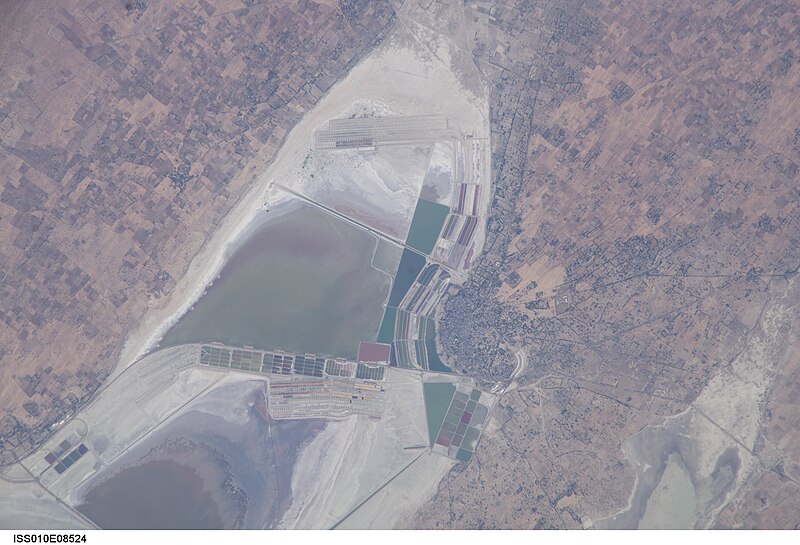
Welcome to one of the most remarkable and visually breathtaking landscapes in India. You are standing on the shore of Sambhar Salt Lake, the largest inland salt lake in the country and the expansive seasonal playa of the Thar Desert. Spanning across the three administrative districts of Jaipur, Ajmer, and Nagaur in Rajasthan, this unique saline wetland lies roughly sixty to eighty kilometers southwest of the Pink City of Jaipur, surrounding the historic Sambhar Lake Town. Geologically, a playa is a flat bottomed basin that transforms dramatically through the shifting seasons, filling with water after monsoon downpours and drying back into a blinding crust of salt under the blazing sun. The physical dimensions of Sambhar Lake are immense. It commands a vast catchment area of five thousand seven hundred square kilometers, receiving water from surrounding hills and streams. Depending on seasonal rainfall, its surface area expands and contracts between one hundred ninety and two hundred thirty square kilometers. The basin is elliptical in shape, extending over a maximum length of thirty five point five kilometers, while its width ranges between three and eleven kilometers along an elevation of three hundred sixty meters above sea level. The total circumference of the lake bed measures ninety six kilometers, framed on all sides by the ancient Aravali hills. Water depth fluctuates dramatically throughout the hydrological cycle, measuring as little as sixty centimeters during dry months and rising to nearly three meters at the end of the monsoon. What makes this water body unique is its extreme hypersalinity, which reaches levels three to four times higher than standard sea water. At sunrise and sunset, this wide expanse undergoes a magical transformation. As early morning or evening light reflects off the shallow water and salt crust, the landscape turns into a luminous silver sheet, while evaporation pans glow in shades of pink and orange. Visiting this delicate ecosystem requires careful preparation. Due to intense glare from the white salt bed, wearing quality sunglasses, sunscreen, and a protective hat is essential. Sturdy footwear that handles wet salt and mud is necessary. Never attempt to drive private vehicles onto the open lake bed, as soft mud beneath the dry crust can trap automobiles. Stay on firm ground and established paths, carry water, pack out all trash, and maintain a quiet presence to protect this fragile saline wetland environment.
02 Devyani Temple and Sacred Tank
Step gently into a sacred sanctuary where ancient Indian epic traditions, royal chronicles, and classical geography interweave seamlessly. Near the edge of Sambhar Lake Town stands the historic Devyani Temple and its ancient stone stepwell water tank, a site deeply embedded in the spiritual consciousness of traditional India. …
03 Shakambhari Mata Temple and the Divine Creation Legend
Travel roughly twenty kilometers across the remote, blinding salt flats from the main railway hub, and you will arrive at the solitary Shakambhari Mata Temple, anchored dramatically on the isolated southern edge of the lake bed. This ancient shrine is dedicated to Goddess Shakambhari, a powerful manifestation of Goddess Durga and the cherished tutelary deity of the Chauhan Rajputs. …
04 British Era Salt Railway and Industrial Legacy
As you gaze across the structured salt pans stretching near the eastern bank, you are looking at an industrial landscape shaped by centuries of imperial trade, colonial engineering, and administrative evolution. During the height of the Mughal Empire, salt harvesting at Sambhar Lake was managed directly under imperial control, supplying salt across northern India. …
05 Sandstone Dam and Salt Evaporation Ponds
Look closely at the sprawling stone divide that cuts directly across the lake bed between the historic settlements of Jhapok and Gudha. This extraordinary piece of traditional hydraulic engineering is a five point one kilometer long dam constructed entirely from solid local sandstone. The dam plays a pivotal role in regulating the natural hydrological balance and salt concentration of the entire Sambhar basin. …
06 Bird Watching Viewpoint and Ramsar Ecological Zone
Look out over the shimmering shallow waters, where thousands of elegant pink silhouettes move gracefully across the saline horizon. On March twenty third, nineteen ninety, Sambhar Salt Lake was officially designated as a Ramsar Site of international importance under reference number four hundred sixty four. This prestigious ecological status highlights its position as one of India's most critical wintering habitats and stopover feeding grounds along the Central Asian Flyway. …
07 Archaeological Discoveries and Film Heritage
Beyond its natural and industrial grandeur, Sambhar possesses a rich archaeological legacy and a celebrated position in contemporary Indian pop culture. Archaeological excavations conducted here in eighteen eighty four unearthed ancient sculptural art, terracotta structures, historic coins, seals, and a clay stupa, revealing deep Buddhist artistic influences. …
08 Closing
As our audio tour concludes, take a quiet moment to reflect upon the complex multi faceted identity of Sambhar Salt Lake. It is at once a mythic cradle recorded in ancient epics, an industrial lifeline supplying salt to a nation, an archaeological treasure trove, and a fragile ecological haven for migratory waterfowl. However, this magnificent saline wetland faces grave environmental challenges that threaten its very existence. …