Contents
History & cultureBY TELLBY7 sections · numbered as on the map01 Orientation
Welcome to Serjilla, one of the most astonishing and flawlessly preserved ancient settlements hidden within the vast limestone massif of northwestern Syria. Situated in the rugged Jebel Riha region, also known as Mount Al-Zawiyah, this ancient sanctuary lies approximately sixty-five kilometers north of Hama and eighty kilometers southwest of Aleppo, in close physical proximity to the neighboring archaeological site of Bara. Standing here at the entrance to the site, you are stepping onto ground that flourished between the first and seventh centuries, reaching its economic zenith under the radiant sunshine of the Byzantine Empire during the fifth and sixth centuries. At that time, this natural limestone basin echoed with the vibrant sounds of agricultural commerce and the rich fragrance of freshly pressed olive oil. Serjilla is celebrated on the UNESCO World Heritage list as an outstanding relict cultural landscape because it offers an exceptionally clear window into the gradual historical transition from the ancient pagan Mediterranean world of the Roman Empire to Byzantine Christianity within a rural village context. What makes Serjilla truly unique among ancient ruins across the Mediterranean basin is its astonishing state of structural completeness. The town was not destroyed by catastrophic military sieges or sudden cataclysmic earthquakes; rather, following shifting trade routes in the seventh century, its inhabitants gradually and peacefully evacuated the site, leaving their stone houses, civic buildings, and processing facilities intact. Because human occupation ceased for over a thousand years, and because later populations never dismantled the masonry for raw materials nor subjected the site to intrusive modern reconstructions, Serjilla remains frozen in time. As you gaze across these standing limestone facades, you can immediately appreciate why early European scholars famously hailed this silent ghost town as the Pompeii of the East. Our specialized audio guide tour today will lead you through a carefully planned physical itinerary through the heart of the settlement. We will begin at the luxurious Public Baths built in four hundred and seventy-three, which demonstrate the extraordinary wealth generated by this rural community. From there, we will visit the Andron, an imposing two-story meeting house where village elders gathered for civic discourse and social banquets. We will then explore a remarkably resilient two-story residential villa, followed by the industrial press-house that served as the economic engine of the regional olive trade. Finally, we will ascend the gentle eastern slope toward the Byzantine church and its surrounding monumental stone sarcophagi, concluding on the elevated ridge overlooking the entire urban panorama. Please walk carefully along these ancient stone pathways and let the carved limestone speak of a forgotten golden age.
02 The Public Baths: Luxury in the Limestone Hills
It is utterly astonishing to discover a fully intact Roman-style thermal bathhouse standing in the middle of these arid limestone hills where water was historically one of the most precious and scarce resources. Please turn your eyes directly toward the entrance of the complex, pointing your gaze at the massive ashlar masonry walls and the subfloor stone pillars of the hypocaust heating system resting beneath the main bathing chambers. …
03 The Andron: Meeting Place of the Elders
It is fascinating to realize that a modest agricultural village in late Antiquity possessed its own highly sophisticated civic assembly hall and community tavern, serving as the social and political nerve center for its inhabitants. Please look directly at the imposing stone columns standing before you, directing your vision up toward the elegant open two-story portico that defines the noble facade of the building. …
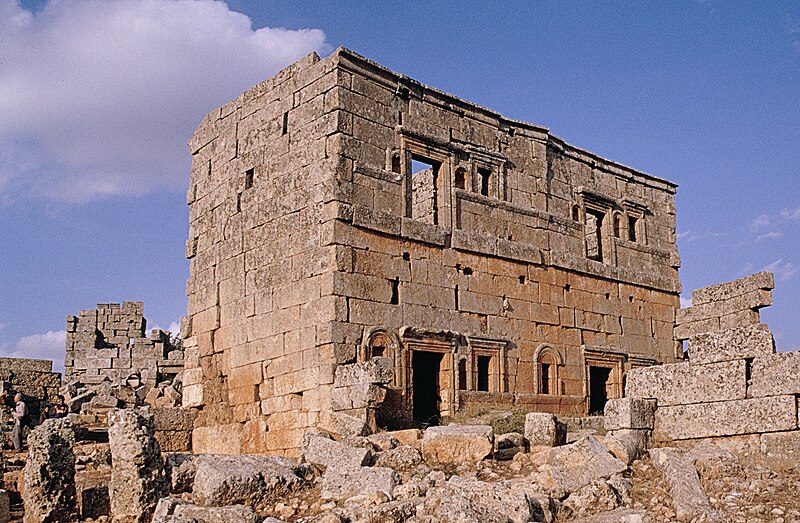
04 The Two-Story Villa: Masterpiece of Stone Masonry
It is a true structural marvel that a private domestic dwelling, constructed entirely out of local limestone blocks without a single piece of timber framing, has survived intact at its full two-story height for more than fifteen centuries. Please step closer to the ground floor entrance and look inside the room, directing your gaze at the massive load-bearing stone arch spanning the center of the interior space. …
05 The Press-House: Engine of Ancient Wealth
It is remarkable to realize that this quiet stone ruin was once a bustling regional industrial hub, processing and exporting massive quantities of high-grade olive oil and wine across the Mediterranean world. Please look down at the floor inside this facility, directing your visual attention toward the circular stone millstone grooves and the heavy counterweight supports embedded into the ground. …
06 The Church and Sarcophagi: Echoes of Early Faith
It is a profound historical revelation that the architectural layout of this modest rural church served as an essential structural prototype that directly influenced the evolution of Western European Gothic cathedrals. As architectural historian Diana Darke demonstrates in her landmark work Stealing from the Saracens, early Syrian church designs featuring twin-tower western facades and double-arched porticos—famously seen in fifth-century sites like Qalb Lozeh and Saint Simeon—were documented…
07 Closing
Standing on this elevated ridge, looking out across the complete panorama of Serjilla, one is struck by a deep sense of reflection on history, human endurance, and the passage of time. Why did this once-flourishing agricultural center transform into a silent ghost town during the seventh century? While many ancient cities met their demise through violent military sieges or cataclysmic earthquakes, Serjilla met a vastly different fate. …