 Photo Wikimedia Commons
Contents
History & cultureBY TELLBY7 sections · numbered as on the map01 Orientation
Welcome to the Island of Saint-Louis, an extraordinary living architectural monument resting gracefully at the mouth of the Senegal River in West Africa. In the year 2000, this historically rich urban landscape was officially inscribed on the UNESCO World Heritage list as an outstanding example of a colonial river island city. The site was celebrated for its remarkable orthogonal urban plan, its unified architectural heritage, and its extensive system of waterfront quays that border the riverbanks. As you step onto this famous island today, you are stepping into a profound crossroads of human history where African traditions and European interactions shaped centuries of commerce, culture, and governance.
Geographically, the Island of Saint-Louis is nestled inside a broad estuarine lagoon created by two distinct arms of the Senegal River. These flowing waters separate the narrow island from the sandy coastal barrier peninsula known as the Langue de Barbarie to the west, while bordering the continental mainland district of Sor to the east. The island itself stretches roughly 2500 meters from north to south and maintains an average width of about 350 meters. In its earliest era, before permanent settlement began, this low lying land stood completely uninhabited, serving as an atmospheric river island surrounded by dynamic water currents.
As trade expanded across the Atlantic network, European trading companies recognized the strategic value of this river location. Early merchants established trading operations that dealt in valuable regional commodities such as gum arabic, raw leather, ivory, gold, grains, and enslaved human beings. Over time, the island evolved from a fragile mercantile post into the dominant urban metropolis of the region. Saint-Louis proudly served as the official capital of Senegal from eighteen seventy two until nineteen fifty seven, and it simultaneously stood as the grand capital of French West Africa until nineteen hundred two. During this golden age, the city blossomed into the premier educational, intellectual, and artistic sanctuary of sub Saharan Africa.
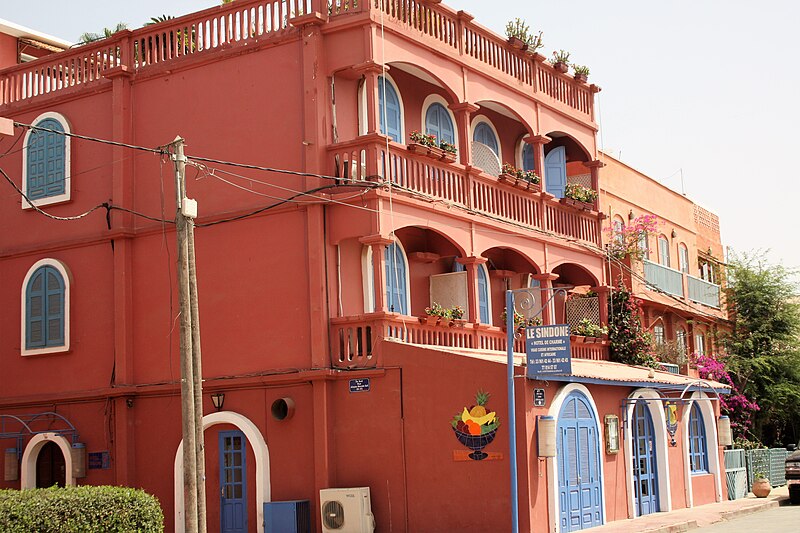
As you embark on our walking tour today, you will experience the enduring spirit of Saint-Louis firsthand. You will stroll along wide parallel avenues aligned north to south, crossed by short side streets designed in eighteen twenty eight to catch the fresh ocean breezes blowing off the river quays. Along these historic grid blocks, you will see elegant colonial townhouses adorned with carved wooden shutters and wrought iron balconies. We invite you to step forward and begin your journey through this historic river island.
02 Main Spot 1: Faidherbe Bridge
We begin our walking tour at the extraordinary Faidherbe Bridge, an engineering marvel that stretches across a total length of 506 meters over the Senegal River. Built toward the closing years of the nineteenth century, this monumental iron bridge serves as the vital lifeline connecting the historic island directly to the mainland district of Sor. …
03 Main Spot 2: Rognat Barracks
As you reach the primary central intersection of the island grid, you arrive at the imposing military complex known as Rognat Nord and Rognat Sud. Built in the year 1837, these twin classical military barracks were designed to frame the principal civic axis of colonial administration and public order. …
04 Main Spot 3: Baya Ndar Square & The Contested Monument
You are now standing in the center of Baya Ndar Square, the historic civic gathering place of Saint-Louis. In September of the year 2020, the local municipal government officially renamed this prominent public space to Place Baya Ndar, adopting the native Wolof name for Saint-Louis. For more than a century prior to this decision, the square had officially carried the name of Governor Louis Faidherbe. …
05 Main Spot 4: Governor's Palace & Ancient Fort
Standing directly before us is the magnificent Governor Palace, an iconic civic compound that marks the absolute historic foundation of European presence on the island. In the year 1659, a French sea captain named Louis Caullier chose this exact midpoint of the low lying island to construct a fortified trading post for the Cap-Vert Company, which had been established in sixteen thirty three. …
06 Main Spot 5: Saint-Louis Cathedral
Positioned immediately adjacent to the Governor Palace stands the historic Saint-Louis Cathedral, a sacred sanctuary completed in the year 1828. This classic structure holds a legendary distinction in regional architectural history, as it is officially recorded as the oldest existing church building constructed in the entire region of West Africa. Take a moment to look up at its balanced neoclassic façade facing the quiet street. …
07 Closing
As our walking tour concludes along the peaceful waterfront quays of the Senegal River, let us reflect on the extraordinary history and enduring cultural legacy of the Island of Saint-Louis. From its humble beginnings as an uninhabited river islet and a seventeenth century European trading post, this town grew into the vibrant intellectual, artistic, and civic heart of West Africa. …