 Photo Wikimedia Commons
Contents
History & cultureBY TELLBY7 sections · numbered as on the map01 Orientation
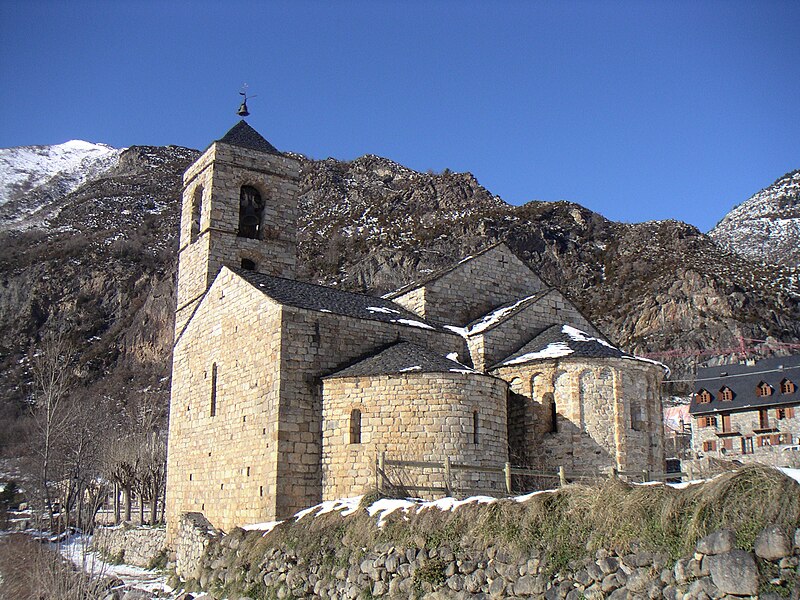
Welcome to the extraordinary Vall de Boí, a high Pyrenean mountain valley dramatically enclosed by steep, soaring peaks, lush slopes, and traditional alpine meadows. Located in the Alta Ribagorça district in the northeastern Iberian Peninsula, this narrow valley presents an intact cultural landscape defined by mountain slopes, traditional stone-walled fields, and high seasonal grazing pastures that have sustained rural communities for centuries. Within this breathtaking setting, eleven century and twelve century Romanesque churches stand in remarkable harmony with their natural surroundings. In inscribing this ensemble as a UNESCO World Heritage site, global experts recognized these buildings as exceptionally pure and consistent examples of Lombard Romanesque architecture and pictorial art. They vividly illustrate how a profound cultural movement successfully crossed a formidable mountain barrier to establish itself with extraordinary technical and artistic excellence across alpine territories. Built under the feudal patronage of the Lords of Erill, these rural churches played a pivotal role in defining Catalan cultural identity, embodying both local faith and an international medieval exchange. Today, we invite you on a memorable walking journey through five signature architectural gems along this mountain valley. We will begin our exploration at Sant Feliu de Barruera, resting peacefully amidst green pasture fields. From there, we will ascend along the winding mountain paths to La Nativitat de Durro, perched high above sea level to overlook the entire sweeping basin. Crossing back down to the valley floor, we will admire Santa Eulàlia d'Erill la Vall with its soaring six-story bell tower and elegant exterior portico. We will then proceed across the mountain stream to Sant Joan de Boí, one of the valley's oldest structural centers housing vibrant mythological art traditions, before culminating at Sant Climent de Taüll, celebrated worldwide as the ultimate symbol of Catalan Romanesque art and spiritual architecture. Step forward with us into a landscape where medieval spirit, human craftsmanship, and alpine tranquility remain forever entwined. As you walk along these ancient stone paths between the villages, allow your senses to absorb the crisp Pyrenean air, the gentle rustle of mountain breezes, and the subtle interplay of light across aged granite and slate. The unique geography of this valley served not as an isolating wall, but as an elevated stage where stone masons, painters, and woodcarvers produced art of astonishing clarity and emotional resonance. Each sanctuary along our route offers a distinct portal into the medieval world, reflecting both the humble daily devotion of mountain villagers and the grand stylistic ambitions of feudal patrons. Take your time at each stop to appreciate how every arch, apse, and bell tower was meticulously designed to harmonize with the surrounding slopes and fields.
02 Spot 1 - Sant Feliu de Barruera
Welcome to Sant Feliu de Barruera. What strikes visitors most when approaching this historic church is its solitary, tranquil placement amidst open green pastures rather than dense village streets. While many medieval places of worship across the European continent were embedded within tightly packed urban centers, Sant Feliu stands peacefully surrounded by fields, retaining its ancient rural spirit and unhurried rustic character completely intact. …
03 Spot 2 - La Nativitat de Durro
Welcome to La Nativitat de Durro. The most dramatic surprise for travelers arriving at this site is the church's extraordinary location, perched within a mountain village sitting at an altitude of exactly one thousand three hundred and eighty-six meters above sea level. From this soaring vantage point, Durro overlooks the sweeping expanse of the valley floor, positioning the church as a formidable spiritual beacon and watchtower visible across the entire Pyrenean landscape. …
04 Spot 3 - Santa Eulàlia d'Erill la Vall
Welcome to Santa Eulàlia d'Erill la Vall. The most striking architectural surprise of this church is its soaring six-story Lombard bell tower, reaching a extraordinary height of twenty-three meters. This remarkably slender tower served not only a sacred religious purpose, calling villagers to prayer across the valley, but also functioned as a strategic watchtower, offering unobstructed sightlines across the basin to communicate with neighboring mountain settlements. …
05 Spot 4 - Sant Joan de Boí
Welcome to Sant Joan de Boí. A remarkable revelation of this church is that it represents one of the oldest structural centers in the entire valley. Originating around eleven hundred, its early architectural features connect stylistically to specialized masonry techniques from Aquitaine, proving how medieval artistic currents moved fluidly across high mountain passes. Direct your attention to the south facade where the Lombard bell tower stands attached to the lateral nave. …
06 Spot 5 - Sant Climent de Taüll
Welcome to Sant Climent de Taüll. Consecrated on December tenth, eleven twenty-three by the bishop of Roda, this magnificent basilica stands recognized worldwide as the ultimate symbol of Catalan Romanesque architecture. It represents the largest, best preserved, and most architecturally complete monument in the entire Vall de Boí. Look up at the exterior to admire the soaring, freestanding six-story Lombard bell tower that stands proudly alongside the main body of the church. …
07 Closing
Thank you for joining us on this audio tour of the Catalan Romanesque Churches of the Vall de Boí. As our exploration comes to a close, we reflect on an extraordinary cultural landscape where medieval masterworks, community devotion, and pristine Pyrenean nature exist in unbroken harmony. The preservation of these sanctuaries represents a remarkable triumph of early heritage conservation. …