Contents
History & cultureBY TELLBY7 sections · numbered as on the map01 Orientation
Welcome to the Ḥimā Cultural Area and Minshaf, an immense open-air library and museum located in the arid, mountainous desert of southwest Saudi Arabia. Spanning a period of seven thousand years, this extraordinary landscape preserves a continuous record of human life, spiritual beliefs, and the historical evolution of writing. Positioned along one of the oldest known desert caravan routes in the Arabian Peninsula, this site served as a vital crossroads for transcontinental trade and travel. For thousands of years, merchant caravans, marching armies, and nomadic pastoralists halted here, leaving behind an exceptional wealth of rock art and inscriptions carved into the red sandstone cliffs and massive boulders. Covering three hundred to four hundred generations, these surviving cultural expressions chronicle how human societies adapted to a volatile environment marked by climate fluctuations and gradual desertification. Inscribed on the World Heritage List, the nominated property encompasses six primary serial component sites representing the highest density and most significant concentrations of rock art, complemented by five hundred and forty-five additional inventoried sites distributed across the wider buffer zone containing tens of thousands of petroglyphs. Our audio guide tour takes you through these six primary component sites to discover this remarkable heritage. We begin our journey at Minshaf, where intricately decorated Neolithic bovid carvings reveal the vibrant lives of ancient herders. From there, we move east to Dhibāh to examine the puzzling depictions of elephants in a desert where they never naturally existed. Next, we explore ʿĀn Jamal, an ancient toll station and rock library densely covered with hundreds of petroglyphs and inscriptions written in various scripts including Musnad, Aramaic-Nabatean, Thamudic, Greek, and early Arabic. We then proceed to the legendary ancient wells of Bi’r Ḥimā, which have provided fresh water to desert travelers for at least three thousand years, before concluding at Najd Khayrān to observe polished rock slides and evocative panels depicting interactions between humans and animals. As you walk along the trail, look closely at the cliff faces and sandstone blocks surrounding you. Beyond the petroglyphs, the landscape is rich in unexcavated surface archaeological resources, including dry-laid stone tombs, cairns, stone arrangements, and scattered stone tools dating back to the Lower Palaeolithic Acheulian period. These pristine remnants offer a profound lesson in human resilience and cultural continuity. Please follow the guided path, step carefully, and immerse yourself in the echoing voices of seven millennia preserved within this timeless desert sanctuary.
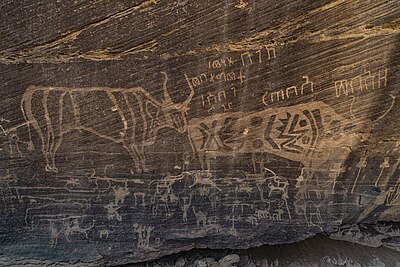
02 Minshaf, Intricate Bovid Engravings of the Neolithic Era
We begin our first main detailed exploration with a truly astonishing fact: in the very heart of this desolate desert, the red sandstone rocks of Minshaf preserve vibrant Neolithic bovid engravings whose inner bodies were meticulously decorated with intricate geometric patterns by ancient artisans thousands of years ago. Please direct your gaze toward the magnificent red sandstone cliff face standing directly before your eyes. …
03 Dhibāh, The Mystery of Elephant Petroglyphs in the Desert
We open our second stop with a captivating mystery: although elephants never naturally existed in the desert environment of the Arabian Peninsula, the hard sandstone rocks here at Dhibāh feature three or four clearly engraved figures of elephants preserved in pristine detail. Please direct your eyes toward the lower left section of the rock cliff along the cluster of massive boulders stretching near your feet. …
04 ʿĀn Jamal, The Ancient Toll Station and Rock Inscription Library
We open our third stop at ʿĀn Jamal with an extraordinary revelation: this site stands as the oldest known desert caravan toll station in the world, functioning as a vast outdoor guestbook densely etched with hundreds of ancient inscriptions. Please raise your eyes to behold the magnificent vertical cliff face that rises dramatically before you. …
05 Bi’r Ḥimā, Three Thousand Years of Living Desert Wells
We open our fourth stop with an astonishing fact of desert survival: dug at least three thousand years ago, the five ancient wells of Bi’r Ḥimā continue to produce fresh, drinkable water to this very day. Please turn your head to look at the impressive rock cliff face extending over forty-five meters in length behind the wells. …
06 Najd Khayrān, Polished Rock Slides and Human-Bovid Interactions
We begin our fifth stop with a truly mysterious discovery: directly in front of a waterfall rock formation in the valley, there exist four smoothly polished rock slides that were rubbed and burnished over centuries. Please inspect the large, sloped sandstone block situated right in front of the waterfall terrain. …
07 Closing
As we conclude our exploration of the Minshaf and Ḥimā Cultural Area in the expansive desert of southwest Saudi Arabia, we reflect with deep emotion on the profound human legacy etched into these timeless rocks. The path we have traveled today is far more than a desert trail; it is an immense open-air library preserving seven thousand years of human life, spiritual beliefs, and written history across three hundred to four hundred generations. …