 Photo Wikimedia Commons
Contents
History & cultureBY TELLBY7 sections · numbered as on the map01 Orientation
Welcome to the Historic Centre of Sighișoara, an extraordinary living medieval citadel situated in Mureș County in the heart of Transylvania, Romania. As you stand here today, you are gazing upon an exceptionally preserved fortified settlement that stretches along an eight hundred fifty meter long hill ridge on the southern bank of the Târnava Mare River. Founded back in the twelfth century by German craftsmen and merchants known as the Transylvanian Saxons, this fortress was originally established under the Latin designation Castrum Sex. Sighișoara is also famous across the globe as the birthplace of Vlad the Impaler, known locally as Vlad Țepeș, whose historical legacy adds a fascinating layer of legendary lore to this ancient town. Unlike many historical fortifications across Europe that have been reduced to quiet open-air museums, Sighișoara remains a vibrant, continuously inhabited citadel where local residents go about their daily lives within the very same walls built hundreds of years ago.
For centuries, this citadel occupied a vital strategic and commercial position on the fringes of Central Europe, serving as a flourishing crossroads where the Latin-oriented culture of Central Europe met the Byzantine-Orthodox traditions of Southeastern Europe. In recognition of its outstanding architectural ensemble and its invaluable role as a monument to Saxon culture, Sighișoara was inscribed on the UNESCO World Heritage list in 1999. The site preserves an extraordinary eight hundred fifty year cultural legacy of the Transylvanian Saxons, represented through its authentic urban layout and remarkable defensive architecture.
Topographically, the citadel is constructed across two distinct levels or terraces on the hillside. The lower terrace, known locally as Citadel Hill or Dealul Cetăţii, sits at an altitude of three hundred fifty meters above sea level, rising approximately thirty meters above the lower town. Above it sits the upper terrace, known as School Hill or Dealul Şcolii, located at an elevation of four hundred twenty-nine meters, elevated roughly forty-nine meters higher than the lower terrace. Throughout our walking tour today, we will explore both of these historic hill terraces, discovering how medieval craft guilds designed a formidable defensive ring, erected impressive gate towers, established early centers of education, and created an enduring urban habitat. Prepare to step back into the Middle Ages as we begin our journey at the primary entrance of the citadel, right before the towering landmark known as the Clock Tower.
02 The Clock Tower - The Symbol and Main Gate
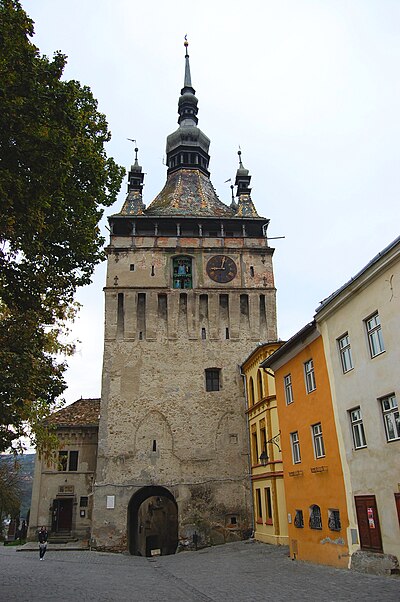
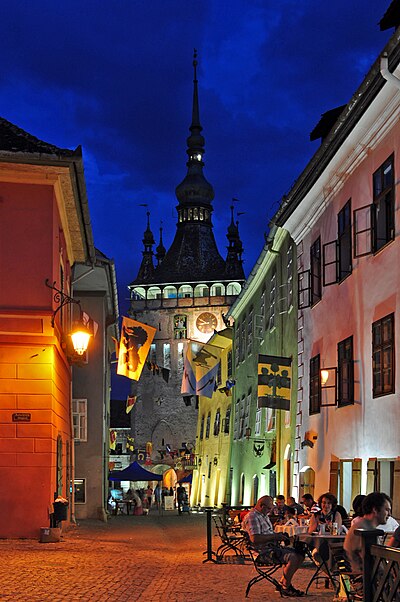
Standing guard over the primary entrance to the fortress, the majestic Clock Tower is a soaring sixty-four-meter-tall gate tower that has continuously defined the skyline of the citadel since the fourteenth century. As the most iconic symbol of Sighișoara, this formidable structure represents the architectural prowess, civic pride, and defensive determination of the medieval town. …
03 The Monastery Church and the Lower Citadel Terrace
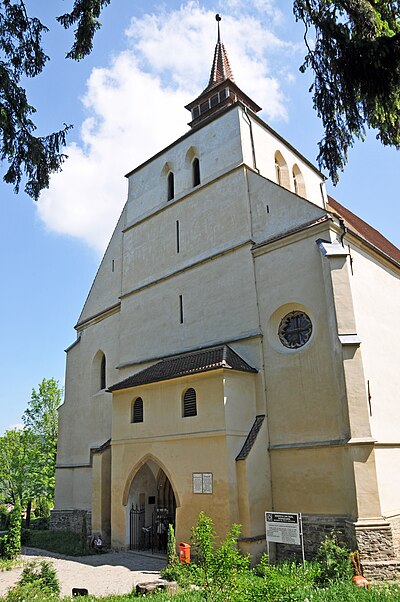
Stepping out from the Clock Tower onto the lower hill terrace, please direct your attention immediately toward the elegant architectural contours of the Dominican Monastery Church standing directly in front of you. This impressive sacred building represents the very cradle of urban development in Sighișoara, where human settlement on this lower hill terrace originally expanded directly around the church beginning in the late twelfth century. …
04 The Tailors' Tower - The Resilient Gate Tower
Standing opposite the Clock Tower along the fortress perimeter, the Tailors' Tower carries a dramatic history defined by catastrophic destruction and miraculous rebirth. In 1676, a devastating fire swept through the citadel, during which the gunpowder stored inside this very tower suddenly exploded, completely obliterating the original structure in a instant. Despite this total loss, the resilient community immediately set to work rebuilding their gate tower. …
05 The Covered Stairs and the School on the Hill
Stretching upward before you like a timeless wooden tunnel, the Covered Staircase is one of the most charming architectural features of the citadel. When constructed in 1642, this enclosed wooden stairway originally featured three hundred individual steps designed specifically to shield school children from freezing winter winds, snow, and rain as they walked up to their classes. …
06 The Shoemakers' Tower - Guardian of the Northern Wall
Reaching the northern tip of the fortress wall, you are standing before the Shoemakers' Tower, a structure defined by its extraordinary history of repeated destruction and triumphant reconstruction across three centuries. Partially destroyed in sixteen hundred six, rebuilt in sixteen fifty, and burned to the ground during the catastrophic fire of 1676, this resilient tower still firmly anchors the northern wall of the citadel today. …
07 Closing
Our journey through the Historic Centre of Sighișoara now comes to a peaceful close. Standing here within this extraordinary inhabited medieval citadel, we have walked through centuries of vibrant history shaped by the Transylvanian Saxons. For over eight hundred fifty years, this remarkable community built, protected, and nurtured a fortified town that served as an essential strategic and commercial crossroads between Central Europe and the Byzantine-Orthodox traditions of Southeastern Europe. …