 Photo Wikimedia Commons
Contents
History & cultureBY TELLBY7 sections · numbered as on the map01 Orientation
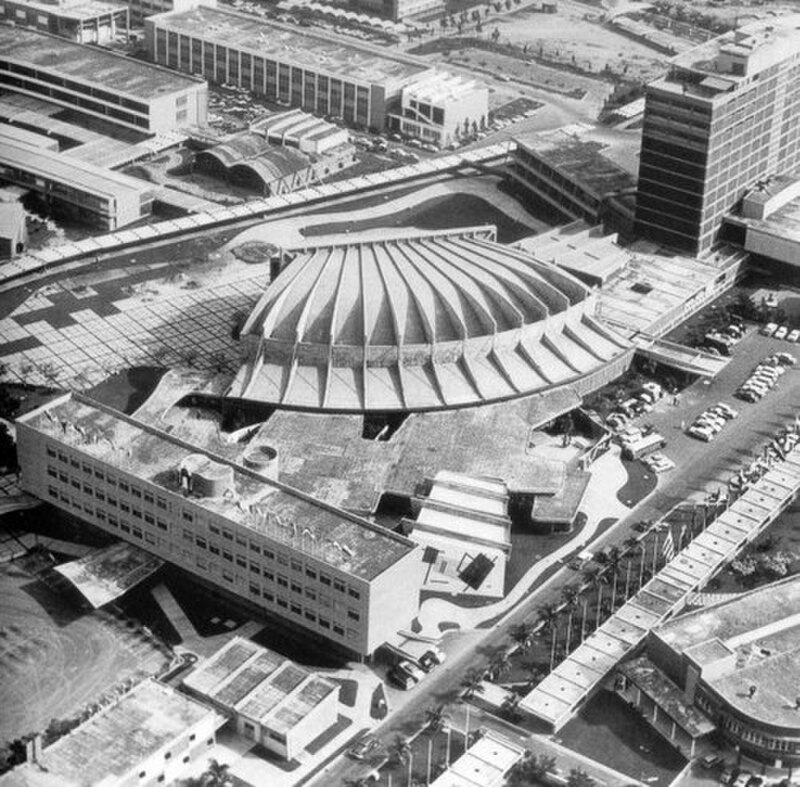
Welcome to the University City of Caracas, located in the central district of Venezuela's capital city. This extraordinary academic campus was inscribed as a UNESCO World Heritage Site in the year 2000 under cultural criteria one and four because it represents a masterly and unmatched synthesis where modern architecture, visual arts, and tropical nature converge in absolute harmony across a unified environment. Among prestigious World Heritage properties globally, this campus stands out as a unique masterpiece, being the only twentieth-century university campus designed entirely under the singular vision of a single master architect to receive such historic international recognition.
Originally, this vast terrain was the historic site of the Hacienda Ibarra, an expansive estate that once belonged to the family of Simon Bolivar. In nineteen forty-two, under the presidency of Isaias Medina Angarita, the Venezuelan government acquired this land to establish a comprehensive modern university capable of accommodating a rapidly growing student population beyond its historical convent facilities at the Saint Francis Convent. In October nineteen forty-three, an autonomous institute was officially created to oversee the complex development. Master Venezuelan architect Carlos Raul Villanueva was entrusted with the master plan and architectural design, dedicating more than twenty years of his life to constructing over forty buildings across this two-square-kilometer property. Villanueva applied his visionary concept of the Synthesis of the Arts, collaborating closely with international avant-garde masters to seamlessly embed sculpture and painting into structural forms.
The design utilizes reinforced concrete as its primary structural material, capturing the technological momentum of its era. To adapt to the tropical environment, Villanueva cleverly incorporated covered walkways, open interior patios, and latticed windows that invite cooling breezes and provide continuous shade. The campus also encompasses a seventy-hectare Botanical Garden featuring the Henri Pittier Library, National Herbarium, and a Palmetum with two hundred fifteen palm species, alongside the artificial Lake Venezuela shaped like a map of the nation.
Today, our walking tour will guide you gracefully through the key highlights of this dynamic architectural landmark. We will begin at the Rectory Plaza and its iconic concrete Clock Tower, an open space that successfully transformed a former parking lot into a vibrant pedestrian square. From there, we will step into the shaded realm of the Plaza Cubierta, an open-air museum where concrete structures, natural sunlight, and masterpiece sculptures interlock. We will then enter the grand auditorium known as the Aula Magna to experience its world-famous acoustic clouds created by Alexander Calder. Following our auditorium visit, we will emerge onto the lush green lawns of Tierra de nadie to view the Central Library with its stained glass art by Fernand Leger, and finally conclude our journey at the sweeping structure of the Olympic Stadium. Let us begin our tour.
02 Plaza del Rectorado & Reloj Universitario
Did you know that this spacious, sunlit pedestrian plaza overflowing with students and visitors was originally designed and used as a bustling parking lot packed with automobiles? When it was initially constructed in nineteen fifty-two, this broad concourse was laid out primarily as a large-scale parking facility servicing the surrounding administrative offices and academic faculties. …
03 Plaza Cubierta (Covered Plaza)
Welcome to the Plaza Cubierta, or Covered Plaza, a groundbreaking indoor-outdoor space where boundary walls are completely removed to create a seamlessly flowing, wind-ventilated open-air art gallery. Rather than constructing traditional enclosed corridors between individual academic buildings, Villanueva envisioned a covered sanctuary that remains open on all sides. …
04 Aula Magna
Step inside the breathtaking auditorium of the Aula Magna, and your eyes will immediately be drawn to the vibrant, oversized colorful shapes suspended beneath the ceiling. At first glance, these striking forms appear to be purely decorative modern art sculptures designed to embellish the hall's interior. Surprisingly, however, these suspended structures function as highly sophisticated acoustic reflectors engineered to deliver flawless sound distribution throughout the vast hall. …
05 Tierra de Nadie & Biblioteca Central
As you emerge from the Aula Magna, a broad expanse of lush green lawns and shady trees unfolds before you. Known in Spanish as Tierra de nadie, which translates to No-Man's Land, this open green space occupies a unique position on the campus. Because it is not owned by or assigned to any specific faculty or department, this area belongs paradoxically to everyone, serving as a shared public commons for all students and academic disciplines. …
06 Estadio Olímpico de la UCV
Constructing a massive, full-scale Olympic football stadium and athletic track at the very heart of a university campus was a truly extraordinary and ambitious urban planning endeavor for its time. Initiated in nineteen fifty and officially inaugurated in nineteen fifty-one, the Olympic Stadium of the Central University of Venezuela expanded the traditional scope of an academic campus to embrace athletic training, physical culture, and major public sporting events. …
07 Closing
The University City of Caracas, which we have explored together today, stands as the crowning achievement of master architect Carlos Raul Villanueva, who dedicated more than twenty years of unwavering vision and determination to its creation. Villanueva did not merely construct functional university buildings; he cultivated profound artistic collaborations with world-renowned avant-garde artists, realizing a utopian ideal where architecture, sculpture, painting, and tropical nature function as…