Contents
History & cultureBY TELLBY7 sections · numbered as on the map01 Orientation
Welcome to the Old Town of Ghadamès, historically celebrated in ancient Arab manuscripts as Jawhart Al-Sahra, or the Pearl of the Desert. Situated in a vast pre-Saharan oasis positioned precisely between the sprawling sand dunes of the Great Erg and the arid stone plateau of Al Hamada el-Hamra, this historic settlement stands as an exceptional testament to human adaptability in one of the most unforgiving thermal environments on Earth. For over two millennia, this site functioned as a peaceful and strategic crossroads for trans-Saharan trade networks, welcoming caravans, merchants, and travelers from across North Africa and the Mediterranean basin. UNESCO recognized its Outstanding Universal Value by designating it as a World Heritage site, honoring its traditional earthen architecture and masterfully integrated urban design that flourishes without reliance on modern energy or mechanical systems.
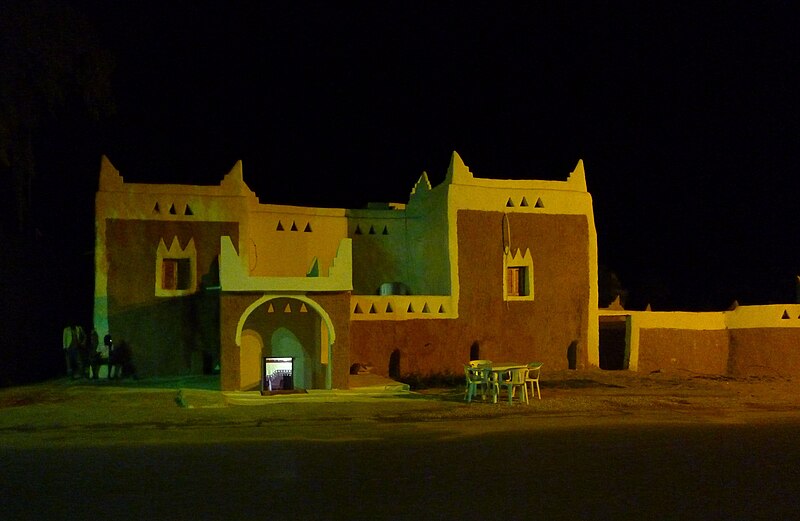
The foundational identity of Ghadamès is defined by its extraordinary architectural response to extreme desert weather. Constructed entirely from locally sourced raw materials including mud brick, stone foundations, and flexible palm wood, the settlement was systematically engineered to temper harsh solar radiation and dramatic temperature fluctuations. The domestic buildings display a highly specialized vertical division of function that harmonizes spatial utility with socio-cultural traditions. Ground floors are dedicated strictly to the safe storage of agricultural provisions and grain supplies. The intermediate living levels extend outward directly over the narrow public thoroughfares, forming dark vaulted alleyways that resemble a subterranean network. This shaded street environment provides men with temperate gathering places protected from desert winds. Meanwhile, the interconnected open-air rooftop terraces above create an elevated secondary domain reserved exclusively for women and children.
Throughout its lengthy history, Ghadamès was shaped by successive cultural interactions across North Africa. The outer perimeter of the town features reinforced continuous house walls that shield the inner core against burning desert winds and external threats. Together with the lush surrounding palm groves and the central spring, the urban fabric forms a balanced ecological system where built structures, water resources, and agricultural zones reinforce one another. As you embark on this audio walking tour, you will explore how this ancient oasis city combined natural resources, ingenious passive engineering, and community spirit to establish a sustainable habitat that continues to inspire modern design principles around the world.
02 Ain al-Faras Spring: The Heartbeat of the Oasis
It is truly astonishing that a single natural spring known as Ain al-Faras, referred to locally as ghusuf, emerging from the depths of a sun-scorched stone plateau, managed to sustain continuous urban settlement and trans-Saharan commerce for well over two thousand years. In a harsh pre-Saharan territory where precipitation is practically non-existent and ambient temperatures routinely reach extreme limits, this unfailing water source served as the ultimate foundation for the origin and…
03 The Shaded Network of Covered Passageways
It is a remarkably astonishing architectural phenomenon that even when exterior ambient temperatures in the surrounding desert climb well past fifty degrees Celsius during midsummer, the temperature inside this subterranean network of covered passageways remains consistently cool and comfortable without the assistance of any mechanical cooling equipment. …
04 The Living Heart of a Ghadamès Home
It is a truly astonishing reality that these traditional mud-brick residences require no mechanical heating or air conditioning systems whatsoever, yet manage to maintain comfortable, highly stable indoor thermal conditions throughout the entire year. Constructed over durable stone foundations, the exceptionally thick walls composed of sun-dried mud bricks act as an extremely efficient thermal mass. …
05 The Elevated World of Women and Connected Terraces
It is a truly extraordinary architectural marvel that the entire rooftop system of Ghadamès functions as a continuous, elevated secondary city layer designated exclusively for women and children. While the darkened covered passageways on the ground level served primarily as the social domain and public thoroughfares for men, the rooftops were systematically joined across individual property lines at a uniform height of approximately ten meters to form a vast, private upper cityscape. …
06 The Outer Defensive Perimeter and Oasis Border
It is a fascinating architectural revelation that the formidable outer defensive fortification surrounding the Old Town of Ghadamès is not a standalone municipal wall, but rather a continuous defensive perimeter created by joining and reinforcing the thick exterior walls of individual residential homes. …
07 Closing
As our walking audio guide tour comes to its conclusion, we hope you have enjoyed exploring the extraordinary urban landscape and living history of the Old Town of Ghadamès, the Pearl of the Desert. Our journey today has taken us from the beating heart of the oasis at the ancient Ain al-Faras spring, through the cool microclimates of the shaded covered passageways, into the radiant domestic hall of Sadr el-beit inside a traditional mud-brick home, across the elevated skyways of the connected…