Contents
History & cultureBY TELLBY7 sections · numbered as on the map01 Orientation
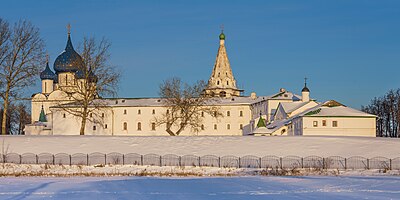
Welcome to the Monastery of Saint Euthymius, a magnificent cultural treasure situated high above the winding Kamenka River in the historic town of Suzdal, Russia. As an officially recognized component of the UNESCO World Heritage site known as the White Monuments of Vladimir and Suzdal, this extraordinary architectural ensemble represents the absolute pinnacle of medieval Russian stone architecture and fortified monastic design. Set upon a prominent scenic headland, the monastery served for many centuries as both a vital spiritual sanctuary for Orthodox believers and a formidable defensive bastion guarding the northern approaches of the regional principality.
The origins of this sacred sanctuary date back to the year 1352, when Prince Boris of Suzdal invited the revered and deeply pious monk Yevfimi from Nizhny Novgorod to establish a new monastic community on this advantageous natural height. Initially designated as the Spassky Monastery, or the Monastery of Our Savior, the sanctuary was later renamed the Spaso-Yevfimiev Monastery to honor its holy founder following his death in 1404. Yevfimi served faithfully as the monastery's very first archimandrite, establishing the strict spiritual rules and structural foundations that enabled the community to flourish over the coming centuries.
This historic ground has also borne witness to pivotal moments of military drama. In July 1445, the disastrous Battle of Suzdal took place right outside the monastery's wooden walls, resulting in the defeat of Grand Prince Vasily II of Moscow and his capture by the forces of the Kazan Khanate princes Makhmud and Jakub. Though the original fourteenth-century timber structures were destroyed or replaced over time, lavish monetary contributions from grand princes and prominent boyar dynasties during the sixteenth and seventeenth centuries allowed for the construction of the formidable masonry fortifications, ornate churches, and extensive monastic quarters that stand before us today.
Our guided audio tour follows a thoughtful, scenic clockwise path around the historic complex. We begin our exploration at the impressive red brick main gate tower, passing through its archways into the expansive central plaza. From there, we proceed to the grand Transfiguration Cathedral, famed for its breathtaking interior frescoes and the honored tomb of a national hero. Next, we admire the towering campanile and the Church of Saint John the Baptist, where the legendary melodic tradition of Suzdal bell ringing continues to echo. Our path then leads us to the Assumption Refectory Church and the attached Archimandrite's House, which reveal the fascinating daily routines and administrative functions of medieval monastic leadership. Finally, we examine the solemn brick walls of the monastery prison, learning about its centuries of dark state history before concluding our walk at a tranquil river overlook. Please step forward into the courtyard and begin this remarkable journey through Russian history.
02 Main Entrance Tower and Fortification Walls
Despite featuring a truly imposing outer perimeter of deep red brick walls spanning twelve hundred meters in length and reinforced by twelve massive defensive towers, this extraordinary fortress monastery never actually engaged in a single military battle or repelled an active enemy siege throughout its entire six-century history. …
03 Cathedral of the Transfiguration of the Saviour
The breathtaking cycle of vibrant frescoes covering every single square meter of the cathedral's lofty interior walls and vaults was miraculously created in just a single summer season in 1689 by the celebrated master painter Gury Nikitin of Kostroma and his gifted artistic school. Working alongside his key artistic collaborator Sila Savin, Nikitin led a dedicated guild of iconographers who painted hundreds of complex biblical narratives and expressive saintly portraits with astonishing speed…
04 The Monastery Campanile and Clock Tower
Although all the priceless historic bells cast for this grand tower during the sixteenth and seventeenth centuries were tragically removed and melted down in the 1930s under Soviet anti-religious campaigns, today the meticulously restored campanile features seventeen newly cast and tuned bells that play complex, harmonious chime compositions at the top of every single hour. …
05 Assumption Refectory Church and Archimandrite's House
The ground floor level of this extraordinary medieval refectory church functioned as an extensive service center containing massive heating furnaces and kitchen facilities designed to channel hot air upward through internal flues, enabling the expansive second-floor dining hall—where a single central stone pillar miraculously supports the entire vaulted brick ceiling—to remain comfortably warm during the most brutally cold Russian winters. …
06 The Prison Castle
Established in 1764 and expanded by royal decree of Empress Catherine the Great in 1766 to incarcerate religious dissidents and state enemies, this grim isolation fortress housed German Field Marshal Friedrich Paulus during World War II following his catastrophic defeat and historic surrender at the Battle of Stalingrad in 1943. …
07 Closing
As our audio guide tour comes to a peaceful conclusion, please step up toward the edge of the monastery's perimeter wall overlooking the Kamenka River. Take a quiet, reflective moment to absorb the breathtaking natural view stretching before you, where the gentle river winds through green water meadows and historic timber houses that embody the timeless, tranquil atmosphere of rural Suzdal. …