Contents
History & cultureBY TELLBY7 sections · numbered as on the map01 Orientation
Welcome, dear travelers, to Vecrīga, the historic heart of Riga, the capital city of Latvia. Situated gracefully on the right bank of the River Daugava, Vecrīga is a living outdoor museum where centuries of rich European history have accumulated layer by layer. It is an immense pleasure to accompany you on this walking journey through one of Northern Europe's most captivating medieval urban landscapes.
Vecrīga is recognized as a UNESCO World Heritage site for reasons that are immediately apparent as you explore its charming cobbled streets. From the thirteenth to the fifteenth century, Riga served as a major commercial hub for the Hanseatic League, deriving immense prosperity from trade connecting Central and Eastern Europe. As a vital intersection of international trade routes and cultural exchange between West and East, the city developed a remarkably rich urban fabric. The medieval street layout, shaped naturally along ancient traffic contours, has survived intact without disruptive modern re-alignments. Rather than relying on rigid complex academic criteria, one can simply feel its value in the harmony between ancient cobblestone passages, red-tiled roofs, and soaring church towers.
While the visible architecture above ground is breathtaking, a fascinating historical realm lies buried beneath your feet. Below the surface of Vecrīga lies an extraordinary archaeological cultural layer ranging from three to five meters in average thickness, reaching up to eight meters in certain historic sectors. Over many centuries, as the city expanded, suffered destruction during military conflicts or fires, and underwent subsequent rebuilding, successive generations left behind dense structural remains and artifacts. In ancient times, the small Riga River flowed into the Daugava, forming a natural harbour suitable for early settlements; however, as the urban footprint grew, this river was entirely filled up by the nineteenth century.
Since Bishop Alberts founded Riga in twelve hundred and one as an episcopal seat, the city expanded rapidly from a modest harbour settlement into a formidable fortified stronghold. Systematic scientific archaeological excavations only began in Riga in nineteen thirty-eight, yet the discoveries made since then have yielded invaluable insights into ancient wooden structures, stone fortification fragments, and forgotten urban layouts.
Our audio guide is carefully designed to lead you seamlessly along the physical contours of the city. As you feel the gentle breeze from the River Daugava, let yourself be transported back in time. We will explore grand cathedrals, royal strongholds, and subterranean bastions that fought off modern developers to preserve their authentic heritage. Please ensure you are wearing comfortable walking shoes as we prepare to begin. Let us now embark on our exploration by walking towards our first landmark, the Ramera Tower and the medieval defensive wall.
02 Ramera Tower and Medieval Defensive Wall
Remarkably, the stone tower standing right before our eyes was first constructed in the 13th century, only to be completely enveloped within the interior walls of residential buildings erected on both sides in the 16th century, remaining hidden from public view for centuries until it was finally brought back to light in 1987.
Please take a moment to look up at the soaring red brick tower and the imposing stone wall extending directly from its side. …
03 St Jacob's Cathedral
Remarkably, archaeological investigations beneath the sacred floor of this cathedral revealed an astonishing eleven distinct burial levels stacked continuously over centuries of history.
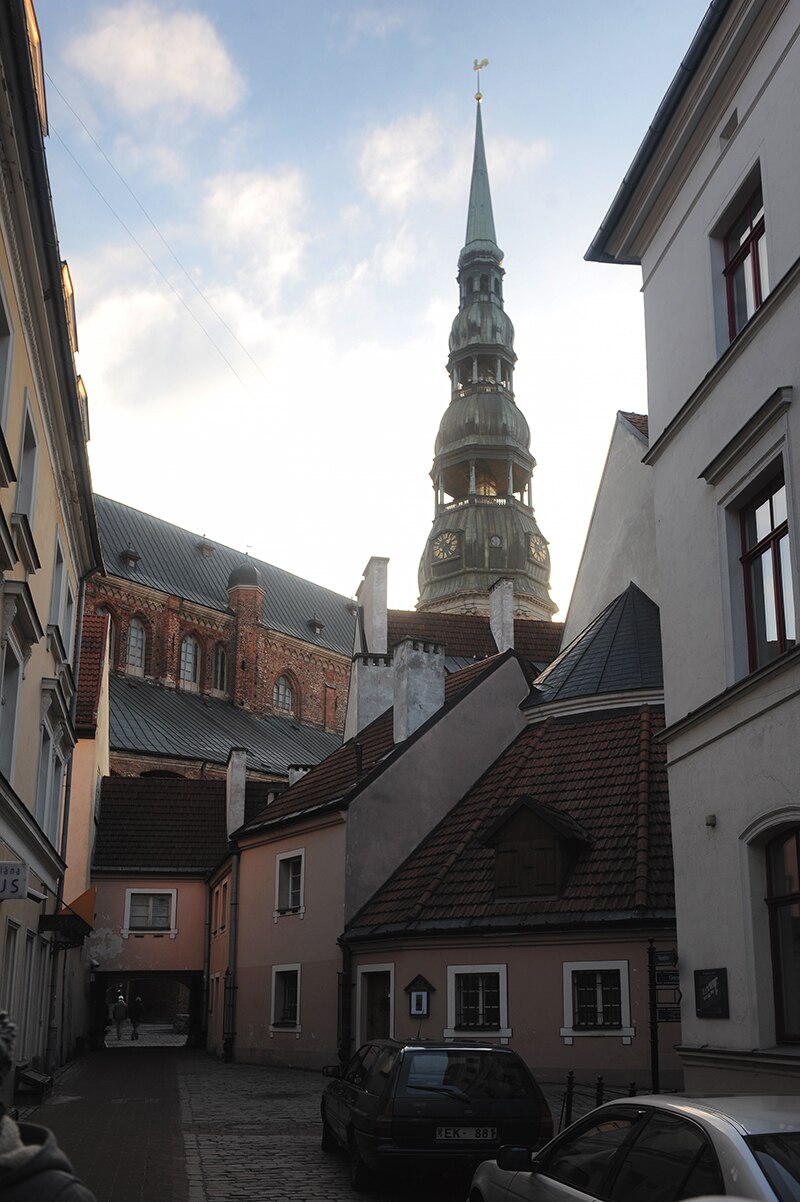
Please take a moment to gaze up at the soaring green spire and the weathered red brick exterior of St Jacob's Cathedral. Originally constructed in the medieval era, this majestic Gothic cathedral decorates the skyline of Old Riga with its elegant arches and towering steeple. …
04 Riga Castle
Remarkably, during the 2013 fire restoration project, workers uncovered a 13th to 14th-century hypocaust heating stove in the castle basement—the oldest and most completely preserved air-heating system of its size ever discovered in Latvia.
Please take a moment to look at the majestic outer walls and soaring towers of Riga Castle facing the River Daugava. Standing against the river breeze, Riga Castle presents a powerful historical presence as a defining landmark along Old Riga's waterfront. …
05 Triangle Bastion
Remarkably, an ambitious project to construct a multi-storey car park was completely canceled after archaeological excavations unexpectedly exposed the remarkably well-preserved stone ruins of the 1727 Triangle Bastion buried underground.
Please take a moment to look toward the Daugava river embankment where modern glass structures and busy roads now intersect. …
06 Šēra Bastion
Remarkably, during railway infrastructure works in 2023, the buried stone remains of the ancient Šēra Bastion were miraculously discovered intact just fifty centimeters beneath the modern street asphalt.
Please take a moment to imagine the ancient fortification wall line preserved directly underneath the busy street surface beneath your feet. …
07 Closing
Dear travelers, we sincerely hope that your audio guide tour through Vecrīga, the historic center of Riga, has been an enriching and deeply memorable experience. Today, we have journeyed not only past the soaring green spires of majestic cathedrals and the commanding riverside castle walls, but also over the buried subterranean bastions and ancient wooden riverbank reinforcements resting beneath your feet.
Vecrīga is far more than a static historical monument. …