Contents
History & cultureBY TELLBY7 sections · numbered as on the map01 Orientation
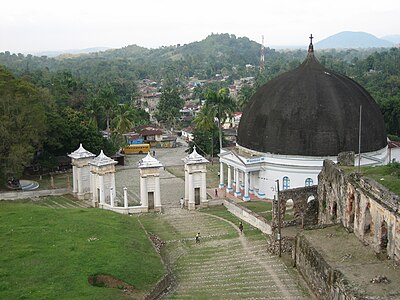
Welcome to the Royal Chapel of Milot, located at the grand entry threshold of the Sans-Souci Palace complex amid the lush, verdant mountain slopes of northern Haiti. Standing here at this remarkable historical site, you are witnessing a profound symbol of freedom and national identity forged by the Haitian people who broke the chains of slavery to establish an independent nation. Built between 1810 and 1813 under the visionary direction of King Henri Christophe, Haiti's first monarch, this chapel represents the spiritual heart and official pride of a newly liberated kingdom. Having fought as a hero in the Haitian War of Independence, King Henri Christophe sought to demonstrate the dignity, sovereignty, and artistic grandeur of his nation to the entire world. He positioned this magnificent religious structure right at the entryway of his expansive royal estate, ensuring that all who arrived would immediately encounter the sacred authority and architectural elegance of his realm. This extraordinary monument was designated a UNESCO World Heritage Site because it stands as a monumental achievement built by a former enslaved person who became king to anchor the liberty of his people.
The Royal Chapel of Milot was constructed using refined neoclassical design principles, featuring a magnificent central dome and a beautifully proportioned, symmetrical layout. Within the broader Sans-Souci estate, which was often celebrated by European and American contemporaries as the Caribbean equivalent of the Palace of Versailles, this chapel held supreme religious and ceremonial importance. King Henri, Queen Marie-Louise, and their two daughters gathered here regularly for sacred devotion and state ceremonies. Among the nine royal palaces, fifteen châteaux, and numerous forts established across the kingdom, this sanctuary stood out as the principal focal point of royal life and spiritual unity. It demonstrated how classical European architectural ideals could be masterfully adapted to reflect the bold ambitions and sovereign dignity of an independent Black nation in the Americas.
Positioned within the National History Park, this site is linked geographically and symbolically to the Citadelle Laferrière atop the mountain peak and the nearby ruins of Ramiers, while sitting just thirteen kilometers southwest of the Protected Area of Three Bays and a short distance from Cap-Haïtien. Throughout its history, this monumental chapel has endured dramatic triumphs and heartbreaking tragedies, from devastating earthquakes to catastrophic fires. As you begin your audio tour from this entrance threshold, you will explore the structural remains of this legendary building, including its classical facade, the site of its collapsed central dome, the sacred inner altar, and the surrounding courtyard grounds. This audio guide will lead you through the rich history, hidden details, and enduring legacy of this magnificent heritage site. Please walk forward at a comfortable pace and immerse yourself in the majestic history of Milot.
02 Main Entrance Gate & Classical Façade
Astonishingly, King Henri Christophe, the visionary ruler who personally conceived and oversaw the construction of this majestic classical facade, was once an enslaved man who fought in the American Revolutionary War alongside George Washington. After returning to his homeland and distinguishing himself as a brilliant military commander in the Haitian War of Independence, he helped break the shackles of French colonial rule. …
03 The Lost Grand Dome & Roof Structure
Astonishingly, the central crowning jewel of this chapel, a monumental wooden dome spanning thirty meters in diameter, stood as the supreme architectural pride of Haiti for more than two centuries before collapsing entirely within a few hours during a mysterious nighttime fire. This towering dome was a masterpiece of nineteenth-century Haitian timber engineering, constructed with intricate geometric precision to span the vast circular nave without internal pillar supports. …
04 Royal Altar & Sacred Interior
Astonishingly, this royal altar space served as the sacred spiritual heart of the Kingdom of Haiti, where lavish royal rituals and state ceremonies were conducted on a scale of grandeur that routinely awed visiting foreign observers. King Henri Christophe regularly presided over solemn religious liturgies at this altar to reinforce the divine authority, moral legitimacy, and spiritual cohesion of his newly liberated nation. …
05 Courtyard Gardens & Artificial Springs
Astonishingly, despite being situated in a rugged, tropical mountain landscape, this courtyard complex was engineered with an extraordinarily sophisticated subterranean aqueduct system and artificial mountain springs during the 1810s. King Henri Christophe commissioned master engineers to capture cool mountain stream runoff and channel it directly through the walls and floors of the palace structures, creating an ingenious natural air-conditioning system that cooled the interior rooms during…
06 Mountain Viewpoint & Defensive Landscape
Astonishingly, this entire royal complex and the colossal mountain fortress crowning the ridge above were constructed at colossal human effort to repel a feared French reinvasion that never actually materialized. Following Haiti's independence in 1804, King Henri Christophe remained deeply convinced that France would eventually return with a massive armada to re-enslave the Haitian population. …
07 Closing
As we conclude this audio tour of the Royal Chapel of Milot, we invite you to reflect deeply upon the profound historical significance and enduring spirit of this remarkable heritage site. Although the heartbreaking fire of April 2020 destroyed the chapel's magnificent thirty-meter dome and its interior religious treasures, the historic dignity of this monument and the resilience of the Haitian people remain unshaken. …