 Photo Wikimedia Commons
Contents
History & cultureBY TELLBY7 sections · numbered as on the map01 Orientation
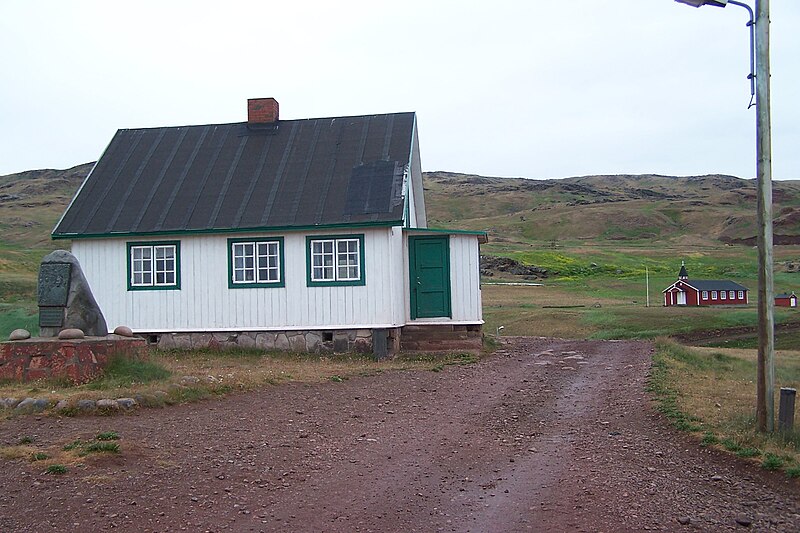
Welcome to the historic settlement of Qassiarsuk. The site where you are standing today represents an extraordinary cultural landscape where a thousand years of Norse history directly connects with modern Arctic sheep farming. Recognized in two thousand seventeen as a core component of the Kujataa UNESCO World Heritage Site, this location preserves the legacy of the earliest European settlement in Greenland while showcasing living agricultural traditions. At the end of the tenth century, the famous Norse explorer Erik the Red arrived at this shore and established his historic homestead known as Brattahlid. Today, this very same land serves as the vibrant heartland of sheep farming and forage production in southern Greenland. Unlike the vast majority of Greenlandic settlements that rely almost entirely on commercial fishing and marine hunting, Qassiarsuk is uniquely built upon agricultural husbandry and land management. An essential aspect of farming here is that all land in Greenland is publicly owned, meaning no private property rights exist, and farmers operate through close institutional collaboration with municipal administrators. Your journey to this remote location reflects the enduring geographic character of the region. Arriving by boat across the sheltered waters of Tunulliarfik Fjord after departing from the international transfer hub at Narsarsuaq Airport offers a dramatic view of the surrounding landscape. While some adventurous travelers undertake a demanding three to five day overland trek spanning fifty-five kilometers from Narsaq across wild rivers and open terrain, visitors arriving at the harbor need only walk fifteen minutes along a gentle gravel road to reach the archaeological grounds of Brattahlid. As your vessel navigated the fjord, you may have noticed how steep rocky mountains give way to rolling green pastures along the coastline. This sheltered maritime environment is precisely what attracted Norse pioneers ten centuries ago. Today, as you walk along these gravel paths, you are retracing ancient footprints while witnessing the daily routines of modern Greenlandic farmers. Throughout this guided audio tour, we will explore the reconstructed wooden church, walk among the ancient longhouse foundations, examine lush pastures where short tailed sheep graze, and discover how farmers utilize greenhouses and tree windbreaks to overcome extreme weather conditions. Please enjoy the peaceful atmosphere of the fjord and take your time as we begin our journey.
02 Thjodhild Church Discovered by Accident
Until its accidental discovery during local construction work in nineteen sixty-one, the structural foundations of the earliest Christian church in Greenland and the skeletal remains of original Norse pioneers lay hidden beneath this ground for nearly a thousand years. Look at the small wooden chapel, the timber bell tower standing beside it, and the low circular dike wall built of fieldstones and turf that completely encircles the sacred site. …
03 Inside the Norse Longhouse Life in the Cold North
Despite the settlement area measuring only about three kilometers long and one kilometer wide, more than sixty individual Norse ruins are densely concentrated across Qassiarsuk, making Brattahlid the highest density Viking archaeological site in all of Greenland. Step inside the reconstructed longhouse and look at the long stone hearth built directly into the center floor with an iron cauldron suspended above the wood fire, as well as the open smoke vents crafted into the turf roof above. …
04 A Century of Greenlandic Sheep Farming
In striking contrast to the vast majority of Greenlandic coastal settlements that rely almost exclusively on commercial fishing and marine hunting, the economy of Qassiarsuk is based entirely on sheep husbandry and agricultural land management. Look at the short tailed sheep descended from historic Icelandic stock grazing peacefully across the rolling green hillsides before you. …
05 Battling Katabatic Winds and Soil Challenges
Destructive katabatic winds known locally as Sydost blow down directly from the inland ice sheet, threatening unshielded agricultural crops and reducing total annual harvest yields by as much as twenty percent. Look at the dense windbreak hedges of willow and spruce trees planted systematically along the edges of these arable fields. …
06 Harnessing the Hundred Day Growing Season
Despite an exceptionally brief growing season lasting only around one hundred days each year, Greenlandic farmers successfully cultivate high quality edible crops such as potatoes, turnips, cabbage, cauliflower, Brussels sprouts, kale, and forage radish by creatively combining greenhouses with protective field covers. Look at the vibrant green turnip sprouts and healthy potato foliage growing vigorously beneath translucent plastic fleece covers before you. …
07 Closing
Standing here on this tranquil hill overlooking the breathtaking fjord of Qassiarsuk, we reflect upon the extraordinary journey we have shared today through time and landscape. This very location bridges two remarkable eras, serving as the tenth century Norse settlement of Brattahlid established by Erik the Red and continuing today as the vibrant agricultural heartland of southern Greenland. …