Contents
History & cultureBY TELLBY8 sections · numbered as on the map01 Orientation
Welcome to Chittorgarh Fort, a monumental place where the majestic history, fierce pride, and noble soul of Rajasthan come vividly alive. You are now standing at the largest fort complex in all of India, a grand UNESCO World Heritage Site inscribed in 2013 that embodies centuries of legendary valor and ultimate sacrifice. Rising proudly on a steep cliff 180 meters above the surrounding plains of Rajasthan, this massive hilltop fortress covers an astounding area of 700 acres, or 280 hectares. With outer defensive stone walls stretching over 13 kilometers along natural precipices, the sheer physical scale of this stronghold is unlike anything else in the country. The deep origins of this fort trace back to the seventh century AD when Chitrangad Mori of the Maurya dynasty established the initial foundation and named the hilltop after himself. Control passed to Bappa Rawal in the mid-eighth century, who established Chittorgarh as the proud capital of the Mewar Kingdom. For more than eight hundred years, the Sisodia dynasty governed their vast realm from this majestic height. Throughout its long existence, this formidable bastion bore witness to three catastrophic sieges by history's most powerful invaders. The first great trial occurred in 1303 when Sultan Alauddin Khalji of Delhi besieged the plateau for eight agonizing months. The second came in 1535 when Sultan Bahadur Shah of Gujarat stormed the citadel. The third and final siege took place between 1567 and 1568, when Mughal Emperor Akbar led an intense four-month campaign that ultimately forced the Mewar capital to relocate to Udaipur. On each tragic occasion, faced with inevitable defeat, the defenders chose supreme honor over surrender. The Rajput women performed Jauhar, the sacred rite of mass self-immolation, while the men donned saffron robes and rode out into Saka, the final suicidal battle charge. Yet one may wonder how thousands of soldiers and civilians could survive on an isolated hilltop through months of continuous siege. The answer lay in the fort's extraordinary water management system. Chittorgarh once contained eighty-four functioning water bodies, including natural springs, storage tanks, and stepwells that made the elevated city entirely self-sufficient. Among these, the famous Gaumukh Reservoir served as a vital lifeline for the fortress. As we guide you through the seven grand gates, royal palaces, victory towers, and sacred reservoirs, you will uncover the true history that shaped this land. Prepare to step back in time and experience the profound legacy of Chittorgarh Fort.
02 Seven Gates and Fortified Walls
The ascent to the summit of Chittorgarh Fort is a grand monument in its own right, offering a masterclass in medieval military strategy and defensive engineering. As you travel along the winding one point five kilometer road that climbs from the plain below to the top of the plateau, you pass through a formidable series of seven massive defensive gates. …
03 Rana Kumbha Palace and Meera Temple
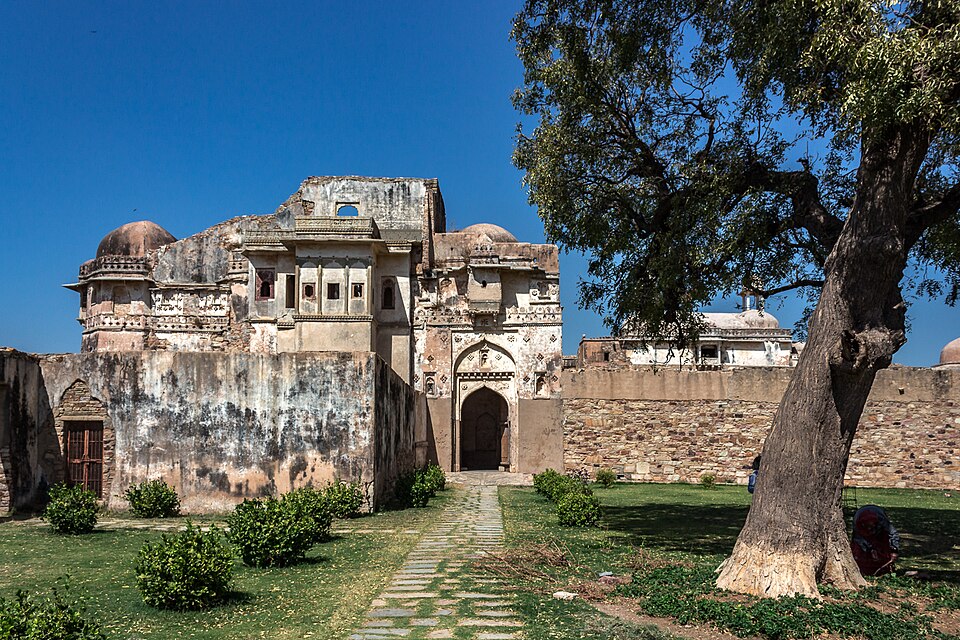
After passing through Ram Pol, you arrive at the sprawling ruins of the Rana Kumbha Palace, the oldest palace complex within Chittorgarh Fort. Although the original structures predate him, the palace takes its name from the great fifteenth-century ruler Rana Kumbha, who extensively restored and expanded it during his glorious reign. Today, even in its ruined state, this imposing complex stands as a monumental testament to medieval Rajput architecture and royal history. …
04 Vijay Stambha - Tower of Victory
Standing grandly against the skyline of Chittorgarh Fort is its most iconic monument, the Vijay Stambha, or Tower of Victory. Soaring to a height of thirty-seven meters, this extraordinary nine-storey tower was commissioned by Rana Kumbha between 1440 and 1448 to commemorate his historic military victory over the combined armies of Malwa and Gujarat led by Sultan Mahmud Khalji. …
05 Samidheshwar Temple
Located near the path leading down to the Gaumukh Reservoir, just south of the Vijay Stambha, stands the magnificent Samidheshwar Temple. This ancient stone sanctuary is a brilliant example of medieval Indian temple architecture, originally commissioned in the eleventh century by Raja Bhoj of Malwa, a famous ruler of the Parmar dynasty. In its early history, the temple was known as the Tribhavannarayan Temple or the Bhoj Jagti Temple. …
06 Gaumukh Reservoir - Core Attraction
You have now arrived at the core highlighting jewel of today's tour, the sacred Gaumukh Reservoir, locally known as Gaumukh Kund. Situated right at the precipitous edge of a high cliff, this stunning spring-fed water body is one of the most serene and historically significant spots inside Chittorgarh Fort. The name Gaumukh is derived from two Hindi words: 'gau' meaning cow, and 'mukh' meaning mouth. …
07 Padmini Palace and Legend vs History
Located near a lotus pond in the southern section of the fortress stands the picturesque three-storey Padmini Palace. Set on a raised stone platform surrounded by water, the reflection of this delicate structure on the surface of the pool creates one of the most iconic and photographed views inside India's largest fort. However, a truly honest exploration of Chittorgarh requires distinguishing romantic folklore from documented history. …
08 Closing
This concludes our audio guide tour of Chittorgarh Fort and the sacred Gaumukh Reservoir. Across this vast seven-hundred-acre plateau—from the seven imposing gates and the ruined Rana Kumbha Palace to the triumphant height of Vijay Stambha, the ancient Samidheshwar Temple, the sacred springs of Gaumukh, and the reflective lotus pool of Padmini Palace—you have journeyed through the very heart of Mewar's history. …