Contents
History & cultureBY TELLBY8 sections · numbered as on the map01 Orientation
We begin our early morning journey in the profound serenity of pre-dawn Agra at approximately five thirty in the morning. Upon arriving at the designated vehicle parking zone, visitors board silent, battery-operated electric golf carts to travel smoothly toward the East Gate along Fatehabad Road. The East Gate is strategically chosen because it experiences significantly lower congestion from large tour buses than the West Gate, offering a far more efficient security clearance process. Security operations inside the monument complex are strictly governed by the Central Industrial Security Force. Visitors must carefully comply with rigorous regulations forbidding tripods, drones, selfie sticks, external power banks, lighters, tobacco products, food items, and bulky backpacks. Carrying only your physical passport, wallet, and basic camera gear will allow you to pass through the inspection checkpoints without unexpected delays. Furthermore, when ascending the elevated white marble plinth later in the tour, shoes must be removed or covered with protective shoe sleeves over your socks. Wearing thick, insulated socks is strongly advised to shield your feet against the sharp cold radiating from the marble during the early morning hours.
This breathtaking architectural masterpiece was conceived by the fifth Mughal Emperor Shah Jahan as an unmatched memorial for his beloved queen Mumtaz Mahal. Born in April 1593 as Arjumand Banu Begum, the daughter of Asaf Khan and granddaughter of Jahangir's chief minister Itimad-ud Daula, she married Shah Jahan in 1612 and remained his most cherished companion. Tragic fate struck in 1631 when she passed away in Burhanpur while giving birth to their fourteenth child. Her body was temporarily interred in the Zainabad garden across the Tapti River before being transported to Agra. In January 1632, Shah Jahan secured a prime riverside site previously occupied by a mansion of Raja Man Singh, acquiring it from his grandson Raja Jai Singh in exchange for a larger imperial estate. Out of Shah Jahan's total building budget of two and a half crore rupees across his imperial construction projects, nearly twenty percent, amounting to an astounding fifty lakh rupees, was expended specifically on creating this mausoleum. Although persistent urban legends claim construction spanned twenty-two years, official court records confirm the primary mausoleum structure was completed in exactly eleven years between 1632 and 1643.
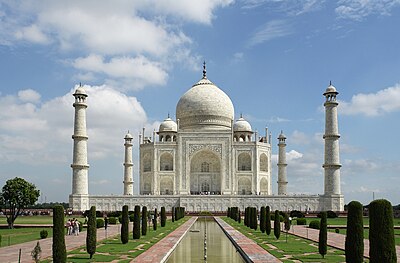
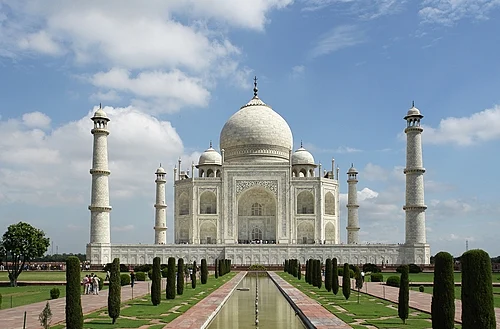
As the complex gates open, prepare to witness a mesmerizing visual phenomenon orchestrated by natural sunlight on Makrana marble. Before dawn, the structure rests in a cool, ethereal palette of pale slate blue and soft grey. The exact moment the sun breaks over the eastern horizon, the entire marble facade undergoes a sudden, dramatic color shift, glowing in a delicate rose pink for approximately eight to twelve minutes. As the sun ascends higher, this pink hue warms into a rich amber gold before settling into a luminous, radiant white by mid-morning. We invite you to step forward into this quiet sanctuary and experience the timeless architecture of the Illuminated Tomb.
02 The Great Gate: Darwaza-i-Rauza
You are currently standing directly before the grand entrance portal known as Darwaza-i-Rauza, or the Great Gate. Soaring thirty meters into the morning air, this imposing red sandstone portal serves as the formal gateway into the sacred complex of the Taj Mahal, standing immediately beyond the imperial forecourt known in contemporary chronicles as the chowk-i jilau khana, which once accommodated the royal retinue. …
03 The Garden of Paradise: Charbagh Quadrangles
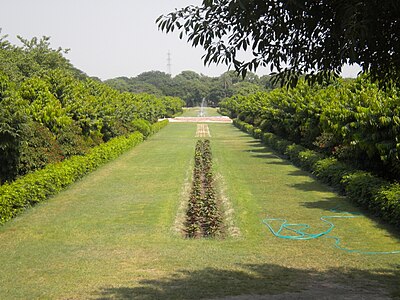
Passing through the heavy threshold of the Great Gate and stepping down onto the open stone pathways brings you into an extraordinary landscape. Before you unfolds the expansive Charbagh, a grand four-part paradise garden meticulously planned across a massive rectangular site measuring five hundred and forty meters in length by three hundred meters in width. …
04 The Reflecting Pool and Central Marble Bench
We have now arrived at the elevated marble platform and central reflecting pool, situated midway along the main water channel. Widely recognized as the iconic vantage point where global dignitaries and historic figures have posed, this spot offers an extraordinary view of the entire mausoleum. This exact location provides the absolute best vantage point for observing the elusive eight-to-twelve-minute sunrise light transition. …
05 The Main Mausoleum and Central Octagonal Chamber
We have ascended onto the high white marble terrace, a massive platform measuring one hundred and twenty cubits square and seven cubits high, resting upon a broader red sandstone base platform measuring three hundred and seventy-four cubits long by one hundred and forty cubits wide. Built upon this solid marble foundation stands the primary mausoleum building, constructed according to a sophisticated Baghdadi octagon plan measuring seventy cubits in diameter. …
06 The Western Red Sandstone Mosque
Walking westward across the sweeping upper terrace brings us to the impressive red sandstone mosque occupying the western flank of the Taj Mahal complex. Constructed from smoothly dressed slabs of high-grade red sandstone, this structure presents a dramatic visual contrast against the shimmering white marble of the central mausoleum. …
07 The Eastern Guest House: Mihman Khana (Jawab)
Continuing across the northern marble terrace past the central mausoleum leads us to the structure standing on the eastern edge of the complex. Known historically as the Mihman Khana, or Guest House, this building is also referred to architecturally as the Jawab, which translates literally to answer or echo. The name perfectly encapsulates its intended function. …
08 Closing
Our sunrise journey across the Taj Mahal complex, beginning in the quiet dark of pre-dawn and concluding in the radiant white light of mid-morning, has now come to a gentle close. Walking through the imposing portal of Darwaza-i-Rauza, navigating the geometric water channels of the Charbagh paradise garden, and ascending to the central octagonal chamber, we have witnessed the profound color sequence that defines this monument of love. …