Contents
History & cultureBY TELLBY8 sections · numbered as on the map01 Orientation
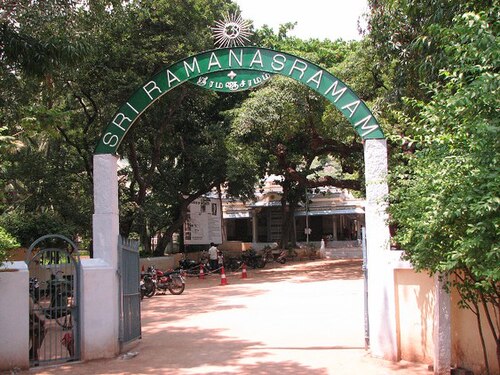
Welcome to the sanctuary of Sri Ramanasramam, established on December 28, 1922, at the foot of the holy mountain Arunachala. Although Bhagavan Sri Ramana Maharshi no longer occupies a physical body, his dynamic spiritual presence remains entirely alive and accessible to all who enter this sacred space with a receptive heart. As you step across the threshold into this refuge of peace, you are invited to transition from external sightseeing to profound inner contemplation. In accordance with traditional Indian reverence, footwear must be deposited outside at the designated sandal stall before entering. Carrying shoes inside bags into the ashram buildings is considered inappropriate. Visitors are asked to wear modest attire that covers the shoulders, chest, and legs. Mobile phones should be completely switched off or silenced at all times to protect the silent sanctuary.
The story of this holy refuge is inseparable from the extraordinary life of Venkataraman Iyer, who was born on December 30, 1879, in the small town of Tiruchuzhi in Tamil Nadu. Raised in an orthodox Brahmin family, he was a normal youth until July 1896, when he was sixteen years old. While sitting alone in his uncle's house in Madurai, a sudden and overwhelming fear of death seized him without any physical illness. Instead of panicking, he drove his inquiry inward, asking the fundamental question, Who am I? He stiffened his body to mimic a corpse and observed with penetrating clarity that while the physical body dies, the inner conscious Spirit remains untouched by death. This spontaneous death experience, lasting about twenty minutes, established him permanently in absolute Self-realization.
Transformed by this illumination, the young sage departed Madurai on Saturday, August 29, 1896, leaving a simple note explaining that he was going in search of his Father. Taking three rupees from his brother's college fee money, he boarded a train originally ticketed for Tindivanam. During the journey, a Muslim Moulvi sitting opposite advised him to change trains at Villupuram. Arriving at Villupuram early in the morning without sufficient funds for a direct ticket, he bought a ticket to Mambazhapattu and walked on foot toward his destination. He rested at the Atulya Nadheswara temple in Arayaninnalur, where he experienced a vision of divine light. On August 31, the auspicious day of Gokulashtami, he pledged his ruby ear studs to Muthukrishna Bhagavathar for four rupees to complete his journey. He arrived in Tiruvannamalai on the morning of September 1, 1896, and immediately rushed into the inner sanctum of the great Annamalaiyar Temple to embrace the Shivalingam in supreme bliss.
Following this divine union, Venkataraman walked to the nearby Ayyankulam tank, where he tonsured his head, discarded his sacred thread, threw away his remaining money, and wore a simple loincloth known as a koupinam. As he renounced all worldly possessions, a sharp rain shower bathed him from the heavens. Today, step softly into this sanctuary, allowing the quiet power of Arunachala and the grace of Bhagavan Sri Ramana Maharshi to reveal the true nature of your inner awareness.
02 Section 1
You are standing before the Mathrubhuteswara Shrine, the sacred temple erected over the samadhi of Mother Azhagammal, the mother of Bhagavan Sri Ramana Maharshi. This magnificent granite structure stands as a monument to the sublime transformation of maternal affection into universal spiritual liberation. In 1914, Mother Azhagammal came to live with Bhagavan at the Virupaksha Cave on Arunachala Hill. …
03 Section 2
You are now inside the Samadhi Hall, the sacred shrine containing the final resting place of Bhagavan Sri Ramana Maharshi, known as the Ramaneswara Mahalingam. Though Bhagavan shed his physical body decades ago, his living spiritual presence permeates this high-ceilinged marble hall with a profound, palpable silence. In late 1948, a small nodule appeared below the elbow on Bhagavan's left arm, which rapidly developed into a malignant sarcoma. …
04 Section 3
Welcome to the Old Hall, the sacred meditation chamber where Bhagavan Sri Ramana Maharshi lived, slept, and received seekers for more than two decades. This simple, wooden-couched hall served as the heart of the ashram, where visitors from all walks of life gathered to sit in the silent presence of the Sage. Bhagavan's primary mode of instruction was Mouna Diksha, or initiation through silence. …
05 Section 4
You are standing in the vicinity of the New Hall and the Ashram Library and Archives, known locally as the Granthalaya. Constructed in 1949 adjacent to the Mother's Temple, the New Hall represents the expansion of the ashram infrastructure in Bhagavan's final years, while the library serves as the intellectual and spiritual repository of his timeless teachings. Bhagavan Sri Ramana Maharshi never sought to write formal treatises or establish a personal doctrine. …
06 Section 5
Our path now ascends the rocky slopes of Mount Arunachala to Virupaksha Cave, one of the most sacred sites associated with the life of Bhagavan Sri Ramana Maharshi. Bhagavan resided in this mountain cavern for seventeen years, from 1899 to 1916, radiating an intense atmosphere of silence and spiritual absorption. The cave derives its name from Virupaksha Deva, a renowned saint of the sixteenth century who lived and was buried here. …
07 Section 6
Ascending approximately one hundred meters above Virupaksha Cave along the mountain path, one reaches Skandashramam, a serene oasis perched high on the slopes of Mount Arunachala. Bhagavan Sri Ramana Maharshi resided in this mountain hermitage for six years, from 1916 to 1922. The site was created single-handedly through the extraordinary labor of an early devotee named Kandaswamy. …
08 Closing
As our journey through Sri Ramanasramam comes to a close, we turn our awareness to the supreme spiritual majesty of Mount Arunachala and the sacred practice of Giripradakshina. Geologically estimated to be 3.4 billion years old, this gaunt red mountain is revered as the spiritual axis of the earth and the secret Heart-center of the universe. …