Contents
History & cultureBY TELLBY8 sections · numbered as on the map01 Orientation
Welcome to the entrance of the Tsuglagkhang Complex, nestled in the peaceful hill station of McLeod Ganj in the upper reaches of the Kangra Valley in Himachal Pradesh, India. You are standing at an altitude of 2,082 meters above sea level, positioned directly beneath the magnificent snow-capped peaks of the Dhauladhar mountain range. Originally established in the mid-nineteenth century as a British military retreat and named after Sir Donald Friell McLeod, a lieutenant governor of Punjab, McLeod Ganj underwent a profound historical transformation following the turbulent events of 1959. After the Chinese invasion of Tibet and the national uprising, His Holiness the 14th Dalai Lama, Tenzin Gyatso, escaped across the freezing Himalayan passes to seek asylum in India. The Indian government granted refuge, and McLeod Ganj became the seat of the Tibetan government-in-exile and the official residence of the Dalai Lama, earning the town its renowned title, Little Lhasa.
The centerpiece of this spiritual sanctuary is Namgyal Monastery, also known as Namgyal Tantric College, which functions as the personal monastery of the 14th Dalai Lama. The origins of this venerable institution trace back to sixteenth-century Tibet. It was originally founded in either 1564 or 1565 by the Second Dalai Lama, Gendun Gyatso, who constructed it upon the foundations of a previously defunct monastery known as Phende Gon, naming the new sanctuary Phende Lekshe Ling. The monastery received its current name in 1571 during the reign of the Third Dalai Lama, Sonam Gyatso. When King Altan Khan of Mongolia fell gravely ill and requested long-life prayers, the Third Dalai Lama instructed his monks to perform sacred rituals dedicated to Namgyälma, the female deity of longevity. Following the king's remarkable recovery, the institution became known as Namgyal Monastery, which translates to the Victorious Monastery.
Following the construction of the grand Potala Palace in Lhasa by the Fifth Dalai Lama, Namgyal Monastery was traditionally housed in the Potrang Marpo, the sacred red section at the very top of the palace adjacent to the private residence of the Dalai Lamas. For centuries, its monks assisted successive Dalai Lamas in public religious affairs and performed state rituals for the welfare of Tibet. Following the 1959 exile, 55 Namgyal monks accompanied the 14th Dalai Lama to re-establish the monastery here in Dharamshala. Today, the active monastery is home to nearly 200 monks. Operating as an inclusive non-sectarian institution, Namgyal Monastery preserves the teachings, academic lineages, and tantric practices of all four main schools of Tibetan Buddhism, including Gelug, Nyingma, Kagyu, and Sakya. As you follow this audio guide into the central complex, prepare to experience a living sanctuary of resilience, peace, and sacred heritage.
02 Debating Courtyard
Please step into the central open air courtyard of the Tsuglagkhang Complex. This space serves as the famous debating courtyard where the monks of Namgyal Monastery engage in the rigorous and ancient tradition of formal philosophical debate. As afternoon approaches, this open courtyard transforms into a dynamic arena filled with vibrant energy, resonant voices, and expressive physical gestures from monks clad in traditional maroon robes. …
03 Tsuglagkhang Main Temple Hall
Step out of the debating courtyard and make your way toward the Tsuglagkhang Main Temple Hall, the primary place of worship and spiritual heart of the entire complex. As you approach the entrance of this sacred sanctuary, monastic etiquette requires all visitors to remove their shoes as a gesture of respect and humility. Once inside, you are asked to maintain strict silence or speak only in hushed whispers to preserve the quiet sanctuary atmosphere. …
04 Namgyal Tantric College & Ritual Hall
We now direct our focus to the defining institutional identity of this sacred site: the Namgyal Tantric College and Ritual Hall. As a specialized institution, Namgyal Monastery differs fundamentally from ordinary public temples. Its primary purpose is not merely to accommodate lay worship, but to serve as the personal monastery of His Holiness the Dalai Lama. …
05 Tibet Museum
Please walk over to the Tibet Museum, located conveniently within the Tsuglagkhang Complex grounds. While the surrounding monastery offers a quiet space for spiritual contemplation, the Tibet Museum provides a poignant historical narrative documenting the tragic history, cultural resistance, and extraordinary resilience of the Tibetan people. …
06 Kora Path & Prayer Wheels
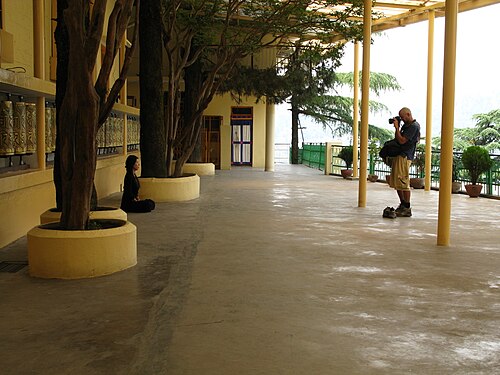
Now, let us walk toward the Kora path, a sacred circumambulation trail that winds around the outer perimeter of the Tsuglagkhang Main Temple and through the surrounding forested hillsides. Circumambulation, known locally as Kora, is one of the most fundamental daily spiritual practices in Tibetan Buddhism, where devotees walk in a clockwise direction around a sacred object, temple, or monastery while reciting prayers. …
07 Dhauladhar Viewpoint
Please make your way toward the outer vantage point near the edge of the monastery grounds, overlooking the magnificent Dhauladhar mountain range. From this spectacular viewpoint, visitors are treated to an unobstructed panoramic vista of snow-capped Himalayan peaks towering dramatically above the lush, green contours of the Kangra Valley below. …
08 Closing
As we bring our audio guide tour of Namgyal Monastery and the Tsuglagkhang Complex to a close, we hope this journey has provided you with deep insights and a lasting sense of inner tranquility. The sanctuary you have explored today is far more than a historical monument or a scenic tourist destination. …