Contents
History & cultureBY TELLBY8 sections · numbered as on the map01 Orientation
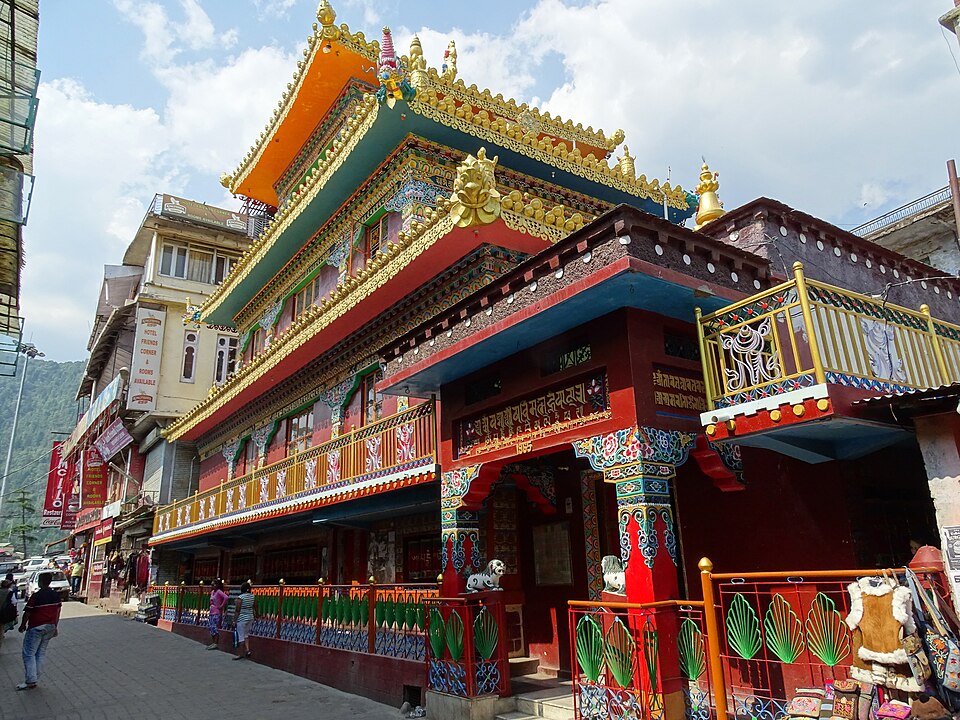
Welcome with all my heart to McLeod Ganj, a sanctuary where the majestic panorama of the Dhauladhar mountain range meets the deep spiritual resonance of Tibetan Buddhism. I am your audio guide, and today I will walk alongside you through the narrow lanes and scenic mountain paths of this extraordinary town, sharing its multi-layered history and living breath. McLeod Ganj is a tranquil and welcoming hill station located in the upper reaches of the Kangra Valley in Himachal Pradesh, India, resting gracefully at an altitude of two thousand eighty-two meters above sea level. Throughout ancient history, this land belonged to nature and to nomadic spirits. It was originally the homeland of the Gaddi people, a predominantly Hindu transhumant group who moved with the changing seasons across the Himalayas to herd their goats and sheep. Following the Second Anglo-Sikh War, the British annexed the region in March eighteen fifty. When establishing a subsidiary military cantonment for troops stationed at Kangra, the British chose the high slopes near an existing Hindu resthouse, or dharamshala. This sanctuary gave its name to the new cantonment town of Dharamshala. A formal military cantonment was established in eighteen forty-nine, and in eighteen fifty-two, Dharamshala became the administrative capital of Kangra district. By eighteen fifty-five, the civilian settlement on the upper ridge was named McLeod Ganj after Sir Donald Friell McLeod, the Lieutenant Governor of Punjab during British colonial rule. The suffix ganj originates from a traditional Persian word meaning neighbourhood or market town. In eighteen sixty, the historic First Gurkha Rifles were stationed here, further solidifying the foundations of the settlement. However, on the morning of April fourth, nineteen hundred and five, at six nineteen in the morning, a devastating earthquake of magnitude seven point eight struck the Kangra region. The calamity killed nearly twenty thousand people and destroyed almost all structures across Kangra, Dharamshala, and McLeod Ganj. The administrative headquarters were subsequently shifted to a lower location, and the town quieted into relative obscurity for half a century. A profound rebirth occurred in March nineteen fifty-nine when Tenzin Gyatso, the fourteenth Dalai Lama, escaped from Tibet and sought refuge in India. Through the gracious hospitality of Indian Prime Minister Jawaharlal Nehru, the Central Tibetan Administration was established in McLeod Ganj in May nineteen sixty. As thousands of Tibetan refugees settled here, the town gained its cherished nickname, Little Lhasa. Today we embark together on a walking route steeped in history and spirituality, from the main square to Tsuglagkhang, Namgyal Monastery, St John in the Wilderness, Bhagsunag Temple, Bhagsu Waterfall, and Naddi Viewpoint. Let us begin our peaceful journey.
02 Section 1
Our first official stop brings us to the spiritual heart of McLeod Ganj, the Tsuglagkhang Complex, which encompasses the main temple and the official residence of His Holiness the fourteenth Dalai Lama, Tenzin Gyatso. As you step through the entrance, you are immediately greeted by the vibrant sight of prayer flags, known as Lungta, fluttering vigorously in the crisp Himalayan breeze. …
03 Section 2
Step directly adjacent to the main shrine to explore Namgyal Monastery and the Tibet Museum. Namgyal Monastery was originally established in Tibet during the sixteenth century as the personal monastery of the Dalai Lama, tasked with preserving esoteric Tantric rituals and academic scholarship under the Gelug tradition. …
04 Section 3
Leaving the Tibetan quarter for a moment, we make our way down toward Forsyth Ganj into a shadowy grove of towering Himalayan cedar trees, locally known as Deodar. Nestled serenely within this dense forest stands St John in the Wilderness Church, an Anglican place of worship constructed in eighteen fifty-two. …
05 Section 4
Our journey now leads us to the eastern suburb of Bhagsunag, home to the ancient Bhagsunag Temple and its sacred spring pool. Framed by majestic deodar trees and scenic views of the Dhauladhar foothills, this historic shrine is dedicated to Lord Shiva, worshipped here under the title Bhageshwar, alongside the serpent deity Nag Devta. According to local mythology, a powerful king named Bhagsu once ruled this region. …
06 Section 5
From behind the Bhagsunag Temple, a well-marked pedestrian trail ascends gently along the hillside, leading trekkers toward the scenic Bhagsu Waterfall. This popular short hike covers a distance of approximately five hundred to one thousand meters, requiring an easy to moderate fifteen to thirty-minute walk. …
07 Section 6
We now journey slightly northwest from the busy bazaar toward the peaceful village of Naddi, home to the Naddi Viewpoint and the charming Dal Lake. Situated at an elevation of approximately two thousand meters above sea level, Naddi Viewpoint offers arguably the most breathtaking three hundred and sixty-degree panoramic views of the snow-capped Dhauladhar range and the sprawling Kangra Valley below. …
08 Closing
Our walking audio tour of McLeod Ganj now gently draws to a close. Today we have traversed a truly unique landscape where deep Himalayan spirituality, diverse cultural traditions, and stunning natural beauty converge beneath the shadow of the Dhauladhar range. We listened to the rhythmic murmuring of mantras and the turning of prayer wheels at the Tsuglagkhang Main Temple, witnessed the spirited monastic debates at Namgyal Monastery, and reflected solemnly upon the strength of the Tibetan exile…