Contents
History & cultureBY TELLBY8 sections · numbered as on the map01 Orientation
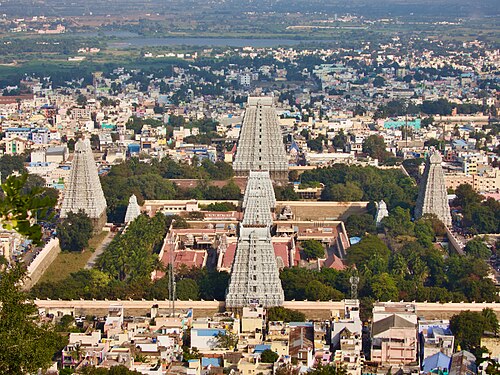
Welcome to the sacred grounds of the Arunachaleswara Temple, located at the foot of the holy Arunachala Hill in Tiruvannamalai, Tamil Nadu. As you stand in the eastern outer plaza facing the rising sun, look toward the western horizon directly behind the temple walls, where the sacred peak of Arunachala rises in quiet grandeur. Also widely known as the Annamalaiyar Temple, this divine sanctuary is one of the largest and most venerated Hindu temple complexes dedicated to Lord Shiva in all of India. The Tiruvannamalai District Administration records that the complex covers an expansive area of approximately twenty five acres, or ten hectares. The surrounding granite boundary walls span about seven hundred feet on the east and west, one thousand four hundred and seventy nine feet on the south, and one thousand five hundred and ninety feet on the north. The entire architectural ensemble is oriented precisely toward the east, welcoming the morning rays, while the holy mountain stands as the physical embodiment of the deity directly behind it. In the Shaivite tradition, this temple holds a central place as one of the Pancha Bhuta Sthalams, the five major temples representing the fundamental elements of nature. Specifically, Arunachaleswara embodies the element of fire, known as Agni. According to sacred scriptures, Lord Shiva manifested here as Lingodbhava, an infinite column of cosmic fire, which later cooled to form both the holy mountain and the Agni Lingam worshipped within the sanctuary. Furthermore, this temple is glorified as a Paadal Petra Sthalam, one of the two hundred and seventy six sacred Saivite shrines praised in canonical Tamil devotional literature, including the seventh century Tevaram hymns by the Nayanar saints, the ninth century Tiruvempavai by Manikkavacakar, and the fourteenth century Tiruppugazh by Arunagirinathar. According to the esoteric system of Aathara Thalams, which aligns temples with the energetic chakras of the human body, Arunachaleswara corresponds to the Manipooraga chakra, located at the solar plexus or naabhi moolam. Revering this site as a Mukthi Thalam, a place of ultimate salvation, generations of seekers have sought spiritual liberation here. Architecturally, the complex unfolds across five concentric enclosures known as prakarams. As you begin your walk today, remember that passing inward through these stone courtyards is a reverse journey through history. The outer enclosures were expanded under medieval empires, whereas the core sanctum dates back to Chola antiquity. Your tour starts here at the towering eastern Rajagopuram, proceeds past the Thousand Pillared Hall, descends to the quiet underground chamber of the Pathala Lingam, pauses by the mirror like waters of Sivaganga Theertham, moves past the Hoysala era Vallala Maharaja Gopuram and its sacred Nandi statues, and culminates at the central sanctum sanctorum of the Agni Lingam.
02 Eastern Gateway Rajagopuram
Step directly beneath the massive stone threshold of the Eastern Gateway, known as the Rajagopuram or King Gateway Tower, and look upward toward the sky. Rising through eleven meticulously carved tiers to a height of approximately sixty six meters, or two hundred and seventeen feet, this monumental portal stands as a supreme masterwork of South Indian Dravidian architecture. The foundation resting under your feet measures an astounding one hundred and thirty five feet by ninety eight feet. …
03 Thousand-Pillared Hall Aayiram Kaal Mandapam
As you step inside the fifth outer prakaram from the Rajagopuram archway, turn immediately to your right. Rising above the paved stone courtyard is a vast elevated pavilion supported by an endless forest of sculpted granite columns. This is the famous Thousand Pillared Hall, known in Tamil as the Aayiram Kaal Mandapam. Built during the late Vijayanagara period under the royal patronage of King Krishnadevaraya, this hall stands as an extraordinary triumph of medieval stone masonry. …
04 Underground Shrine Pathala Lingam
As you walk along the base of the Thousand Pillared Hall, look carefully near the stone foundations to discover a narrow flight of stone steps leading down into darkness beneath the raised floor. Descend these steps cautiously into the quiet, shadowed subterranean chamber known as the Pathala Lingam. The word Pathala signifies the underworld in Hindu cosmology, and this quiet basement shrine houses a holy Shiva lingam set deep within the earth. …
05 Sacred Temple Tank Sivaganga Theertham
Ascend the stone steps from the underground shrine back into the sunlight of the fifth prakaram, and walk southwest across the courtyard. Spread out before you is the vast and serene expanse of the Sivaganga Theertham, the primary stepped temple tank within the complex. Enclosed by meticulously cut granite steps that descend gracefully into the water, this sacred pool serves as an essential focal point for ritual purification and major festival ceremonies. …
06 Vallala Maharaja Gopuram and Courtyard
Continue your journey westward from the water tank toward the inner enclosures, where you will pass under the threshold of the Vallala Maharaja Gopuram. This historically significant inner gateway tower derives its name from King Veera Ballala the Third of the Hoysala Dynasty, who established his royal capital in this region around thirteen twenty eight CE. …
07 Central Sanctum Annamalaiyar Agni Lingam
Step across the stone threshold into the innermost first prakaram, the sanctuary at the heart of the complex. The central stone masonry of this sanctum sanctorum dates back to the ninth century CE during the Chola Empire, making it the oldest structural foundation in the temple. At the center of this cool inner chamber rests the sacred Agni Lingam, representing Lord Shiva as the cosmic element of fire. …
08 Closing
As your exploration of the Arunachaleswara Temple comes to a close, step out into the open courtyard and turn around to gaze up at the majestic peak of Arunachala Hill rising directly above the temple walls. In the regional Shaivite tradition, the mountain itself is not merely a sacred site, but is revered as the living physical manifestation of Lord Shiva. The temple complex and the holy hill form an indivisible sanctuary that has drawn saints and seekers for over a millennium. …