Contents
History & cultureBY TELLBY8 sections · numbered as on the map01 Orientation
Welcome to the serene and historic town of Belur, beautifully situated along the banks of the Yagachi River in the Hassan district of Karnataka, India. This sacred waterway, recorded as the Badari River in ancient texts and historical inscriptions, flows gently past this elevated settlement located at an altitude of nine hundred and seventy nine meters, or three thousand two hundred and twelve feet above sea level. Positioned as the highest town in the Hassan district, Belur is located thirty five kilometers northwest of Hassan city, sixteen kilometers west of Halebidu, the historic site of Dwarasamudra, and approximately two hundred and twenty kilometers west of Bengaluru via National Highway seventy five. Serving as the primary capital of the glorious Hoysala Empire between the tenth and fourteenth centuries before the royal seat moved to Dwarasamudra, Belur is reverently recorded in medieval inscriptions as Velur, Velapuri, or Beluhur. Throughout their reign, the Hoysala dynasty constructed around fifteen hundred magnificent temples across nine hundred and fifty eight centers, developing a unique Karnata Dravida architectural tradition that harmonized North Indian and South Indian artistic influences. A pivotal moment in Belur history occurred in the early twelfth century when King Vishnuvardhana, who came to power in the year eleven ten, met the revered philosopher Ramanujacharya, the celebrated exponent of Sri Vaishnavism. Inspired by this spiritual encounter, King Vishnuvardhana embraced the faith and commissioned the monumental Vijaya Narayana temple, now known as the main Chennakeshava temple, in the year eleven seventeen. This transformation elevated Belur into a preeminent center of Vaishnava worship, filled with grand temples, residence quarters, and monastic institutions. In later inscriptions, the city was reverently praised as Earthly Vaikuntha, meaning the heavenly abode of Lord Vishnu on Earth, as well as Dakshina Varanasi, honoring it as the sacred holy city of the South. The exceptional artistic mastery, architectural innovation, and profound theological vision manifested in the Chennakeshava temple complex earned it global recognition when it was designated as a UNESCO World Heritage Site in twenty twenty three under the Sacred Ensembles of the Hoysalas. Despite suffering damages during historical conflicts, this enduring sanctuary remains an active and vibrant center of Hindu pilgrimage to this day. As you begin your journey through this architectural masterpiece, please walk slowly toward the towering brick gopuram gate located at the eastern entrance of the temple enclosure. Together, we shall step into a world where stone turns into poetry and history comes alive.
02 The Eastern Gopuram and Enclosure Wall Rebuilt Through History
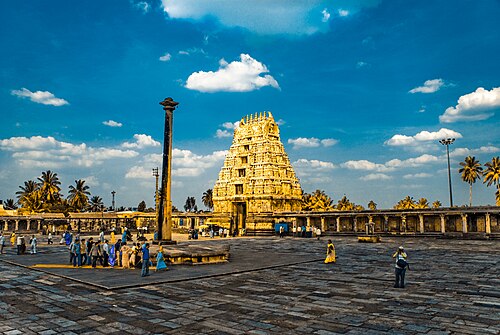
You are now standing before the impressive eastern entrance tower, known as the gopuram, and the sturdy enclosure wall that safeguards the sacred Chennakeshava temple complex in Belur. As you look upward, you can see the imposing seven storey brick structure reaching toward the sky, serving as a grand portal into this holy sanctuary. …
03 Courtyard Pillars and the Vasudeva-Sarovara Stepped Tank
As you step through the eastern gopuram into the expansive open courtyard, measuring four hundred and forty three feet by three hundred and ninety six feet, two remarkable stone pillars standing prominently on the paved court immediately draw your attention. Directly facing the main shrine is the magnificent Garuda sthambha, erected during the Vijayanagara period to honor the divine eagle Garuda, the sacred mount of Lord Vishnu. …
04 Queen's Devotion: Kappe Chennigaraya and Viranarayana Shrines
As you walk along the southern side of the main sanctuary, you will arrive before the exquisite Kappe Chennigaraya temple. Measuring one hundred and twenty four feet by one hundred and five feet, this impressive shrine was built concurrently with the main temple in eleven seventeen under the direct sponsorship of Queen Shantala Devi, the beloved consort of King Vishnuvardhana. …
05 Epic Carvings on the Star-Shaped Jagati Platform
Let us now step up onto the jagati, the wide stone terrace elevated about three feet above the ground that supports the main Chennakeshava temple. Following the intricate star shaped contour of the shrine, this platform provides a spacious circumambulatory path known as the pradakshina patha, allowing worshippers to walk clockwise around the sacred structure while admiring its outer walls. …
06 Navaranga Hall: Lathe-Turned Pillars and Celestial Dome
Stepping past the guarded doorways into the inner navaranga hall, you enter a mystical and dimly lit space filled with profound spiritual tranquility. The navaranga in the Kesava temple at Belur is the largest of any Hoysala temple, arranged in a brilliant diamond shaped triratha layout featuring sixty individual compartments or bays supported by forty eight exquisitely carved stone pillars. …
07 Sanctum Sanctorum: The Divine Beauty of Chennakeshava
At the westernmost end of the navaranga hall, you stand before the sacred threshold of the garbha griya, the innermost sanctum sanctorum housing the primary deity. Guarding the entrance to this holy shrine are two imposing dvarapala guardian statues, Jaya and Vijaya, who stand watch on either side of the doorway. Above the doorway lintel, a central pediment displays a majestic relief of Lakshminarayana, under which sculpted musicians play various twelfth century musical instruments. …
08 Closing
As we conclude our tour of the main Chennakeshava sanctuary and step back into the courtyard, we encourage you to explore several other historical monuments located just a short distance away in Belur. Approximately four hundred meters northwest of the main gopuram stands the Shankareshvara temple, dedicated to Shiva. …