 Photo Wikimedia Commons
Contents
History & cultureBY TELLBY8 sections · numbered as on the map01 Orientation
Welcome to the Kasturba Road Museum Precinct, a vibrant cultural node where the rich history and artistic heritage of Bengaluru come alive. You are currently standing at the entrance along Kasturba Road, a historic thoroughfare formerly known as Sidney Road. This important avenue connects MG Road in the north to JC Road in the south, running through the heart of the central business district. As you look around, you will notice an extraordinary concentration of iconic landmarks. Surrounding this area are the lush green expanses of Cubbon Park, the Karnataka High Court, Vidhana Soudha, and Chinnaswamy Stadium. Nearby, you will also find Sree Kanteerava Stadium, Kanteerava Indoor Stadium, UB City, and a six hundred year old Ganesha temple. Most notably, this road brings together three major cultural institutions: the Government Museum, the Venkatappa Art Gallery, and the Visvesvaraya Industrial and Technological Museum.
The Government Museum, established on August eighteenth eighteen sixty five under Mysore State, holds a distinguished position as one of the oldest museums in India and the second oldest in South India. The institution owes its foundation to the advice of Surgeon Edward Balfour, a medical officer of the Madras Army who founded the museum in Madras in eighteen fifty one. Balfour, who had organized zoological and natural specimens for the Great Exhibition of eighteen fifty one, recommended setting up a similar repository in Bengaluru. His proposal received strong support from LB Bowring, the Chief Commissioner of Mysore State. A formal notification was published in the Mysore Government Gazette on April seventeenth eighteen sixty six, inviting citizens to contribute cultural and natural artifacts for display. A copy of this gazette notice is preserved in the Karnataka State Archives in Bengaluru.
During this audio tour, we will explore this precinct in a guided sequence. We begin in front of the striking red neoclassical facade of the Government Museum. We will then examine the Epigraphy Gallery, home to the Halmidi inscription from four hundred fifty AD, the earliest known Kannada inscription, alongside slabs from Begur and Atakur. We will journey through the Sculpture Gallery to admire masterpieces from the Hoysala, Gandhara, and Nolamba periods, prehistoric pottery from Chandravalli, Mohenjodaro artifacts, and a model of Tipu Sultans Srirangapatna fort. Outside, we will inspect a World War I trophy field gun and outdoor sculptures. Next, we will visit the adjacent Venkatappa Art Gallery, celebrating modern art and the legacy of K Venkatappa. Finally, we will stroll along the green avenues of Cubbon Park. Let us now move toward the main facade of the Government Museum to begin.
02 Government Museum Facade: Neoclassical Architectural Legacy
Please step forward to a position where you can fully appreciate the grand front facade of the Government Museum. The impressive red structure standing before you is the primary museum building, located centrally along Kasturba Road. It is flanked on one side by the Visvesvaraya Industrial and Technological Museum and on the other by the Venkatappa Art Gallery, forming an exceptional architectural ensemble. …
03 Epigraphy Gallery: Ancient Inscriptions of Karnataka
As we step carefully into the interior exhibition halls of the Government Museum, we enter the Epigraphy Gallery, which houses some of the most precious treasures in the entire collection. As an archaeological museum, this institution holds a rare assembly of archaeological and geological artifacts, including ancient jewellery, coins, and stone inscriptions. …
04 Sculpture Gallery: Masterpieces of Hoysala, Gandhara, and Nolamba
We now enter the grand Sculpture Gallery, part of the museum complex that spans two exhibition floors divided into eighteen distinct galleries. These exhibition spaces cover diverse subjects including stone sculpture, natural history, geology, fine arts, music, and numismatics. The core of this vast collection traces its origins back to the pioneering efforts of Benjamin L Rice of the Mysore Gazetteer, whose original collection formed the museum foundation. …
05 Venkatappa Art Gallery: Modern and Contemporary Art Space
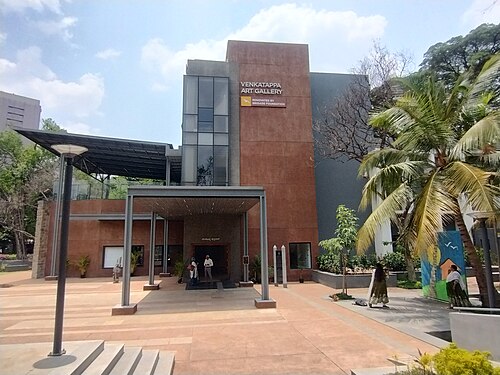
We have now arrived at the entrance of the Venkatappa Art Gallery, located directly adjacent to the Government Museum along Kasturba Road. Because these two iconic institutions stand side by side, visitors frequently mistake the Venkatappa Art Gallery for the Government Museum. However, despite their physical proximity, they are fundamentally different institutions with distinct historical missions. …
06 Museum Grounds: World War I Trophy and Outdoor Sculptures
We now step out into the open air grounds and surrounding garden space of the Government Museum. While the indoor galleries showcase delicate epigraphic slabs and intricate antiquities, the outdoor precinct presents a captivating collection of large scale stone sculptures and historical monuments set against the natural green backdrop of the museum lawn. …
07 Heritage Promenade: Connecting Attara Kacheri and Cubbon Park Avenues
Leaving the immediate museum complex, we now step onto the heritage promenade that seamlessly connects the museum grounds to the avenues of Cubbon Park. Extending symmetrically from the central hall of the historic Attara Kacheri building, this formal promenade links the museum with one of the most magnificent architectural landmarks in South India. …
08 Closing
This brings our audio guide tour of the Venkatappa Art Gallery and Government Museum precinct to a successful conclusion. Today, we have walked through one of the most culturally dense quarters of Bengaluru, tracing a remarkable journey across five thousand years of history, epigraphy, sculpture, and modern artistic practice along Kasturba Road. …