Contents
History & cultureBY TELLBY8 sections · numbered as on the map01 Orientation
Welcome to the sacred domain of Udayagiri, nestled near the town of Vidisha in Madhya Pradesh, where the serene Betwa River merges with its tributary, the Bes River. As you step onto this red sandstone landscape, you are standing at a sanctuary whose very name in Sanskrit translates to the Sunrise Mountain. In the most ancient epigraphic records preserved upon these cliffs, this ridge was reverently inscribed as Visnupadagiri, a name signifying the holy hill positioned at the feet of Lord Vishnu. Long before the rock-cut caves were carved into the cliffs, Udayagiri served as a premier astronomical center and a seat of Saura sun-worship dating back to at least the second century BCE. Ancient astronomers and priests recognized the unique geographical alignment of this sandstone ridge. Over two millennia ago, during the summer solstice, the midday sun stood directly overhead at its zenith, illuminating the horizontal rock strata without casting a single shadow. This dramatic solar phenomenon invested the ridge with immense cosmic significance, establishing it as a bridge between the terrestrial realm and the divine heavens. During the golden age of classical India, in the late fourth and early fifth centuries CE, the great Gupta Emperor Chandragupta II transformed this astronomical height into a monumental canvas of imperial theology and artistic devotion. Under royal patronage, master sculptors and stonemasons excavated twenty distinct cave sanctuaries directly out of the living sandstone, stretching across a ridge two point five kilometers long. Udayagiri holds an extraordinary position in South Asian archaeology as the only site that can be verifiably tied to specific Gupta monarchs through original royal Sanskrit inscriptions. Within these twenty rock-cut chambers, the major spiritual traditions of ancient India thrive in harmonious proximity. Here, the grand cosmic narratives of Vaishnavism, the introspective depth of Shaivism, the maternal power of Shaktism, and the ascetic discipline of Jainism peacefully share the same holy mountain. As we prepare to begin our walking tour along the southern foothills toward the summit, take a moment to adjust your footwear, breathe in the historic air, and listen to the silent echoes of ancient chisels that transformed solid rock into an everlasting sanctuary of faith and empire.
02 The Foot of the Hill and the War God Skanda
As we turn left from the main entrance area and proceed along the tranquil path hugging the southern foothills of the ridge, we arrive at the initial cluster of rock-cut monuments, comprising Cave 1 and Cave 3. Please pause first before Cave 1 to inspect its peculiar architectural configuration. Unlike conventional subterranean caverns excavated deep into cliff faces, Cave 1 is an ingenious structure frequently classified by architectural historians as a false cave. …
03 Cave 4: The Harmony of Music and Sacred Shiva
Continuing our progress along the rock face, we step up to Cave 4, an architectural and iconographic treasure historically designated as the Vina Cave. It received this musical moniker from the pioneering nineteenth-century archaeologist Sir Alexander Cunningham, who was captivated by the extraordinary musical instruments sculpted into its portal. Approach the entrance to inspect its ornate doorway frame. …
04 Cave 5: The Masterpiece of Cosmic Rescue by Varaha
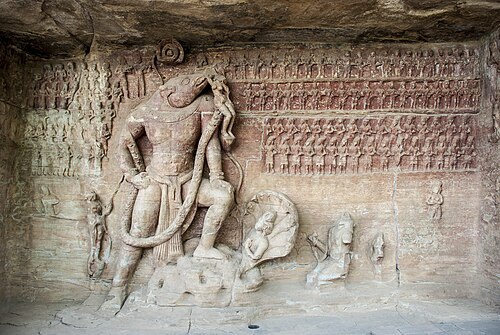
Step forward into Cave 5, home to the unquestioned crown jewel of Udayagiri and one of the absolute masterpieces of Indian art: the Colossal Varaha Panel. This grand rock-cut relief serves as the monumental artistic centerpiece of the entire cave complex. The panel narrates the celebrated Vedic legend of Lord Vishnu incarnating as Varaha, the colossal man-boar avatar, to rescue the earth goddess Bhudevi from cosmic devastation. …
05 Caves 6 and 7: Divine Feminine Power and the 401 CE Royal Record
Moving past the Varaha panel, we arrive at Caves 6 and 7, an extraordinary zone rich in royal epigraphy and divine feminine iconographies. Cave 6 is entered through a finely crafted T-shaped portal flanked by dvarapala gatekeepers. Inspect the outer wall reliefs surrounding this entrance to discover two pivotal depictions in early Hindu iconography. To the right of the portal, observe the imposing ten-armed figure of Goddess Durga in her Mahishasuramardini form. …
06 The Ancient Passage and the Reclining Lord Vishnu
Leaving Caves 6 and 7, we enter a narrow, rock-cut canyon known simply as The Passage, carved directly through the vertical sandstone bedrock. As you walk along this cool rock corridor, look up at the high wall surfaces. Here you will observe large, elegant characters known as Sankha Lipi, or Shell Script, named after their distinctive shell-like swirling flourishes. Epigraphers highlight that these undeciphered characters were cut through when the cave chambers were excavated in 401 CE. …
07 Cave 19, the Jain Sanctuary, and the Summit Vista
Ascending higher along the stone path, we reach Cave 19, the largest sanctuary in the complex, spanning six point seven meters in length, historically known as the Amrita Cave. Inside this expansive square hall, four massive stone pillars support the ceiling. Look at the pillar capitals, decorated with horned and winged lions. Architectural historians note that the ceiling is divided into nine square structural panels by architraves crossing over these interior pillars. …
08 Closing
Our journey through the twenty rock-cut sanctuaries of Udayagiri now comes to its peaceful conclusion as we follow the descending path back toward the exit. The Udayagiri Caves represent far more than an ancient archaeological site. From the colossal cosmic rescue of Varaha to the serene face of Shiva, the formidable power of Durga, and the peaceful renunciation of the Jain monk, this sunrise mountain captures the absolute pinnacle of Gupta art and the remarkable spirit of religious tolerance…