 Photo Wikimedia Commons
Contents
History & cultureBY TELLBY8 sections · numbered as on the map01 Orientation
Welcome to Junagarh Fort, a majestic royal heritage located in the heart of Bikaner, Rajasthan. My name is your dedicated audio guide, and I am honored to walk you through the splendid history and architecture of this unique fortress. Before we begin our walkthrough, let us step back in time to understand how this magnificent city and fort came to exist in the middle of the Thar Desert. Prior to the mid fifteenth century, this vast arid region was a barren wilderness known as Jangladesh. It was inhabited by Jat clans who governed themselves according to their long standing customary laws. In 1488, Rao Bika, who was the eldest son of Maharaja Rao Jodha of Jodhpur, arrived in this northern territory. Wanting to create his own independent kingdom rather than simply inherit Jodhpur from his father, Rao Bika set out to conquer the desert lands. According to historical accounts recorded by James Tod, the spot chosen for the capital belonged to a local proprietor named Nehra or Naira Jat. Nehra agreed to concede his birthright on the sole condition that his name would be perpetually linked with the city's identity. Thus, Rao Bika combined his own name with Nehra, creating the name Bikaner, meaning the settlement of Bika and Nehra. Earlier in 1478, Rao Bika had built his first fortress, Bikaji Ki Tekri, which today lies in ruins. Even though Bikaner was situated deep within the arid Thar Desert, it flourished as a vital oasis along the prosperous trade routes connecting Central Asia with the ports of the Gujarat coast due to its reliable spring water supply. A century after Rao Bika established the original settlement, the state reached a golden era under its sixth ruler, Raja Rai Singhji, who reigned from 1571 to 1611. Between 1588 and 1593, Raja Rai Singh built a brand new fort approximately one point five kilometers from the old city center. This fortress was initially named Chintamani Durg, which translates to the fort of the mind's jewel, before becoming widely known in later centuries as Junagarh Fort, or the Old Fort. Unlike most major fortresses across Rajasthan that were strategically constructed on steep, elevated hills, Junagarh Fort was built on a flat plain at an average elevation of two hundred thirty meters. Over the centuries, successive rulers added new floors, grand public audience halls, mirror decorated private chambers, and secluded royal quarters, creating the complex you see today. As you walk through the fortress, please keep to the designated walking paths and enjoy the stories etched into these red sandstone walls. Now, let us move toward the main entrance to explore the formidable exterior walls and the Sun Gate.
02 Surajpol: The Sun Gate and Desert Defense
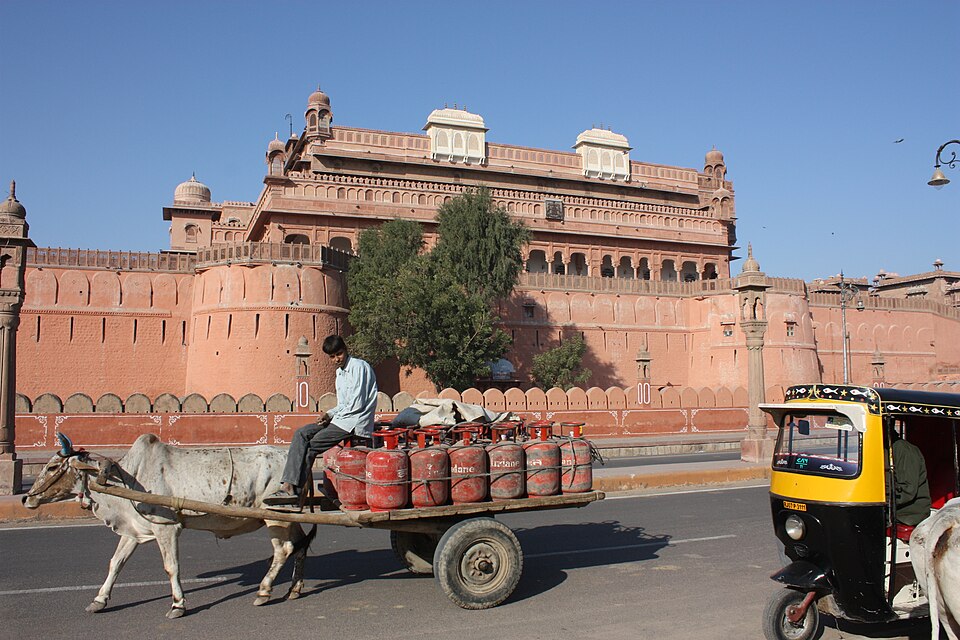
We are now standing before Surajpol, which translates to the Sun Gate, the primary entrance of Junagarh Fort. Take a moment to admire the sheer scale and rich reddish color of the fortress walls stretching before you. The entire fort is constructed using red sandstone, locally known as Dulmera stone, which gives the structure its striking appearance and earned Bikaner its world famous nickname, The Red City. …
03 Karan Mahal: The Palace of Public Audiences
Step into Karan Mahal, one of the earliest and most historically significant palaces within the Junagarh Fort complex. This magnificent palace was originally constructed by Maharaja Karan Singh, who ruled the princely state of Bikaner under Mughal suzerainty from 1631 to 1639. As you walk through this spacious hall, notice the graceful arcades, delicately carved marble and sandstone pillars, and harmonious architectural proportions. …
04 Anup Mahal: The Splendor of Gold and Glass
Welcome to Anup Mahal, widely regarded as the absolute crown jewel of Junagarh Fort's interior palace architecture. This breathtaking hall represents the absolute pinnacle of royal luxury and artistic refinement in Bikaner. The transformation of this space began under Maharaja Anup Singh, who ruled the state from 1669 to 1698. …
05 Chandra Mahal: The Moon Palace
Welcome to Chandra Mahal, or the Moon Palace, one of the most romantic and exquisitely crafted private chambers inside Junagarh Fort. The creation of this soothing royal retreat is attributed to Maharaja Gaj Singh, who ruled Bikaner from 1746 to 1787. Maharaja Gaj Singh extensively refurbished Chandra Mahal to serve as an opulent private sanctuary for the sovereign's personal relaxation. …
06 Badal Mahal: The Palace of Clouds
You have now entered Badal Mahal, which translates to the Palace of Clouds or the Weather Palace. This unique chamber was built during the reign of Maharaja Dungar Singh, who ruled Bikaner from 1872 to 1887. To fully appreciate the remarkable art surrounding you in this room, one must first understand the harsh environment of Bikaner. …
07 Ganga Mahal and Maharaja Karni Singh Museum
We are now exploring Ganga Mahal and the Maharaja Karni Singh Museum, structures that showcase the modern era and international significance of the Bikaner royal state. Ganga Mahal was constructed by General Maharaja Ganga Singh, who ruled from 1887 to 1943 and was one of the most prominent and visionaries of Indian princes. …
08 Closing
As our tour comes to an end, we conclude our exploration of Junagarh Fort here in its peaceful central courtyard. Standing on a flat plain in the very heart of Bikaner, this red sandstone fortress remains an enduring symbol of Rathore courage, architectural genius, and artistic brilliance. From Rao Bika's first settlement in Jangladesh to the grand expansions under Rai Singh, Anup Singh, and Ganga Singh, every corner of this fort reflects the rich heritage of the royal family. …