Contents
History & cultureBY TELLBY8 sections · numbered as on the map01 Orientation
Welcome to Padmini's Palace, located within the majestic Chittor Fort, a place where Rajasthan's nobility, honor, and tragic grand history converge. Standing here on this elevated plateau rising 180 meters above the surrounding plains drained by the Berach River, you are witnessing one of the largest fortresses in all of India. Sprawling over an impressive area of 280 hectares, Chittor Fort stands as a monumental testament to India's enduring heritage and architectural brilliance, encompassing 65 historic built structures including four grand palaces, 19 large temples, 20 functional water reservoirs, and iconic victory towers.
Originally known as Chitrakut, this formidable fortress was initially constructed in the 7th century by Chitrangada Mori, a ruler of the Mori dynasty. Early Buddhist stupas dating back to the 9th century near the Jaimal Patta lake offer glimpses into the site's multi-layered history. By the early 8th century, around 728 or 734 AD, the legendary Guhila ruler Bappa Rawal captured the fort, establishing it as the historic capital of Mewar. Across the centuries, this massive hilltop stronghold served as the seat of power for successive Rajput rulers, incorporating functional water systems and monumental structures that echo the valor of ancient kings and queens.
Among the historical treasures housed inside Chittor Fort, Padmini's Palace, situated in the southern region of the fortress complex, holds a deeply revered place. Dating back to the 13th century, this palace is inextricably bound to the legend of Rani Padmini, the revered queen of King Ratnasimha, also known as Ratan Sen. In the year 1303, Sultan Alauddin Khalji of the Delhi Sultanate led a massive military campaign against Chittorgarh. Following an arduous eight month siege, when defeat became imminent, Queen Padmini and her female companions chose an act of supreme sacrifice. To protect their chastity, dignity, and honor from the invading forces, they committed Jauhar, a ritual mass self immolation on a burning pyre, while the Rajput warriors opened the fortress gates and fought to the death on the battlefield in an act known as Saka.
This epic tale of sacrifice and unyielding pride was later immortalized in 1540 by the Sufi poet Malik Muhammad Jayasi in his celebrated poem Padmavat, as well as in numerous subsequent Jain and Rajput traditions. Beyond being a royal residence, Padmini's Palace remains an enduring symbol of courage, moral fortitude, and Rajput heritage. As you begin your walk through this sacred site, let us step forward together to explore its defensive pathways, elegant courtyards, and the timeless history carved into every block of sandstone.
02 Palace Main Gateway & Defensive Entrance
As you arrive at the main gateway and outer defensive walls of Padmini's Palace, take a moment to admire the warm, reddish hue of the surrounding masonry. Constructed primarily from locally sourced Rajasthan sandstone, this historic entrance showcases both aesthetic elegance and remarkable scientific ingenuity. Sandstone possesses a high thermal mass, meaning it can absorb heat during the scorching daytime hours and release it slowly when temperatures drop at night. …
03 Central Courtyard / Chowk
Stepping into the inner sanctuary of the palace, you now find yourself standing in the central courtyard, traditionally referred to as the Chowk. Serving as the functional and cultural heart of Padmini's Palace, this open-air courtyard was the primary gathering space where daily royal life, sacred rituals, and official assemblies took place. Architecturally, this courtyard exhibits remarkable acoustic design principles. …
04 The Mirror Room / Shish Mahal
You have now stepped inside the Mirror Room, widely known as the Shish Mahal, one of the most famous and visually mesmerizing chambers within Padmini's Palace. As you inspect the walls and ceiling, you can see delicate glass mosaics and reflective mirror pieces embedded into the plasterwork. In medieval times, long before modern electricity, when a single candle or oil lamp was lit in the center of this room, thousands of tiny mirror facets reflected the flickering flame, creating a dazzling…
05 Water Moat & Island Pavilion / Jal Mahal Prototype
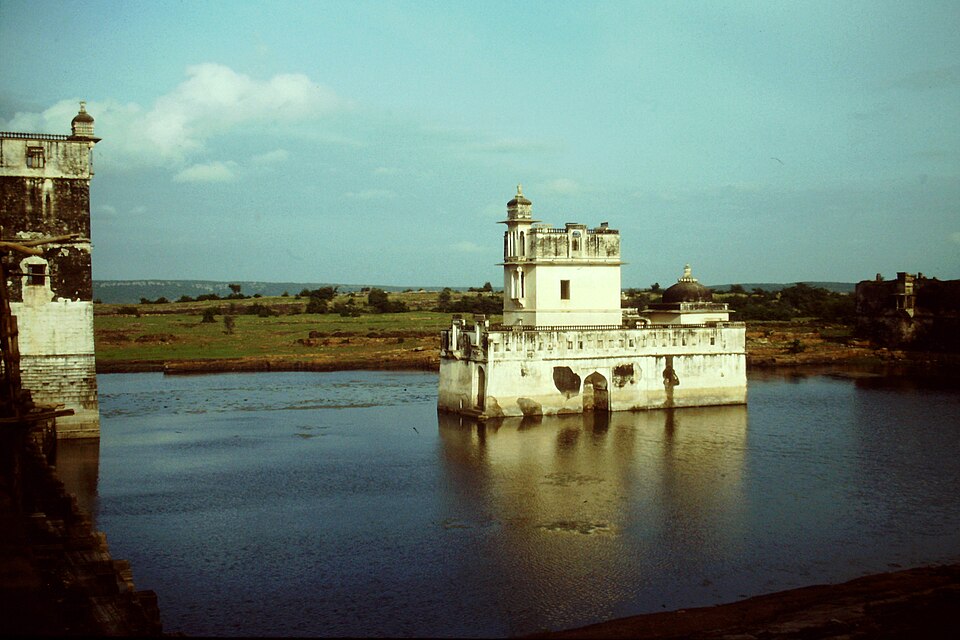
Stepping out toward the outer courtyard, your eyes are immediately drawn to the tranquil water moat surrounding the palace and the striking three-storied white pavilion rising gracefully from its center. This water feature served both aesthetic and functional purposes. Structurally, the moat acted as a protective defensive barrier against intruders, while simultaneously creating a cooling microclimate through evaporative cooling around the living quarters. …
06 Bada Mahal & Strategic Vantage Point
Ascending to the uppermost level of the palace complex, you arrive at the magnificent Bada Mahal, which translates literally as the Big Palace or Great Pavilion. Occupying the highest elevation within Padmini's Palace, the Bada Mahal provides an extraordinary panoramic vantage point over the entire surrounding landscape. …
07 Kalika Mata Temple Opposite the Palace
Looking directly across from the entrance of Padmini's Palace, you will observe the grand architectural silhouette of the Kalika Mata Temple. Situated just steps away from the palace complex, this ancient temple shares a deep spatial and spiritual relationship with Padmini's Palace, serving as one of the oldest and most sacred religious sanctuaries inside Chittor Fort. …
08 Closing
Ladies and gentlemen, this concludes our audio docent tour of Padmini's Palace within the historic Chittor Fort. The remarkable site you have explored today gained global recognition in June 2013 during the 37th session of the UNESCO World Heritage Committee held in Phnom Penh, Cambodia, where Chittor Fort was inscribed as a UNESCO World Heritage Site under criteria ii and iii as part of the serial property known as the Hill Forts of Rajasthan. …