Contents
History & cultureBY TELLBY8 sections · numbered as on the map01 Orientation
My feet are in Pugal, my torso in Merta, and my shoulders in Barmer. When I lose my way, you can find me in Jodhpur too, but I truly reside in Jaisalmer.
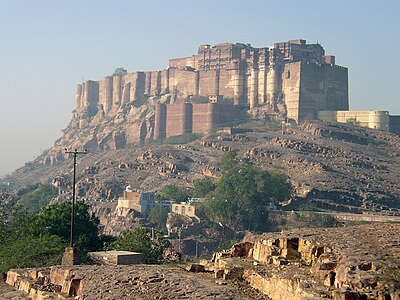
This ancient Rajasthani folk verse vividly captures the geography of the Thar Desert and sets the scene for Jodhpur, situated at the eastern gateway of this arid realm. Welcome to Mehrangarh Fort and its extraordinary five-hundred-year-old water harvesting trail. In a desert landscape where survival depends on foresight, establishing a thriving city and sustaining a heavily populated fortress required an absolute mastery over water management. In this part of India, eighty to ninety percent of the total annual precipitation falls exclusively within the brief months of the monsoon season. Because of this extreme rainfall pattern, capturing every single drop of rainwater during the wet season was the ultimate prerequisite for enduring the long, punishing months of dry heat that followed.
When Rao Jodha, the founder of Mehrangarh Fort, selected Pachetia Hill in the fifteenth century, he prioritized its formidable cliffside defenses. At that time, a natural waterfall streamed down the rugged red sandstone terrain. However, this secluded spot served as the sacred hermitage and meditation site of a revered ascetic named Saint Chidiya Nath Ji. Disturbed by the encroachment of royal construction, the saint pronounced a severe curse upon the realm, foretelling that the new fortress would suffer perpetual droughts and famines. Driven by the urgent threat of this curse, Rao Jodha and his court recognized that engineering a foolproof water harvesting network was just as vital as erecting impenetrable defensive walls. More than five centuries ago, long before the advent of electrical power or modern mechanical machinery, the builders devised an ingenious water management system that transformed the natural slope of the sandstone hills into an integrated hydrological network.
On this tour, you will walk along the historical water trail that sustained life inside this desert citadel. You will trace how monsoon runoff was collected from the expansive valley catchment of Dhobi Kund, slowed down through the engineered rock cut canal of Hathi Nahar, purified through natural sedimentation dips at the entry of Ranisar Lake, elevated by Persian wheels known as Arahat, and stored across interconnected twin reservoirs including Padamsar Lake. Even today, heavy monsoon rains revitalize these ancient channels, directing water through centuries-old pathways to replenish the fort. Let us begin our walking tour to discover how indigenous engineering and environmental wisdom turned a harsh desert rock into a self-sufficient sanctuary.
02 Chidiya Nath Ji ka Tanka: Where the Fort's History Began
Our first stop brings us to Chidiya Nath Ji ka Tanka, also commonly known as Chidiya Nath Ji ka Hauz, located deep within the interior bedrock of Mehrangarh Fort. This historic water tank marks the precise physical location where the origin story of the fortress and the city of Jodhpur unfolded. As you stand in this historic spot, direct your eyes toward the rugged red sandstone cliff face looming above. …
03 Hathi Nahar: Calibrating the Speed of Running Water
Our second stop brings us to Hathi Nahar, popularly translated as the Elephant Canal, a magnificent rock cut channel specifically engineered to control and calibrate the flow velocity of surging rainwater. As you walk alongside this historical canal, take a moment to admire the massive walls of exposed red sandstone rising on either side. This spot demonstrates how ancient Rajasthani hydro-engineers mastered the immense kinetic energy of seasonal floodwaters. …
04 Ranisar Lake Entry: Natural Filtration and Fortified Protection
Our third stop brings us to the Entry Point of Ranisar Lake and its Fortified Protection Wall, where the calibrated rainwater from Hathi Nahar crosses the threshold into the fortress perimeter. Ranisar Lake was constructed between 1459 and 1460 under the explicit royal sponsorship of Rani Jasmade Hadi Ji, the senior queen of Rao Jodha, specifically to guarantee a permanent, long-term water reserve for the fortress and its surrounding city. …
05 Arahat and Kuiyaan: Lifting Water and Tapping Underground Reservoirs
Our fourth stop brings us to the Arahat and Kuiyaan complex at Ranisar Lake, where stored water was mechanically lifted up steep fortification cliffs and tapped from underground aquifers during severe dry seasons. In ancient and medieval India, many fortresses were perched high upon rocky citadels, making the vertical transportation of water from low-lying reservoirs to elevated living quarters a critical engineering challenge. …
06 Aqueducts and Tanks: Vertical and Horizontal Water Distribution
Our fifth stop brings us to the Aqueducts and Chokelao Well Complex, illustrating the sophisticated two-dimensional water distribution network that moved liquid both vertically and horizontally across the steep fortress slopes. Once water was mechanically elevated from Ranisar Lake by the main Arahat Persian wheel, it entered a network of inclined sandstone channels constructed directly along the sloping ramparts. …
07 Padamsar Lake: The Interconnected Twin Reservoir
Our sixth stop brings us to Padamsar Lake, the interconnected twin reservoir located in the valley immediately adjacent to Ranisar Lake. Constructed in the fifteenth century shortly after the laying of Mehrangarh Fort's foundation, Padamsar Lake represents another crown jewel of royal water architecture. …
08 Closing
Our walking audio tour along the five-hundred-year-old water trail of Mehrangarh Fort has now reached its conclusion. Today, we have journeyed through a brilliant hydrological network that begins at the sandstone catchment valley of Dhobi Kund, flows through the flow-calibrating rock canal of Hathi Nahar, enters the naturally filtered and fortified reservoir of Ranisar Lake, ascends via the Persian wheels and hidden kuiyaan wells of Arahat, distributes across the inclined aqueducts of the…