 Photo Wikimedia Commons
Contents
History & cultureBY TELLBY8 sections · numbered as on the map01 Orientation
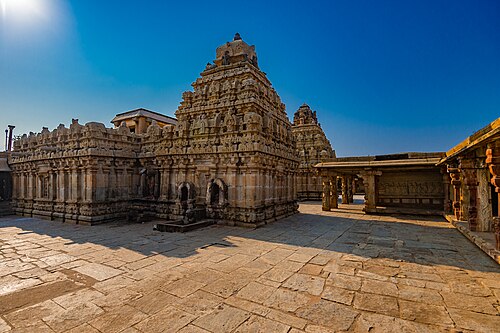
Welcome to Shree Bhoga Nandishwara Temple, an astonishing thousand-year-old sanctuary resting quietly at the foot of Nandi Hills in Nandi Village, located within the Chikkaballapur district of Karnataka, just sixty kilometers northeast from Bengaluru. As you stand before the grand un-finished gopuram entrance, you are stepping directly into a profound chronicle of South Indian architectural heritage. While many hurried travelers hasten past to catch the morning sunrise at the summit of Nandi Hills, this temple complex below remains one of the finest, most ornate, and complete masterpieces of Dravidian design ever constructed. What makes this sacred space extraordinary is its rich multi-dynastic lineage spanning over seven centuries of royal patronage. Originally founded in the ninth century by Queen Ratnavali of the Bana Dynasty, the complex grew significantly under the Nolamba Dynasty during the reign of King Mahendra the First and his revered mother Queen Devalabbarasi, alongside patronage from the Rashtrakuta Emperor Govinda the Third, giving birth to the distinct Nolambavadi artistic style. Subsequent expansions were carried out by the Western Gangas, the Chola Empire, the Hoysala Dynasty, the Vijayanagara Empire, and later the Yelahanka Gowda rulers. Remarkably, none of these ruling dynasties erased, defaced, or overrode the artistic creations of their predecessors. Instead, each generation added its own distinct craftsmanship while meticulously retaining the original aesthetic, exhibiting a rare architectural gesture of mutual respect across centuries. Furthermore, the overall layout embodies a deeply sacred spatial philosophy. Unlike traditional single-shrine temples, this sanctuary is designed as a three-dimensional spatial mandala representing the life journey of Lord Shiva across distinct shrines. Here at the base of the hill, Arunachaleswara signifies childhood and the dawn of existence, Bhoga Nandishwara represents youth and prime vitality, while Uma Maheshwara symbolizes divine union and marital fulfillment. Meanwhile, the Yoga Nandeeshwara Temple atop Nandi Hills embodies the fourth and final stage of renunciation and spiritual liberation. Devotees traditionally circumambulated these shrines in sequence, walking through a physical manifestation of life's spiritual progression. As you prepare to explore these sacred grounds, please observe traditional temple etiquette. Kindly remove your footwear before stepping onto the mandapa platforms, maintain a respectful demeanor, refrain from touching the delicate ancient stone carvings, and avoid flash photography inside the inner sanctums. Let us begin our walking journey into this timeless marvel of stone, faith, and ancient Dravidian engineering.
02 Arunachaleswara Shrine and Climate Control Jalis
Please move toward the southern portion of the main open courtyard, where you will find the Arunachaleswara shrine. Built during the early Nolamba period in the ninth century, this shrine stands as the oldest surviving structure in the complex and represents the childhood stage and dawn of Lord Shiva's divine life. …
03 Bhoga Nandishwara Main Shrine and Royal Patronage
Now, let us walk northwards to the central focus of the entire complex, the Bhoga Nandishwara main shrine. This magnificent sanctuary represents the second stage of Lord Shiva's life journey, symbolizing youth, vitality, material abundance, and the prime of existence. As you step inside the outer hall of this main shrine near the sanctuary entrance, look carefully for a quiet, deeply moving stone sculpture of King Rajendra Chola the First. …
04 Uma Maheshwara Shrine and the Single-Stone Chatra
Positioned directly between the twin major shrines of Arunachaleswara and Bhoga Nandishwara lies the exquisite Uma Maheshwara shrine. This sanctuary represents the third stage of Lord Shiva's life story, symbolizing divine marriage and sacred spiritual union with Goddess Parvati. Because of this sacred symbolism of marital fulfillment, newlyweds from across Karnataka and South India frequently journey here to seek divine blessings for a harmonious and prosperous life together. …
05 Kalyana Mantapa: The Crown Jewel of Hoysala Artistry
Step into the open pavilion attached to the Uma Maheshwara shrine to enter the Kalyana Mantapa, the sacred marriage hall. Constructed during the twelfth to thirteenth centuries under the artistic patronage of the Hoysala Dynasty, this open pavilion is widely regarded as the crowning jewel of sculptural artistry within the entire temple complex. As you stand among the soaring pillars, take a moment to examine their unique lathe-turned cylindrical shapes. …
06 Navaranga Hall and Acoustic Engineering
Walk north into the expansive pillared hall known as the Navaranga Hall and Vasantha Mantapa, expanded during the sixteenth century under the Vijayanagara Empire. As you step beneath its soaring stone roof, you are surrounded by dramatic grey-green granite pillars decorated with fierce relief carvings of the Yali, a mythical protective beast combining features of a lion, elephant, and horse, accompanied by finely carved attendant maidens. …
07 Shringi Teertha: Ancient Hydrology and Reflection Mandala
Now, exit through the northern perimeter wall to discover the magnificent stepped temple tank known as Shringi Teertha Pushkarini. Expanded during the Vijayanagara era, this massive stone water reservoir is deeply revered as the mythical source of the South Pinakini River, also known as the South Pennar, named after Sage Shringi who performed intense penance here according to the sacred Nandimahatmya text. …
08 Closing
As you stand near the tranquil waters of Shringi Teertha or rest in the quiet stone courtyards, our audio-guided tour of Shree Bhoga Nandishwara Temple comes to a close. This sanctuary is far more than an ancient monument preserved under glass by the Archaeological Survey of India. It is a vibrant, living temple where oil lamps have been lit, Sanskrit mantras chanted, and daily worship offered continuously for over a thousand years. …