 Photo Wikimedia Commons
Contents
History & cultureBY TELLBY8 sections · numbered as on the map01 Orientation
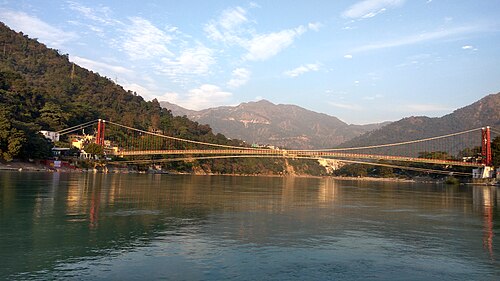
Welcome to Lakshman Jhula Bridge and the sacred upper Ganga region of Uttarakhand India. You are standing at one of the most revered spiritual centers nestled within the historic Tehri Garhwal district where the holy river flows out of the high Himalayan glacial headwaters into the sacred pilgrimage zones of the lower foothills. In the rich cultural traditions of India rivers are never viewed as simple channels of flowing water. They are personified as mother deities possessing an unequalled sacred aura and a deep nurturing character. The river Ganga holds a supreme position in human consciousness as a self purifying goddess named Ganga Devi who descended from the heavens to nourish all living beings and cleanse humanity of its spiritual burdens. This living spiritual connection is so powerful that in two thousand seventeen the High Court of Uttarakhand granted the rivers Ganga and Yamuna the status of legal persons possessing all corresponding rights duties and liabilities taking inspiration from New Zealand recognition of the Whanganui River. This groundbreaking legal declaration recognized that harming the sacred river is equivalent to committing harm against a human being. Yet despite this revered status the river faces monumental ecological threats. Everyday approximately one point five billion liters of untreated sewage and five hundred million liters of industrial waste flow into the river system. Furthermore the Gaumukh glacier the very glacial snout where the river is born has been receding at a rate of ten to forty meters every year due to global environmental changes. As you prepare to explore this extraordinary heritage site our guided walking journey will take you across eight key physical and spiritual locations surrounding the Lakshman Jhula suspension bridge. This iconic bridge serves as a monumental gateway connecting the western bank with the historic ashrams and sacred precincts of the eastern shore. Here along the banks where the Bhagirathi and Alaknanda rivers flow the natural landscape and human devotion embrace each other completely resolving the timeless philosophical concepts of Purusha and Prakriti representing humanity and nature into a unified harmony. Before we begin walking please take a moment to review a few essential safety recommendations. The pathways surrounding the bridge feature stone steps busy pedestrian walkways and narrow viewing areas near the rushing river edge. Please walk at a comfortable pace remain mindful of your footing at all times and avoid leaning over protective barriers when observing the swift glacial currents below. Let us now move forward toward the western approach of the bridge where our detailed historical exploration begins.
02 Western Approach and the Legend of Prince Lakshman
You are now standing at the western approach and cable anchor platform of Lakshman Jhula Bridge. Look down at the solid granite bedrock supporting your feet on this western shore. This precise spot serves as a remarkable crossroads where ancient Indian epic literature meets the impressive history of early twentieth century civil engineering. …
03 Mid-Bridge Over the Sacred River Ganga
As you step into the absolute middle of the suspension bridge please find a safe space along the sturdy side railing and pause to absorb the breathtaking panorama below. From this central vantage point you are looking down directly at the luminous turquoise waters of the sacred river Ganga as it flows swiftly through the forested gorge of the Garhwal Himalayas. …
04 Eastern Bridge Tower and Architectural Heritage
Having completed your crossing of the main suspension span you have now arrived at the eastern bridge tower and cable anchor platform. Similar to its counterpart on the western bank this massive structural anchor embeds heavy iron support cables deep into the solid bedrock of the eastern bank. Erected in the early twentieth century this architectural milestone was built to endure the extreme hydrological forces of the Himalayan region including violent monsoon surges and massive seasonal water…
05 Lakshman Jhula Ghat and Holy Waters
Descending the stone staircase from the eastern bridge tower brings you directly to Lakshman Jhula Ghat resting along the edge of the rushing river. A ghat is a series of stepped stone platforms designed to provide safe public access to the sacred water. Here at the river brink you can experience the immediate raw energy of the glacial current as it churns past the granite boulders. …
06 Thirteen-Storey Trayambakeshwar Temple
Stepping up from the riverbank ghat into the open courtyard you are now standing at the base of the majestic thirteen storey Trayambakeshwar Temple also popularly known as Tera Manzil Temple. Soaring high above the eastern anchor of Lakshman Jhula this multi tiered architectural marvel dominates the river skyline. Dedicated to Lord Shiva and housing shrines for numerous Hindu deities on each of its thirteen terraced levels the temple offers a structured vertical journey for pilgrims. …
07 Swarg Ashram Lane and Spiritual Heritage
Leaving the temple courtyard behind you now step into the vibrant pedestrian alleyways of the Swarg Ashram lane and pilgrim bazaar. This historic heritage corridor forms the spiritual heart of the eastern bank where venerable monastic compounds yoga ashrams and traditional market stalls line the paved walkway. …
08 Closing
We have now reached the peaceful conclusion of our audio tour at a tranquil vantage point overlooking Lakshman Jhula and the sacred river Ganga. Throughout our walking journey together we have traced the legendary footsteps of Prince Lakshman at the western approach marveled at the turquoise glacial current from the center of the suspension bridge examined the engineering heritage and Heinrich Harrer escape legacy at the eastern tower experienced the holy ritual waters and ancient Brahmananda…