Pagoda Forest of Shaolin Temple
Henan · China
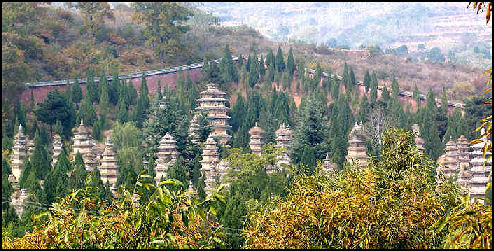
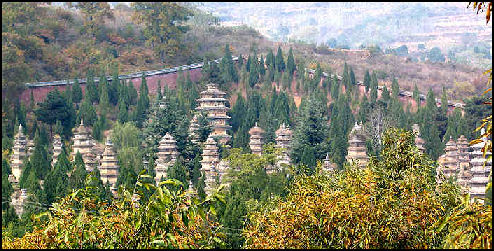
The Shaolin Pagoda Forest, burial site of Shaolin's eminent monks, gets its name from its dense pagodas. Per Buddhist traditions, disciples built pagodas of varying sizes for deceased monks—scale reflecting their achievements, status, knowledge, reputation, and standing—resulting in numerous different-sized pagodas. China's largest existing stupa group, it has 228 stone stupas from seven dynasties (Tang, Five Dynasties, Song, Jin, Yuan, Ming, Qing), plus 3 modern pagodas and 14 stone sculptures. Their shapes, decorations, construction, and carving techniques record architectural styles of their eras, showing stupa art evolution since the Tang and Sino-foreign Buddhist exchanges. Hailed as an "ancient pagoda art museum," it offers tangible materials for researching ancient Chinese architecture, sculpture, and religion.
Contents
8 sections · tap a section for its opening lines1Pagoda Forest of Shaolin Temple
Welcome to the Pagoda Forest of Shaolin Temple, a site of profound stillness located just three hundred meters west of the bustling main temple complex. As we stand here at the base of Mount Song, one of China's five sacred…
Listen in the app2The Tang and Song Foundations — The Roots of the Forest
Our journey through the forest begins with its most ancient inhabitants, the pagodas of the Tang and Song Dynasties. To understand these structures, we must look back to the founding of Shaolin in four hundred and ninety-five AD. …
Listen in the app3The Yuan and Ming Expansion — Height and Complexity
As we move further into the heart of the forest, we encounter the grander, more imposing structures of the Yuan and Ming Dynasties. This period, spanning from the thirteenth to the seventeenth centuries, saw a significant…
Listen in the app4The Architecture of a Stupa — Symbolic Anatomy
To truly appreciate the Pagoda Forest, we must analyze the specific anatomy of these stone structures. A Shaolin pagoda is generally composed of four distinct parts: the base, the body, the eaves, and the steeple. …
Listen in the app5The Iconography of Power — Martial and Spiritual Symbols
While the Pagoda Forest is primarily a religious site, it is impossible to ignore the martial heritage of the men buried here. Many of the pagodas feature carvings that provide a rare glimpse into the history of Shaolin Kung Fu. …
Listen in the app6Qing Dynasty and Modern Pagodas — Continuity in a Changing World
As we reach the edges of the forest, we find the more recent additions from the Qing Dynasty and the modern era. The Qing pagodas, dating from sixteen forty-four to nineteen twelve, often show a greater degree of ornamentation…
Listen in the app7The Sensory Landscape — Chanting, Stone, and Mountain Air
Before we conclude our walk, let us take a moment to fully immerse ourselves in the sensory environment of the Pagoda Forest. This site is designed to be experienced with all the senses, not just the eyes. …
Listen in the app8Closing
As we prepare to leave the Pagoda Forest and return to the main temple complex or continue our ascent toward the Dharma Cave, take a final look back at this remarkable assembly. We have traversed over a thousand years of history…
Listen in the app
What is Pagoda Forest of Shaolin Temple?
Pagoda Forest of Shaolin Temple is a place in Henan · China with 8 story sections on Tellby. You can read the opening of each section on this page; the sound plays in the app.
| Location | Henan · China |
|---|---|
| Type | Heritage |
| Story sections | 8 |
| Text language | English |
| Coordinates | 34.5032, 112.9376 |
| Last updated |